
Friday, January 13, 2012
Name That Audience 10
Here's an interesting one. What's happening, here? It's obviously a theater, but why is there an audience on both sides of the proscenium? A theater in-the-round? An elaborate production about a large theater audience? The answer is after the jump.


Wednesday, January 11, 2012
Laurie Anderson on Audience

Musician Laurie Anderson has interesting things to say about audiences in an interview published in the January 2012 issue of The Believer Magazine. She suggests that audiences very much bring with them associations and judgments to any performance--interpretive moves, in Steven Feld's terms--that a performer may, if they choose, then work to subvert with "jump cuts" and other techniques that might "throw things off." That, in turn, can create new sets of expectations. This dynamic game of performer-audience interaction, of course, is one comedians know well (Anderson appropriately mentions Andy Kaufman, with whom she worked in the 1970s, by way of explanation). And it's important to note that it also has a long and storied history in American entertainment, from P.T. Barnum's playfully deceptive exhibitions to today's spoiler culture. Overall, Anderson provoked me to think about questions of reception: Where do expectations for different forms of cultural performance--a comedy show, a concert, a lecture--come from? How do we shape and share audience literacy, not only at the large scale of institutions or culture but also in the dynamics of any performance, moment to moment? Fascinating, indeed!
Tuesday, January 10, 2012
Protest as Heard

One of the aspects of audience history I’ve been thinking about lately (since 2012 is the Woody Guthrie Centennial) is the reception of protest songs. Music historians and writers typically analyze the composition or performance of protest music; scholarship is relatively plentiful on the content of songs like “Get Off the Track,” “The Preacher and the Slave,” or “We Shall Overcome.” And news features, interviews, and biographies have filled us in about the great performers of protest music, from Woody Guthrie to Rage Against the Machine. But we don’t know very much about how such songs have been encountered by actual listeners in different contexts; what those encounters made people think, feel, or do; or how those songs and their reverberations were woven into the daily lives of abolitionists, workers, activists, teachers, police officers, politicians, businessmen, or even opposition groups.
There is some good work out there that suggest some answers by delving into historical or cultural contexts of social movements. T. V. Reed’s The Art of Protest, Annie J. Randall’s Music, Power, and Politics, and Mark Mattern’s Acting in Concert, among others, all have profound thinking about the power of music in society and in social change. Still, there is a general assumption in the scholarship of music and politics, influenced in part by the folk movement of the 20th century, that the best protest music is a participatory enterprise, a marked ritualized moment in which people make music together and, through that action, cohere and inspire the front lines of a social movement. Obviously, the shared experience that is engendered in such music-making represents a significant form of public discourse and social meaning. Music-making is politics, in that sense. But I think also that there is another way that protest songs operate, especially in the contemporary world of commercial popular music—through listening. How do we make sense of the fan who hears a song of conscience--on the radio or at a concert--or the average citizen who encounters singing protesters in the street? Presumably, that act of audiencing has the potential to change him or her in some way. But how?
In fact, what do we make of the large volume of 19th century sheet music that offered social commentary and even confrontation? Who was buying it and why? George P. Holt’s “Wanted a Substitute” (published by Oliver Ditson & Co. in 1863) offered a clever take on the class politics of the Civil War draft and the resentment it created. But how can we accurately assess the kinds of dynamism the song afforded various people in their daily lives in 1863 and beyond?

How protest songs were heard is an area that desperately needs more study. There are so many possibilities, here, for thinking about historical reception—one could go song by song, issue by issue, era by era, documenting listener's interpretive moves and/or the literacies of protest at work in each level of analysis. Scholars of fandom, who are already attuned to the varieties of attention and response to cultural forms, as well as to the intricacies of commercialized manipulation, might have something significant to offer.
Monday, January 2, 2012
Collecting

The New York Times recently posted a web page, "Why We Collect Stuff," featuring various experts weighing in on the phenomenon of collecting. While purportedly a "debate," the positions aren't really about collecting, or its history, or its complex role in broader realms of audiencing and the arts, but rather about the fine line between collecting and hoarding. Unfortunately, as a whole, it reads a lot like media analyses in the 1980s which sensationally--and wrongly, in my opinion--portrayed fandom as amusing on the surface but always ready to tip over into stalking and murder. (John Hinckley and Mark David Chapman were, in this analytical frame, simply extreme versions of any Trekkie or teenybopper). Why assert, as do several of the Times debaters, that collecting is all well and good in a quick opening sentence and then outline in lengthy detail how it can become a problem? Why connect collecting and hoarding at all?
I expect better from the Times. The narrowness of the debate stems, perhaps, from the fact that several of the debaters are psychologists specializing in compulsion disorders. Few elaborate very deeply on material culture and its long-standing role in creating meaning, memory, and identity for individuals and communities. And few acknowledge the growing academic work on collecting, which suggests that it is not a single behavior, good or bad, but rather an analytical category pointing to a range of human practices that articulate people's relationships with the material world. Where were the curators, anthropologists, and historians? They would have provided definitions of relics, souvenirs, exhibits, artifacts, and collectibles; shown how such items can be made meaningful through accumulation, association, interpretation, gifting, narrative; and situated collecting into wider contexts of imperialism, commericialization, ritual, and the modern self.
At any rate, check it out, if you want. But do so knowing that there is better analysis and research out there, including the work of Walter Benjamin, Jean Baudrillard, Susan M. Pearce, Susan Stewart, John Elsner, Seth C. Bruggeman, Leonard J. Davis, Daniela Bleichmar and Peter C. Mancall.
Saturday, December 31, 2011
Romantic Fandom

Before the holiday, I heard from Professor Eric Eisner of George Mason University, who shared that he had edited a volume of the Romantic Circles Praxis Series, on "Romantic Fandom," in April 2011. I am not very well-acquainted with literary studies these days (and especially not British Lit.), so I was delighted to check it out. Clearly there are exciting things happening in the study of Romanticism--between this and Judith Pascoe's book on Sarah Siddons, I now see the Romantic Era as a key moment in the history of audiences. Much as the "market revolution" in the United States during the 1830s and 1840s changed the very nature of cultural consumption and participation, Eisner writes that, in England, the Romantic period of the late 18th century
...saw the popularization of recognizable "fan practices," spurred by the growth of consumer culture and the development of a mass audience for culture generally. Admirers collected autographs, souvenirs, portraits and relics of celebrity writers, artists, performers, military heroes, and athletes; snapped up mementos associated with beloved plays or books or music; visited the homes and haunts of celebrities; pored over gossip-filled periodicals and newspaper notices; imitated celebrities’ fashion statements; fantasized about becoming friends or lovers with celebrities; wrote fan mail and formed communities of like-minded aficionados.And while I’ve emphasized the connections between modern and historical fans in this blog, these essays advocate caution. As Eisner explains in his introduction, “If these essays contest literary criticism’s abjection of the fan as ‘naïve, obsessive, desirous, and dangerously predatory’ (Watson), they also resist simply celebrating the fan or identifying Romantic-era readerly desire with our own…Fandom is always historically situated, always tied to specific and shifting cultural as well as individual situations.”
The essays are consistently excellent, examining everything from the literary tourism of Lady Frances Shelley to the surprising mania in the 1820s for Pierce Egan’s Life in London; or, the Day and Night Scenes of Jerry Hawthorn, Esq., and his Elegant Friend Corinthian Tom, Accompanied by Bob Logic, the Oxonian, in their Rambles and Sprees through the Metropolis, with other contributions by Nicola J. Watson, Clara Tuite, Mark Schoenfield, and David A. Brewer. I have taken note!
Favorite Historical Fan Studies, 2011
While I have not covered every book in fan studies that has come out in the past year, I have encountered quite a few good reads in fan history. It really is time for fan studies to expand beyond the idea that fandom is simply rooted in the “popular media” of the 20th century. As many of these books and articles show, those with enthusiastic devotion to public cultural figures and forms, whom sportswriters first called “fans” in the 1890s, have been around for centuries. There were no “fans” before 1890, but there were amateurs, beggars, boomers, buffs, bugs, connoisseurs, devotees, dilettantes, enthusiasts, fanatics, the fancy, fiends, gluttons, habitués, heads, hounds, kranks, lions, longhairs, lovers, maniacs, matinee girls, nuts, rooters, Lisztians, Wagnerians, and more.
Here are some of my favorite historical fandom books for 2011. They all engagingly offer new insights into the practices of ardent audiencing, over time and across sports, theater, literature, and music.

Lapham’s Quarterly: Celebrity
In many ways an update of Leo Braudy’s Frenzy of Renown (1988) this special issue of Lapham’s Quarterly (Winter 2011) sought to collect primary and secondary sources about celebrity in history, from Cicero’s complaints about the demands of fame to Steve Martin’s tongue-in-cheek form-letter response to fan mail. I found Lapham’s opening essay a bit too dependent on Daniel Boorstin’s negative assessment of the media’s role in modern life; I would say that the overall skepticism of the issue’s interpretive essays stem from a Frankfurt School-like focus on the productive machinations of celebrity rather than the varied activities of media reception and their meaning in the daily lives of fans. The issue nevertheless offers very good writing and a useful compendium of audiences, culture, and desire over the past several centuries.

John Thorn, Baseball in the Garden of Eden: The Secret History of the Early Game
Written by the Official Baseball Historian for Major League Baseball, this book is a detailed and fascinating account of the early days of baseball in the nineteenth century, including some nice tidbits on fandom, from audiences’ frequent interference in games and penchant for gambling (which, in part, explains rooters’ fascination with statistics) to DeWolf’s Hopper’s popularization of “Casey at Bat” to the status of a cultural mania in 1888. Most interesting is the many ways in which team owners sought to make the game appeal to fans through all kinds of changes to games rules, as well as sales gimmicks. Not directly about historical audiences, it nonetheless is a very readable history of the entire culture of baseball and fans central place in it.

Judith Pascoe, The Sarah Siddons Audio Files
One of the pleasures of writing this blog has been learning about fan research outside of my own realm of expertise. Not only did I learn about all the work out there on historical readers or early sports but also on theater audiences. Judith Pascoe’s book, which was released in May 2011, enthusiastically outlines the appeal of British actress Sarah Siddons, who was the star of London theatre in the late eighteenth century and whose aural presence fascinated Romantic poets and philosophers. Pascoe not only outlines the culture of Siddons’s celebrity, but also the trials of her own learning. Historiography has never been so fun.

Daphne Carr, Pretty Hate Machine
Okay, so the history here is fairly recent, but this is still an incisive, daring, and sometimes quite moving analysis of rock fandom in the 1990s, based on Nine Inch Nails’ 1989 album, Pretty Hate Machine. Rather than merely offering a critical appreciation of the album’s songs or a history of the album’s creative genesis, Carr locates PHM’s most profound significance in what it has meant to the fans who bought and listened to it. Her thinking about Trent Reznor’s is deepened by the transcripts of interviews with fans of various ages and backgrounds, as well as interpretive surveys of the industrial decay of north-central Ohio since the 1960s. Personally, I never really “got” NIN, but I got this.

Emily Satterwhite, Dear Appalachia
Satterwhite examines fan mail from readers of Appalachian-set fiction from 1878-2003 and identifies the ways in which such fiction serves to affirm readers’ imagined understanding of the region as a “rural, rooted place populated by simple whites with a rich cultural heritage protected from mass culture.” The ways in which this romantic construction of “authentic Appalachia” has worked for fans over the past century (from the Gilded Age to the Neo-Gilded Age of the 1980s) is not without controversy (Satterwhite acknowledges that it reinforces “simplistic versions of the region that celebrate whiteness, glorify Americanness, and figure primitive people the world over as in need of the expert guidance of well-to-do Americans”). But Satterwhite also sensitively accounts for the ways in which regional fiction engenders its own kind of fandom for the idea of a place.
Still left to read:
Claudio E. Benzecry, The Opera Fanatic: Ethnography of An Obsession
Amy Blair, Reading Up: Middle-Class Readers and the Culture of Success in the Early Twentieth-Century United States
Nancy Newman, Good Music for a Free People: The Germania Musical Society in Nineteenth-Century America
Looking forward to:
Andre Millard, Beatlemania: Technology, Business, and Teen Culture in Cold War America
Here are some of my favorite historical fandom books for 2011. They all engagingly offer new insights into the practices of ardent audiencing, over time and across sports, theater, literature, and music.

Lapham’s Quarterly: Celebrity
In many ways an update of Leo Braudy’s Frenzy of Renown (1988) this special issue of Lapham’s Quarterly (Winter 2011) sought to collect primary and secondary sources about celebrity in history, from Cicero’s complaints about the demands of fame to Steve Martin’s tongue-in-cheek form-letter response to fan mail. I found Lapham’s opening essay a bit too dependent on Daniel Boorstin’s negative assessment of the media’s role in modern life; I would say that the overall skepticism of the issue’s interpretive essays stem from a Frankfurt School-like focus on the productive machinations of celebrity rather than the varied activities of media reception and their meaning in the daily lives of fans. The issue nevertheless offers very good writing and a useful compendium of audiences, culture, and desire over the past several centuries.

John Thorn, Baseball in the Garden of Eden: The Secret History of the Early Game
Written by the Official Baseball Historian for Major League Baseball, this book is a detailed and fascinating account of the early days of baseball in the nineteenth century, including some nice tidbits on fandom, from audiences’ frequent interference in games and penchant for gambling (which, in part, explains rooters’ fascination with statistics) to DeWolf’s Hopper’s popularization of “Casey at Bat” to the status of a cultural mania in 1888. Most interesting is the many ways in which team owners sought to make the game appeal to fans through all kinds of changes to games rules, as well as sales gimmicks. Not directly about historical audiences, it nonetheless is a very readable history of the entire culture of baseball and fans central place in it.

Judith Pascoe, The Sarah Siddons Audio Files
One of the pleasures of writing this blog has been learning about fan research outside of my own realm of expertise. Not only did I learn about all the work out there on historical readers or early sports but also on theater audiences. Judith Pascoe’s book, which was released in May 2011, enthusiastically outlines the appeal of British actress Sarah Siddons, who was the star of London theatre in the late eighteenth century and whose aural presence fascinated Romantic poets and philosophers. Pascoe not only outlines the culture of Siddons’s celebrity, but also the trials of her own learning. Historiography has never been so fun.

Daphne Carr, Pretty Hate Machine
Okay, so the history here is fairly recent, but this is still an incisive, daring, and sometimes quite moving analysis of rock fandom in the 1990s, based on Nine Inch Nails’ 1989 album, Pretty Hate Machine. Rather than merely offering a critical appreciation of the album’s songs or a history of the album’s creative genesis, Carr locates PHM’s most profound significance in what it has meant to the fans who bought and listened to it. Her thinking about Trent Reznor’s is deepened by the transcripts of interviews with fans of various ages and backgrounds, as well as interpretive surveys of the industrial decay of north-central Ohio since the 1960s. Personally, I never really “got” NIN, but I got this.

Emily Satterwhite, Dear Appalachia
Satterwhite examines fan mail from readers of Appalachian-set fiction from 1878-2003 and identifies the ways in which such fiction serves to affirm readers’ imagined understanding of the region as a “rural, rooted place populated by simple whites with a rich cultural heritage protected from mass culture.” The ways in which this romantic construction of “authentic Appalachia” has worked for fans over the past century (from the Gilded Age to the Neo-Gilded Age of the 1980s) is not without controversy (Satterwhite acknowledges that it reinforces “simplistic versions of the region that celebrate whiteness, glorify Americanness, and figure primitive people the world over as in need of the expert guidance of well-to-do Americans”). But Satterwhite also sensitively accounts for the ways in which regional fiction engenders its own kind of fandom for the idea of a place.
Still left to read:
Claudio E. Benzecry, The Opera Fanatic: Ethnography of An Obsession
Amy Blair, Reading Up: Middle-Class Readers and the Culture of Success in the Early Twentieth-Century United States
Nancy Newman, Good Music for a Free People: The Germania Musical Society in Nineteenth-Century America
Looking forward to:
Andre Millard, Beatlemania: Technology, Business, and Teen Culture in Cold War America
Friday, December 9, 2011
Popular Media Audiences Symposium
The latest symposium on popular media audiences has a good set of speakers; not surprisingly it's in England:

The Centre for Cultural and Creative Research at the University of Portsmouth presents:
Popular Media Cultures: Writing in the Margins and Reading Between the Lines
A Symposium to be held at the Odeon Cinema, Covent Garden, London
Saturday 19th May 2012
Keynote Address by:
Prof. Henry Jenkins
Provost’s Professor of Communication, Journalism and Cinematic Arts, University of Southern California. Author of Textual Poachers (Routledge, 1992), The WOW Climax (NYU Press, 2006), Fans, Bloggers and Gamers (NYU Press, 2006), and Convergence Culture (NYU Press, 2006).
Focus:
The first steps toward a wider consideration of popular media cultures surrounding film, television and the Internet, and the relationship between fans and their object of fandom, is to acknowledge the prominent position of what Jonathan Gray calls media paratexts as opposed to the centrality of specific films or television series as the text. Indeed, we are now accustomed in fan studies to state that the productivity of fans and their related fan practices represent an appropriate and worthy text to study just as much as the media text to which they are related or inspired by. So, rather than studying Star Trek as cult text, we might study fan produced videos on YouTube as important texts of fan activity that carry inherent meaning and significance in and of themselves. Or, for example, Star Wars carries with it meaning within and outside the narrative – from an analysis of its mythic story structure using the work of Joseph Campbell to studies of its fans who actively engage in their own meaning making by dressing up, making videos and writing fan fiction. However, the peripheral texts – those associated with the commercialization of the franchise such as the lunchboxes, toys, video games, and websites – are as much part of the meaning making process that they become texts to study in their own right.
Popular Media Cultures seeks to explore the relationship between audiences and media texts, their paratexts and interconnected ephemera, and the related cultural practices that add to and expand the narrative worlds with which fans engage. How audiences make meaning out of established media texts will be discussed in connection with the new texts produced by fans. The symposium will focus on the cultural work done by media audiences, how they engage with new technologies and how convergence culture impacts on the strategies and activities of popular media fans. If, Ken Gelder argues, “Subcultures are brought into being through narration and narrative: told by the participants themselves, as well as by those who document them, monitor them, ‘label’ them, outlaw them, and so on,” then this symposium will pay attention to what media audiences add to a text, what gets written in the margins of a text and what new meanings fans read between the lines. This symposium will bring together leading academics in the fields of film, television, fan and cultural studies to open up and take further the debates surrounding popular media, its producers, its audiences, and the cultures in which they are ultimately located.
Confirmed Speakers:
Dr Stacey Abbott, Reader in Film Studies, Roehampton University. Author of Celluloid Vampires (University of Texas Press, 2007), editor of The Cult TV Book (IB Tauris, 2010), co-author of Falling in Love Again (IB Tauris, 2009), and series editor of Investigating Cult TV for IB Tauris.
Dr Will Brooker, Reader and Director of Research, Kingston University. Author of Using the Force (Continuum, 2002), Hunting the Dark Knight (IB Tauris, 2012) and editor of The Blade Runner Experience (Wallflower, 2005).
Dr Joanne Garde-Hansen, Principal Lecturer in Media and Director of the Research Centre of Media, Memory and Community, University of Gloucestershire. Author of Media and Memory (Edinburgh UP, 2011), co-editor of Save As... Digital Memories (Palgrave, 2009) and co-author of the forthcoming Emotion Online: Theorising Affect on the Internet (Palgrave).
Dr Kristyn Gorton, Senior Lecturer in Television Studies, University of York. Author of Media Audiences (Edinburgh UP, 2009) and co-author of the forthcoming Emotion Online: Theorising Affect on the Internet (Palgrave).
Dr Matt Hills, Reader in Media and Cultural Studies, Cardiff University. Author of Fan Cultures (Routledge, 2002), The Pleasures of Horror (Continuum, 2005) and Triumph of a Time Lord (IB Tauris, 2010).
Prof. Mark Jancovich, Professor of Film and Television, University of East Anglia. Author of Rational Fears (MUP, 1996) and The Place of the Audience (BFI, 2003) and co-editor of Defining Cult Movies (MUP, 2003), Quality Popular Television (BFI, 2003), and Film and Comic Books (Mississippi UP,
2007).
Prof. Roberta E. Pearson, Professor of Film and Television, University of Nottingham. Author of Eloquent Gestures (University of California Press, 1992), co-editor of Cult Television (University of Minnesota Press, 2004), The Many Lives of Batman (Routledge, 1991), and editor of Reading Lost (IB
Tauris, 2009).
Further details of how to register and attend the event will be published in the New Year. For information on the Centre for Cultural and Creative Research at the University of Portsmouth please visit our website at: http://www.port.ac.uk/research/cccr/
Symposium Coordinator:
Dr Lincoln Geraghty
Director of the Centre for Cultural and Creative Research
School of Creative Arts, Film and Media
University of Portsmouth

The Centre for Cultural and Creative Research at the University of Portsmouth presents:
Popular Media Cultures: Writing in the Margins and Reading Between the Lines
A Symposium to be held at the Odeon Cinema, Covent Garden, London
Saturday 19th May 2012
Keynote Address by:
Prof. Henry Jenkins
Provost’s Professor of Communication, Journalism and Cinematic Arts, University of Southern California. Author of Textual Poachers (Routledge, 1992), The WOW Climax (NYU Press, 2006), Fans, Bloggers and Gamers (NYU Press, 2006), and Convergence Culture (NYU Press, 2006).
Focus:
The first steps toward a wider consideration of popular media cultures surrounding film, television and the Internet, and the relationship between fans and their object of fandom, is to acknowledge the prominent position of what Jonathan Gray calls media paratexts as opposed to the centrality of specific films or television series as the text. Indeed, we are now accustomed in fan studies to state that the productivity of fans and their related fan practices represent an appropriate and worthy text to study just as much as the media text to which they are related or inspired by. So, rather than studying Star Trek as cult text, we might study fan produced videos on YouTube as important texts of fan activity that carry inherent meaning and significance in and of themselves. Or, for example, Star Wars carries with it meaning within and outside the narrative – from an analysis of its mythic story structure using the work of Joseph Campbell to studies of its fans who actively engage in their own meaning making by dressing up, making videos and writing fan fiction. However, the peripheral texts – those associated with the commercialization of the franchise such as the lunchboxes, toys, video games, and websites – are as much part of the meaning making process that they become texts to study in their own right.
Popular Media Cultures seeks to explore the relationship between audiences and media texts, their paratexts and interconnected ephemera, and the related cultural practices that add to and expand the narrative worlds with which fans engage. How audiences make meaning out of established media texts will be discussed in connection with the new texts produced by fans. The symposium will focus on the cultural work done by media audiences, how they engage with new technologies and how convergence culture impacts on the strategies and activities of popular media fans. If, Ken Gelder argues, “Subcultures are brought into being through narration and narrative: told by the participants themselves, as well as by those who document them, monitor them, ‘label’ them, outlaw them, and so on,” then this symposium will pay attention to what media audiences add to a text, what gets written in the margins of a text and what new meanings fans read between the lines. This symposium will bring together leading academics in the fields of film, television, fan and cultural studies to open up and take further the debates surrounding popular media, its producers, its audiences, and the cultures in which they are ultimately located.
Confirmed Speakers:
Dr Stacey Abbott, Reader in Film Studies, Roehampton University. Author of Celluloid Vampires (University of Texas Press, 2007), editor of The Cult TV Book (IB Tauris, 2010), co-author of Falling in Love Again (IB Tauris, 2009), and series editor of Investigating Cult TV for IB Tauris.
Dr Will Brooker, Reader and Director of Research, Kingston University. Author of Using the Force (Continuum, 2002), Hunting the Dark Knight (IB Tauris, 2012) and editor of The Blade Runner Experience (Wallflower, 2005).
Dr Joanne Garde-Hansen, Principal Lecturer in Media and Director of the Research Centre of Media, Memory and Community, University of Gloucestershire. Author of Media and Memory (Edinburgh UP, 2011), co-editor of Save As... Digital Memories (Palgrave, 2009) and co-author of the forthcoming Emotion Online: Theorising Affect on the Internet (Palgrave).
Dr Kristyn Gorton, Senior Lecturer in Television Studies, University of York. Author of Media Audiences (Edinburgh UP, 2009) and co-author of the forthcoming Emotion Online: Theorising Affect on the Internet (Palgrave).
Dr Matt Hills, Reader in Media and Cultural Studies, Cardiff University. Author of Fan Cultures (Routledge, 2002), The Pleasures of Horror (Continuum, 2005) and Triumph of a Time Lord (IB Tauris, 2010).
Prof. Mark Jancovich, Professor of Film and Television, University of East Anglia. Author of Rational Fears (MUP, 1996) and The Place of the Audience (BFI, 2003) and co-editor of Defining Cult Movies (MUP, 2003), Quality Popular Television (BFI, 2003), and Film and Comic Books (Mississippi UP,
2007).
Prof. Roberta E. Pearson, Professor of Film and Television, University of Nottingham. Author of Eloquent Gestures (University of California Press, 1992), co-editor of Cult Television (University of Minnesota Press, 2004), The Many Lives of Batman (Routledge, 1991), and editor of Reading Lost (IB
Tauris, 2009).
Further details of how to register and attend the event will be published in the New Year. For information on the Centre for Cultural and Creative Research at the University of Portsmouth please visit our website at: http://www.port.ac.uk/research/cccr/
Symposium Coordinator:
Dr Lincoln Geraghty
Director of the Centre for Cultural and Creative Research
School of Creative Arts, Film and Media
University of Portsmouth
Saturday, December 3, 2011
Romanticism, The Voice, and the History of Listening

One of the problems of studying historical audiences is evidence. Listeners, readers, and theater-goers don’t leave many traces. While the scores, scripts, journals, account books, and correspondence of professional writers, composers, and performers have been preserved and deposited in public archives, the everyday experiences and activities of audience members have not enjoyed the same recognition, and thus potential evidence for their engagement—descriptive letters, scrapbooks, tickets, or souvenirs, for example—have been undervalued, overlooked, and often lost. Scholars of historical reception seek to recover such audience experiences. It’s painstaking and frequently frustrating work, requiring a good deal of creative interpretation. It’s far more like archeology than history, a matter of piecing together found fragments—a single diary description, or obscure periodical image--with educated assumptions about past cultural institutions and ideological expectations.
Judith Pascoe, in her new book, The Sarah Siddons Audio Files: Romanticism and the Lost Voice, writes engagingly and humorously about this process of historical recovery. Pascoe became intrigued by enthusiastic Romantic-era accounts of London stage actress Sarah Siddons, who manipulated audiences with her command of Shakespeare and had a voice which, as contemporary Joseph Severn explained, “thrilled the air with melodious tones, and at the same time touched the heart with such deep pathos that the audience seemed to think it a merit to shed tears and thus appropriately accompany such sublime acting.” Pascoe realized, however, that while Siddons’s "most celebrated roles all seemed to contain sonic highlights that were anticipated with pleasure,” and while paintings almost always showed Siddons poised to speak, she had no idea how Siddons actually sounded. So she resolved to find out. As she explained, “If I could figure out how Siddons sounded, I might also understand how people listened in the romantic period and how that style of listening influenced what they heard.” (14)
While the book is, in part about Siddons, much of the narrative, written in the first-person, is driven by Pascoe’s own search for an auditory past that always seems just out of reach. She explores Siddons’s life story, the world of London theater in 1775-76, and the acoustic design of theaters like Covent Garden and Drury Lane. She takes an acting class to learn more about vocal technique, reads Barthes on the voice, probes the history of recording, and studies Gilbert Austin’s 1806 Chironomia; or, A Treatise on Rhetorical Delivery: Comprehending Many Precepts, Both Ancient and Modern, for the Proper Regulation of the Voice, the Countenance, and Gesture. Along the way, she offers some wonderful insights in Romantic-era theater-going. As she explains at one point:
Romantic theatergoers not only enjoyed performances that we would find overwrought, they enjoyed watching these performances over and over and over again. In fact, the intensity of their pleasure seemed to stem partly from the repetition, which allowed for a deep familiarity with the lines and gestures associated with particular plays….And serving as a further aide-memoire was the condensation of the romantic theatrical experience to a collection of emotionally, visually, or sonically intense scenes that helped to imprint these plays on the memory. The memorization of these ‘points’ made theatergoing more intensely pleasurable, as audience members anticipated these particular moments, watched them play out, and compared them to versions they had already experiences or even enacted themselves. (72)Pascoe has a great sense of humor about herself and her objective, which, as she herself quickly recognized, was doomed to failure. As she explains, “I had wanted to find out how Siddons made [audience member Joseph] Severn want to change his life, or, failing that, how she caused so many people to go into conniptions when she stepped out on stage, but this meant, of course, and I’d known this all along, that I really had to be there.” (108). In the end, though, Pascoe's frustrations are her readers' gain. Her book is a funny and meaningful meditation on historical methodology, written with both clarity and verve. Its sheer inventiveness reminded me most of Bruce R. Smith’s attempts to discover how the performance of Shakespeare’s plays "actually" sounded in The Acoustic World of Early Modern England. Both Smith and Pascoe acknowledge that we can’t positively know how the past sounded. But through careful historicization of diverse contexts of listening and hearing, and analysis of the fragments of evidence still with us, we can discover faint but tantalizing suggestions of how audiencing had the power to shape lives.
Sunday, November 27, 2011
Gaming the Game
The latest in convergence culture: this video, from the English band Kasabian, features an experiment in which the framework of video gaming is used to shape a soccer game between living players on an actual field. Vocalist Tom Meighan and Aston Villa striker Darren Bent, up in the stands with electronic controllers, are playing the players, who all wear headsets and respond to their commands. What is meant by "audience" and "performer" in this scenario is complicated, which is precisely the point. I'm not convinced this is future, since the roles that are blurred still need to exist in some sort of meaningful tension, but I do wonder about the up-and-coming Xboxed generation and how they understand the experience of spectatorship in sporting events.
If anything, you have to give it to Kasabian; they're pushing the edge of music marketing. A bit of background on the experiment can be found in another video here.
If anything, you have to give it to Kasabian; they're pushing the edge of music marketing. A bit of background on the experiment can be found in another video here.
Thursday, November 24, 2011
Conference: The Audience Through Time

I'm sorry to be missing this conference run by Anna Kretschmer and Christine Twite from the School of English and Drama, Queen Mary, University of London, especially since it deals with many the same issues I explore here at the Ardent Audience. Still, I'm hoping to keep up with the events through Twitter.
Stumbling on the conference site has also made me aware of the audience-related blogs, Cultures of Spectatorship and The New Female Spectator. Theater studies has much to offer the study of historical fandom, so check them out.
Saturday, November 19, 2011
Catching Up

I must apologize for not posting very much recently. It's been a demanding couple of months at work, and finding time to blog has been a challenge. I'm hoping to revive things; as a start, I'd like to highlight some recent activity and correspondence.
Robert Burke Warren wrote to share a piece he had written on R.E.M. for The Rumpus. I had previously noted Warren's engaging reflections on his fandom for Paul McCartney; this piece is equally compelling, weaving reminiscences about R.E.M. with a moving account of personal friendship and loss. You don't have to like or dislike R.E.M. to appreciate his articulation of the profound associations and meanings that popular music can provide us in our daily lives. From now on, when people come up to me and say, with a conspiratorial wink, "So you teach popular music at the college level? What do you talk about for a whole semester?", I'm directing them here.
Scott Thompson, a former student and now guitarist/banjoist with the band Tallahassee, wrote to share a feature on booing at Freakonomics.com. It reminded me that the expression of audience displeasure is as important as audience pleasure in understanding fandom and enthusiasm. The podcast notes that booing is more appropriate in some contexts (sports) than others (Broadway), but also that the sovereignty of audience members to express themselves itself has been significantly reduced since the 19th century (Richard Butsch's work gets a nod, here). I think a deeper discussion about why such expression changed historically would have helped provide some stronger conclusions. And it also raises all kinds of questions about the sound of booing (why "boo" not "bah" or "buh"?) and the physicality of that action--versus clapping, for instance. In general, why do audiences primarily use the sonic capabilities of their bodies to send messages to performers onstage?
Ralph Rosen, at University of Pennsylvania, wrote to ask about my thoughts on Platonic conceptions of fans (or "lovers of sights and lovers of sounds"). His note made me realize the extent to which my own American studies background might be isolating me from wider global and historical conversations about fandom. In particular, I've been enjoying an essay Rosen wrote for Playing Around Aristophanes: Essays in Celebration of the Completion of the Edition of the Comedies of Aristophanes by Alan Sommerstein, ed. by Lynn Kozak and John Rich (Aris & Philips, 2006: 27-47), titled "Aristophanes, Fandom, and the Classicizing of Greek Tragedy." He explores how Greek tragic poets acquired a literary legacy in a time when performances were ephemeral and not made into texts that could establish a measurable "readership." His answer is that devoted audiences, post-performance, played a significant part in creating a poet's legacy:
I would suggest that the key players in the classicizing process are what, for lack of more technical term, I would call 'fans', although other synonyms would work just as well: devotees, cognoscenti, etc. Before a performative work is fixed and circulated as a text, it will amass a coterie of devotees for whom, for whatever reasons (and there may be many), the works have special resonance. As I noted above, however, for a work to endure, it requires some measure of iterability, even if this means simply some mechanism by which the memory of the event and its author are kept alive. Fans provide this service well in advance of any formal means of mechanical reproduction, for they will take the work seriously enough to continue discussing it among themselves and to proselytize among skeptics about the virtues of their chosen heroes. (32)Finally, I noticed that Jennifer L. Brady has an essay about enthusiastic readers of Susan Warner's The Wide, Wide World over at Commonplace. An engaging exploration of fan letters to Warner in the early 19th century, Brady shows how "Warner's fan letters can tell us why readers like (and unlike) Alice's Admirer devoured The Wide, Wide World, why they formed deep emotional bonds with characters whom they knew to be fictional, and why they chose to bare their souls in letters to a writer whom they would never meet. They can tell us why particular readers felt so strongly about this novel and why, for some, their attachment to it endured over decades. These letters can give us fresh perspective, then, on sentimental novels, ordinary readers, and fandom in the nineteenth century—and they do so by recording the varied ways that some ordinary readers and a sentimental author were brought together by loving The Wide, Wide World." Scholarship that draws on historical fan letters is growing in a number of fields; I would add Brady's work, here, with that of Barbara Ryan (see Reading Acts, as well as her new project on Ben-Hur), Courtney Bates (see her article on Willa Cather fans in Transformative Works), Emily Satterwhite (Dear Appalachia: Readers, Identity, and Popular Fiction Since 1878, which is coming out any day now), as well as Marsha Orgeron's work on fans of movie stars like Clara Bow (Hollywood Ambitions).
That's it for me this weekend. Back soon.
Wednesday, October 26, 2011
Literary Pilgrimage

I see that University of Cambridge classicist Simon Goldhill has discovered fandom in his new book, Freud's Couch, Scott's Buttocks, and Bronte's Grave, which was the subject of a recent profile in the Chronicle of Higher Education's PageView blog. His discomfort with readers who make pilgrimages to author-related sites is interesting; if anything, it shows why critics and fans, reading the same books, often exist in completely different universes.
I shouldn't show him, I guess, the photo of me, during a trip to New Orleans in 1989, casually reading a newspaper outside the French Quarter residence of William Faulkner (where he began his career as a writer):

Perhaps, however, my family will sympathize with Goldhill's skepticism. When I suggested a vacation trip to Pittsfield, Massachusetts, this summer, so we could visit the home of Herman Melville, they laughed, and then, with some alarm, asked if I was serious. I was.
Literary tourism is a big business, big enough to get a featured in O Magazine articles like "5 Legendary Writers' Homes." It has also been a hot topic in literary studies, where it is generally equated with superficiality and commercialism, the equivalent of taking a pre-packaged bus tour of a city rather than living in a neighborhood and learning the language. Literary pilgrimage has been the subject of satiric novels (like Brocke Clarke's An Arsonist's Guide to Writers' Homes in New England), as well as condemnatory papers about the public's naive obsession with authenticity or the emotional reality of texts (discussed previously in a Chronicle review, "You've Read the Book, Now Take a Look!," from 2009). Tourism, more generally, has been a hot topic in cultural studies for much of the last decade, the subject of journals like Tourist Studies, or research collectives like UC Berkeley's Tourism Studies Working Group, and also the subject of books in anthropology, literature, history, and music, from Barbara Kirshenblatt-Gimblett's Destination Culture: Tourism, Museums, and Heritage (U. California Press, 1998) to Stephen A. King's I'm Feeling the Blues Right Now: Blues Tourism and the Mississippi Delta (University Press of Mississippi, 2011).
Tuesday, October 25, 2011
E-reading
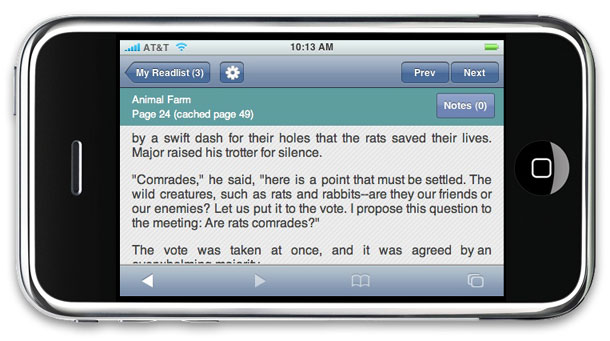
Last year, in a seminar, one of my students was using her iPhone while we were discussing Jim Deetz's In Small Things Now Forgotten. I asked her to put the phone away, since class had begun and we were engaged in discussion. But she protested, indicating that she was engaged--the text had been downloaded to her phone, and she was merely following along with the passage I had asked everyone to turn to!
We certainly live in a new world of "reading." I have no moral or philosophical objection to e-books, the digital humanities, etc. In fact, I see the incredible potential of such technologies for creating and maintaining knowledge and fostering new kinds of educational, research, and business. But I have to say that, personally, I still prefer the "hard" form of a book. Flipping pages is an economical and pleasurable means of encountering text that involves not only a particular kind of spatial understanding but also involves familiar sounds (the swish of a turning page), gestures (holding a book in different stances), and materials (glue, cardboard, pulp). I particularly like each book's design identity, implying an intellectual world. Books as singular objects--with form, color, and weight; that I can carry around, have nearby, and consult--supports my understanding of them as a unique and singular utterances of fellow human beings. I fully understand the convenience of having one's entire library in a tablet device, but at the same time, I resist the idea of making "my library" a basic unit of value, like my stock portfolio. I want my library to be chaotic, more about all the amazing ideas and debates in the world to which I often return, puzzled, curious, and seeking connection. I'd rather not have my library conveniently display my investments but rather function as an imperfectly-wrought sanctuary that I can enter for the purpose of discovery, surprise, and encounter.
At any rate, there have been many writers, readers, and critics out there who have compared old and e-books over the past several years. JBMonco had a nice comparison of experiencing Moby Dick in book and e-book back in 2009, for instance. Or author Margaret Atwood:
This is a nice chart from The Daily Beast that compares the economics of the two forms. And now researchers are starting to get in on the debate, studying reading on different devices (including this study from Johannes Gutenberg University in Mainz, Germany). The findings are not surprising. It appears that reading is not simply a cognitive action of information retrieval or even communication, but also involves wider and more complex frameworks of preference, habit, and ritual. That's why thinking about reading has become so significant. Reading is undergoing changes, but those changes are cultural as much as behaviorial.
In the end, it seems to me that to properly assess "what's the best way to read--book or ebook?", we need to move beyond just the mechanics of the behavior to the institutions and ideologies that define reading for us and make it personally and socially meaningful. How are those changing? Are schools, government agencies, or companies requiring the use of ebooks and why or why not? What does it mean to advocate for older forms of print media through newer forms of communication like blogs or YouTube? If the competition between forms continues, will simply making the choice to read a book rather than an ebook become a form of antiquarianism, curmudgeonliness, or rebellion?
Wednesday, October 5, 2011
NIN PHM

Daphne Carr’s contribution to Continuum's 33 1/3 series, Pretty Hate Machine, has been on my list of things to read since last spring, but other commitments prevented me from fully delving into it until now. I realize now that sitting near me all this time was an engaging work of radical contextualism, one that seeks to literally transform rather than revere Nine Inch Nails’ 1989 album.
Carr writes that the book was inspired by my book Tramps Like Us, which is cool (thanks for the shout-out, Daphne), but I have to say that she moves beyond my limited self-analysis and scholarly representation of fans’ voices to fully embrace the notion that not only musicians make music. She makes it clear that an analysis of Pretty Hate Machine that addressed only the songs on the album, or only the creative process of Trent Reznor, would be a distortion; the album has had such a resonance since its release that the only way to make sense of it is (to quote ethnomusicologist Charles Seeger) to “start in the middle and work outward in all directions.” Carr's analysis is not for the narrow-minded; it unabashedly connects the 1999 Columbine shootings, goth culture, Reaganomics, early rock'n'roll, the history of Youngtown, Trent Reznor's life, industrialization, slum clearance, historic preservation, Hot Topic, cultural contradiction, and American despair.
Despite the breadth of her vision, her specialty is the pithy meta-statement, perhaps learned at the hands of postmodernist theorists, but skillfully honed, here, to the memorable bon mot. (“Hot Topic was where sellouts sold the idea that selling out sucked).” What's most interesting, though, is the slyness of her insights. They often lurk in the background, suggested in word choices or absences in descriptions, finally jumping off the page to clonk you on the head. My favorite moment is her chapter on Cleveland, which starts by linking the cancellation of the Alan Freed’s Moondog Coronation Ball in 1952 to the story of rock’n’roll’s erosion of racial segregation. It’s a well-written description of what is now a conventional story. But then, in the next paragraph, she suddenly flips that truism on its head to reveal Alan Freed’s involvement in Screamin’ Jay Hawkin’s African cannibal/coffin act, which pandered to white racist fantasies and drove Hawkins to cope through drug-use. In a final rhetorical twist, Carr sums it all up by making all these connections a foundation of Nine Inch Nails’ complex appeal, announcing, “This is the story of the first goth-rock stage show.”
The most controversial (for those who want to hear only about Trent Reznor) and the most moving (for those who want to understand the power and legacy of this album) are the ten chapters that each feature a fan talking about his or her experiences with and around the album. Like the Bruce Springsteen fans with whom I conversed in the 1990s, each person has an extraordinary story centered on an experience of hearing that becomes a long-lasting and powerful force for identity, reformation, and belonging. These fans are, like many self-aware people, slightly anxious that “the sounds they believe to be their soul’s salvation are also a mass-mediated commodity.” But that’s the point—the fragments of industrialized entertainment cynically sold to us as “revolution” or “soul-bearing art” can actually—though often unpredictably—foster revolution and soul-bearing.
Notice I said “foster.” I think what Carr’s book hammers home is that these meanings are not “in the music.” In fact, she goes so far as to instruct her readers to resist this commonplace musicological notion, encouraging instead a different approach: “If you have copy of Pretty Hate Machine, listen along to hear the book’s speakers with and against yours. The space between your hearing, their hearing, and my hearing is how we will get into a conversation (or argument) that is part of the point of this book. If the conversation makes us all cringe a bit, so much the better.” If that isn’t a good definition of fandom, I don’t know what is.
Saturday, October 1, 2011
Fandom is a Matter of Life...and Death

I'm also glad that, so far, trademark claims have not been leveled at the grieving families. Can you imagine? (One thing that is not adequately recognized by "intellectual property" law is the illogic whereby corporate entities relentlessly thrust trademarked logos and phrases into people's daily lives and then insist that people's lives must not infringe on the symbolism).
Subscribe to:
Posts (Atom)