Showing posts with label collecting. Show all posts

Thursday, February 16, 2012

Record Listening in the 20th Century


Students listening to records in their dorm, 1930s. U-M Bentley Historical Library, U. of Michigan.

David Gilmour, in an interview in Rolling Stone, Sept. 28, 2011, observed that the social rituals of record listening have pretty much disappeared:
Attention spans have changed. The idea of going around to somebody else's flat or house and sitting around in a comfy room and having a really good hi-fi system and listening to a whole album all the way through, then chatting for a few minutes, then maybe putting another album on...does that happen today? (46).
Shortly thereafter, reading Keith Richards' Life, I took particular note of his account of listening to records with Mick Jagger:
It was, always, all about records. From when I was eleven or twelve years old, it was who had the records who you hung out with. They were precious things. ...Mick and I must have spent a year, while the Stones were coming together and before, record hunting. There were others like us, trawling far and wide, and meeting one another in record shops. If you didn't have money you would just hang and talk. But Mick has these blues contacts...Blues aficionados in the '60s were a sight to behold. They met in little gatherings like early Christians, but in the front rooms in southeast London. There was nothing else necessarily in common amongst them at all; they were all different ages and occupations. It was funny to walk into a room where nothing else mattered except he's playing the new Slim Harpo and that was enough to bond you all together. (80-81)
This all reminded me of William Kenney's account, in his book Recorded Music in American Life: The Phonograph and Popular Memory, 1890-1945, of jazz fans and collectors in the 1930s, including Marshall Stearns, Milt Gabler, John Hammond, Nat Hentoff, and Dan Morgenstern:
Many swing fans found meaning in the records themselves. The very act of gaining ownership of a valued jazz record became an integral part of the meaning that a fan attributed to the music. Collecting records became an enduring passion, an intellectual preoccupation, and a way of life...When at age 16 Morgenstern began collecting seriously--reading the pioneering books on jazz, comparing notes with other collectors, and finding his way to sources of records--he became adept at what he later believed to have been 78 rpm record culture. In a time before widespread record reissues, one was forced to hunt down copies on one's own. This necessity led to a a detailed knowledge of the secondhand bookstores, junk shops, flea markets, and sidewalk browser bins where the occasional jewel awaited...
This, in turn, reminded me of the phonograph society movement in the 1920s, which sought to establish clubs of listeners that would gather in private homes or public meeting halls for "phonograph recitals" and "phonograph concerts." As discussed by Tim Gracyk, phonograph societies were actively promoted by The Phonograph Monthly Review, a publication showcasing the vernacular knowledge of record collectors on, for example, how to best file a collection of 700 or more records, the pitfalls of steel needles, or the best way to listen to Beethoven (with lantern slides!).

Of course, phonograph societies were not that far from the original 1899 Edison tone tests, which themselves set up the whole practice of listening to the phonograph in one's home as one would listen to an orchestra in a concert hall:


In all, an extraordinary 20th century of people developing behaviors, values, and communities centered on listening to records.

Sunday, February 5, 2012

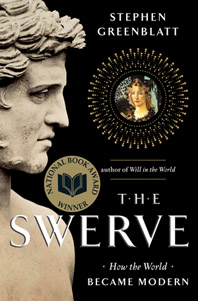
The Swerve: A History of Passionate Reading


I just finished reading Stephen Greenblatt's The Swerve: How the World Became Modern, something that I accomplished in a day. I rarely find myself so enthralled with a nonfiction book that I can't stop reading it, but this instance was even more remarkable since the The Swerve is itself about avid reading. On one level, it narrates the story of a former papal secretary, Poggio Bracciolini, whose passion for ancient texts led him to a German monastery in 1417 and to the discovery of a long-lost poem, On the Nature of Things, by the Roman philosopher Lucretius. The carefully-copied lines asserted Epicurean ideas with such eloquence and daring that--despite its challenge to fundamental precepts of Christianity--Bracciolini sought to make it known again to the world.

At another level, it is about Greenblatt's own fascination with Lucretius. Greenblatt's preface to The Swerve is an eloquent testament to the power of a text to strike, thrill, and infiltrate one's daily life. As he explained: "It was not Lucretius' exquisite language to which I was responding. Later I worked through De rerum natura in its original Latin hexameters, and I came to understand something of its rich verbal texture, its subtle rhythms, and the cunning precision and poignancy of its imagery, but my first encounter was in Martin Ferguson Smith's workmanlike English prose...No, it was something else that reached me, something that lived and moved within the sentences for more than 200 densely packed pages"(2).

Some have cited Greenblatt's engaging analysis of Epicureanism and its influence on Enlightenment thinking, but, for me, what is most significant are Greenblatt's insights into the history of ardent audiences. Most importantly, Greenblatt argues that for Bracciolini to be so passionate about books in the early 1400s was strange: "To all but a handful of people in Germany, this quest, had Poggio tried to articulate it, would have seemed weird"(18). Books were valued mostly in monasteries in the 15th century; all monks had to know how to read and were expected to engage in both "prayerful reading" and manual labor as part of their vocation. This institutionalization of reading was good for the survival of ancient texts; in order to read, the monks had to have books, and they learned to carefully reproduce texts through copying. However, it was not necessarily a joyful or exciting affair--reading and copying were, for most, compulsory chores.

Even more significant than Bracciolini's strange avidity for books was the fact that he was not alone. Greenblatt cites a small but earnest community of humanists in Italy that were devoted to uncovering and collecting lost classics. "Italians had been obsessed with book-hunting for the better part of a century, ever since the poet and scholar Petrarch brought glory on himself around 1330 by piecing together Livy's monumental History of Rome and finding forgotten masterpieces by Cicero, Propertius, and others." (23) Petrarch, Greenblatt suggests, set the model for Bracciolini, by investing "this search with a new, almost erotic urgency and pleasure, superior to all other treasure seeking" (119). Greenblatt quotes Petrarch's own assessment: "Gold, silver, jewels, purple garments, houses built of marble, groomed estates, pious paintings, caparisoned steeds, and other things of this kind offer a mutable and superficial pleasure; books give delight to the very marrow of one's bones. They speak to us, consult with us, and join with us in a living and intense intimacy."

As the story unfolds, it becomes clear that this love of books among humanists in 15th century Italy was actually an emulation of the intellectual culture of the ancient world, in which, "it became increasingly fashionable for wealthy Romans to amass large private libraries in their town houses and country villas...whether on the banks of the Rhone in Gaul or near the grove and Temple of Daphne in the province of Syria, on the island of Cos, near Rhodes, or in Dyrrhkhion in what is now Albania, the houses of cultivated men and women had rooms set aside for quiet reading." Even more remarkable, Greenblatt states that in the first century CE, the first reader-fans emerge: "At the games in the Colosseum one day, the historian Tacitus had a conversation on literature with a perfect stranger who turned out to have read his works. Culture was no longer located in close-knit circles of friends and acquaintances; Tacitus was encountering his 'public' in the form of someone who had bought his book at a stall in the Forum or read it in a library" (60-63). Based on Robert Darnton's work on Jean-Jaques Rousseau's public readership (See "Readers Respond to Rousseau" in The Great Cat Massacre), I had always associated this sort of public reader-author relationship with changing social and urban contexts of the 18th century, but this is a tantalizing revision.

There are other great tidbits in The Swerve about book hunting and collecting, about the circulation of ideas in Renaissance society, and about those whose lives were deeply shaped by the recovery and maintenance of a lost, seemingly better, past. In the end, The Swerve is really about a fan-like love of learning, from Lucretious in the first century BCE, to Bracciolini in in the early 15th century, to Greenblatt today. Their enthusiastic encounters with texts, together with one's own potentially enthusiastic reading, have the power to accumulate--or resonate together--to form an extended community of reception.

Thursday, January 26, 2012

Whither the Music Collector?


Music Man Murray (trailer) from Richard Parks on Vimeo.

A recent post by C. P. Heiser on The Los Angeles Review of Books blog featured Murray Gershenz, a collector seeking to sell his nearly half-million rare records. He is also the subject of a new documentary by Richard Parks, "Music Man Murray." The post and the film both have good insights about the culture of collecting, something that I've talked a bit about before on this blog, particularly as it relates to fandom. Clearly Gershenz represents a fan practice on the decline, or at least, experiencing a profound shift in meaning and definition. As Heiser writes: "...Outside, the building with his name on its façade appears to be shrinking, just as music, too, has shrunk. These days, music lives inside a few scattered bits of data, the fetishized object becoming, at least for the masses, not so much the music as the little hand-held device upon which it plays."

Whither the music collector? What issues would arise if we tried to write a new version of Walter Benjamin's "Unpacking My Library" in the age of digitization and streaming? Is it time for a "Sorting My Playlist?"

Monday, January 2, 2012

Collecting


The New York Times recently posted a web page, "Why We Collect Stuff," featuring various experts weighing in on the phenomenon of collecting. While purportedly a "debate," the positions aren't really about collecting, or its history, or its complex role in broader realms of audiencing and the arts, but rather about the fine line between collecting and hoarding. Unfortunately, as a whole, it reads a lot like media analyses in the 1980s which sensationally--and wrongly, in my opinion--portrayed fandom as amusing on the surface but always ready to tip over into stalking and murder. (John Hinckley and Mark David Chapman were, in this analytical frame, simply extreme versions of any Trekkie or teenybopper). Why assert, as do several of the Times debaters, that collecting is all well and good in a quick opening sentence and then outline in lengthy detail how it can become a problem? Why connect collecting and hoarding at all?

I expect better from the Times. The narrowness of the debate stems, perhaps, from the fact that several of the debaters are psychologists specializing in compulsion disorders. Few elaborate very deeply on material culture and its long-standing role in creating meaning, memory, and identity for individuals and communities. And few acknowledge the growing academic work on collecting, which suggests that it is not a single behavior, good or bad, but rather an analytical category pointing to a range of human practices that articulate people's relationships with the material world. Where were the curators, anthropologists, and historians? They would have provided definitions of relics, souvenirs, exhibits, artifacts, and collectibles; shown how such items can be made meaningful through accumulation, association, interpretation, gifting, narrative; and situated collecting into wider contexts of imperialism, commericialization, ritual, and the modern self.  

At any rate, check it out, if you want. But do so knowing that there is better analysis and research out there, including the work of Walter Benjamin, Jean Baudrillard, Susan M. Pearce, Susan Stewart, John Elsner, Seth C. Bruggeman, Leonard J. Davis, Daniela Bleichmar and Peter C. Mancall.

Wednesday, May 4, 2011

Storing All That Sheet Music

Orchard House, Concord, Massachusetts: Dining Room. (The rack is on left).

On a recent visit with my family to Orchard House, the home of Louisa May Alcott, I noticed a curious piece of furniture in the corner of the dining room that look a bit like an oversized dish-drying rack; it was a finely-finished platform, on bowed legs, topped with a frame intersected by large vertical slots. After the guide suggested that it might have held sheet music, I became curious about "sheet music furniture." Was there such a thing? How far did people go to organize their home sheet music collections in the 19th century? 

This may seem like a bizarre topic to research, but in the age of the memory chip, we have a weakened understanding of the extent to which collecting music before the 21st century required a good deal of physical space and material organization. Besides the piano, one of the most successful consumer products for music in the 19th century was sheet music. (In fact, they often went together: getting a piano invariably meant starting a sheet music collection). Music publishers offered diverse forms of music, including lesson books for instrument and voice, souvenir versions of songs from the musical stage, hymns, minstrel songs, simplified versions of operas and symphonies. An enthusiast's sheet music could quickly number into hundreds of pieces, requiring some sort of cataloguing system for retrieval. As one writer lamented, "We so frequently go into homes and find sheet music thrown about in all sorts of confusion. One family has on old square piano and beneath it is a disorderly heap." (Locomotive Firemen's Magazine, October 1899, 420). How people dealt with issues of storage, organization, and display said a lot about how they consumed, valued, and understood music in general.

Some music-lovers started by identifying their collection with book-plates, similar to those used in home libraries. Music book-plates, as Sheldon Cheney has explained, were often specially-designed to both indicate a person's idiosyncratic interests and to fit in the margins of sheet music pages. 


Many people paid to have their collections of sheet music bound in leather and personalized with their names embossed in gold on the covers. The binders purposefully indicated the individual preferences of their owners through variations in content and organization--by year, by style, by publisher, and by favorite pieces. they could be bulky, but when stored with other books in one's library shelf, they added a sense of refinement and personal achievement to the room.