Showing posts with label fans. Show all posts

Wednesday, August 1, 2012

The Patience of Fans

News reports indicate that the general manager of the Dunkin' Donuts Center in Providence will honor, for an upcoming February show by The Who, tickets from a previously cancelled show. The twist: the cancelled show was 33 years ago. 

I suppose that's one way to distinguish "true fans" from "casual fans."


Monday, July 2, 2012

Cultural Concepts of Fair Play


In the recent Anthropology News, Yağmur Nuhrat of Brown University wrestles with the concept of "fair play," drawing on her ethnographic research among Turkish soccer fans. In "Making Fairness in Turkish Football," she argues that we tend to think of fair play as defined by game rules and promoted as a celebrated ideal of "olympism" and known more colloquially, at least in the U.S., as "good sportsmanship." There is even an International Fair Play Committee that recognizes acts of fair play in "elite sports and sports for all." But Nuhrat explains how this framework is a lot more complicated than it seems. In particular, she uses the example of Alpay Özalan, a player on the Turkish national team in the 1996 Euro tournament who refused to foul a Croatian player in a crucial moment, thus winning a Fair Play award but also losing the game for his team. Fans explained bitterly to Nuhrat that "fair play" could have included a "tactical foul." Since Özalan ignored the good of the team and the nation and appeared to gain personally from it, he had not played "fairly" at all. Nuhrat concludes that "Identifying a universal right or good is but one way to approach ethics...The principles of Fair Play and Olympism ethics exist in a tenuous relationship with alternative conceptualizations of fairness. It is futile and impossible to evaluate in isolation the components of the web in which fairness is couched because it is this socially shifting web which makes fairness on the ground in concrete social sites; through the mouths and practices of football actors, be them footballers or cabbies."

While Nuhrat's piece does not address fandom specifically as a cultural construction, her analysis does present a new perspective on how fans construct the meaning of the events in which they participate, and how that may or may not coincide with the meanings that players enact or that leagues and officials attempt to institutionalize. This isn't "resistance" in the cultural studies sense of the term, but it is an example of the complex ecology of participation (to use Nuhrat's phrasing, the "socially shifting web") in any sporting event.

This is promising anthropological research for those of us who are thinking about the behaviors and values of sports audiences.

Follow-Up: 
In my ignorance of Turkish names, I erroneously assumed that Yağmur was a "he." Since initially posting, I have gone back and corrected the pronouns. My apologies, Yağmur!

Monday, June 25, 2012

Singing in the Stands

A while ago on Twitter I had mentioned the need for an encyclopedia of fan rituals, across history and across cultural forms. Fellow Americanist Adam Golub suggested that a wiki-based source would be a means to start, a place where observers could note rituals they've discovered or witnessed and where a team of volunteer editors could sort the information. The social scientist in me would love the opportunities provided by simply gathering all that information in one place.

I'm thinking about this idea again in response to a piece by soccer writer Grant Wahl in the June 25th issue of Sports Illustrated. In "That's So Euro," Wahl recounts the various rites of European soccer fans, from the noble (Irish fans singing a haunting folk ballad in response to a loss; Lech Poznań fans "doing the Poznań, or groundhopping) to the ignoble (brawls, racist chants).


Wahl wonders whether the ways in which exposure to such rites among the growing numbers of English-language viewers for Euro 2012 might alter American sports spectatorship. As he notes, "NFL commissioner Roger Goodell marveled at European soccer, telling SI's Peter King that he would love to replicate the spontaneous songs and chants that are much a hallmark of the stadium experience as blaring music, Kiss Cams and T-shirt cannons are part of the NFL and other artificially enhanced U.S. sports." Wahl quotes a Polish-American Poznań fan, too, who questions whether refined middle-class NFL audiences would take to the expressive rituals of their European counterparts and whether hardcore fans might need some kind of special section in the stadium, where they might be led by a chant organizer.

It's kind of amusing that Goodell makes it sound like it was the fault of increasingly lethargic American audiences that they had to start showing candid audience shots on the jumbotron and playing AC/DC between plays. I'm not even a big sports person, yet even I have noticed how professional events have become more and more packaged for response, with choreographed fan "rituals" presented for consumption, like the brand name fast food that has taken over stadiums. The whole thing feels packaged like a commercial because, well--could it be possible that increased corporate sponsorship has anything to do with it?

Anyway, if you were to take away the packaging, and leave space for fans to organically respond to what's happening before them, I'm certain that Americans, middle-class or not, would be capable of developing and engaging in exuberant and supportive rituals. After all, they did so for much of the 19th and early 20th centuries, before professional leagues took over. And elite social status certainly does not preclude chants and singing and other forms of exuberance. Has anyone been to an Ivy League hockey game lately?


Tuesday, March 6, 2012

The 12th Man


Great piece in the New York Times today about fan chants and their role in the outcome of soccer games: "...For their passion, a team’s most ardent fans are often called its 12th man — as important to the outcome of a match as the 11 players. They wave banners, paint their bodies and scream until the last whistle sounds. Their chants can create and sustain momentum, help build a rally for a goal, overwhelm an opponent or distract a referee."

In particular, the article features the work of Michael Dennis, one of the founders of the website Fan Chants, a repository of football chants and soccer songs from around the world. It's a pretty extraordinary fieldwork and archival project; if Alan Lomax had turned to sports rather than music, this might have been the result. In fact, Fan Chants might turn out to be a parallel Global Jukebox for future students of sports, audiences, and fandom.

Saturday, February 11, 2012

Beatlemania Emerges in U.S.

It was 48 years ago today...


The O Say Can You See blog, run by the Smithsonian's National Museum of American History, has an interesting post about the Beatles' first concert in America, which took place on February 11, 1964, featuring some the artifacts from the concert in the NMAH collections.

Beatlemania used to be the subject of much head-scratching, and even derision, both in the press and in academia, so I'm glad to see it recognized, here, as a significant moment in history. "Maniacal" audiences existed long before 1964, of course, but the behavior of American Beatles fans was significant as clear evidence for the vast commercial potential of teen culture (see, for example, this great collection of 1964 magazines capitalizing on the Beatles phenomenon) and also, somewhat contrarily, of the grassroots political potential of rock'n'roll, including an empowerment of young women's public expression (see Barbara Ehrenreich, Elizabeth Hess, Gloria Jacobs, "Beatlemania: Girls Just Want to Have Fun").

In the end, it remains an iconic moment of rock'n'roll audiencing.


Saturday, December 31, 2011

Romantic Fandom


Before the holiday, I heard from Professor Eric Eisner of George Mason University, who shared that he had edited a volume of the Romantic Circles Praxis Series, on "Romantic Fandom," in April 2011. I am not very well-acquainted with literary studies these days (and especially not British Lit.), so I was delighted to check it out. Clearly there are exciting things happening in the study of Romanticism--between this and Judith Pascoe's book on Sarah Siddons, I now see the Romantic Era as a key moment in the history of audiences. Much as the "market revolution" in the United States during the 1830s and 1840s changed the very nature of cultural consumption and participation, Eisner writes that, in England, the Romantic period of the late 18th century
...saw the popularization of recognizable "fan practices," spurred by the growth of consumer culture and the development of a mass audience for culture generally. Admirers collected autographs, souvenirs, portraits and relics of celebrity writers, artists, performers, military heroes, and athletes; snapped up mementos associated with beloved plays or books or music; visited the homes and haunts of celebrities; pored over gossip-filled periodicals and newspaper notices; imitated celebrities’ fashion statements; fantasized about becoming friends or lovers with celebrities; wrote fan mail and formed communities of like-minded aficionados.
And while I’ve emphasized the connections between modern and historical fans in this blog, these essays advocate caution. As Eisner explains in his introduction, “If these essays contest literary criticism’s abjection of the fan as ‘naïve, obsessive, desirous, and dangerously predatory’ (Watson), they also resist simply celebrating the fan or identifying Romantic-era readerly desire with our own…Fandom is always historically situated, always tied to specific and shifting cultural as well as individual situations.”

The essays are consistently excellent, examining everything from the literary tourism of Lady Frances Shelley to the surprising mania in the 1820s for Pierce Egan’s Life in London; or, the Day and Night Scenes of Jerry Hawthorn, Esq., and his Elegant Friend Corinthian Tom, Accompanied by Bob Logic, the Oxonian, in their Rambles and Sprees through the Metropolis, with other contributions by Nicola J. Watson, Clara Tuite, Mark Schoenfield, and David A. Brewer. I have taken note!

Friday, December 9, 2011

Popular Media Audiences Symposium

The latest symposium on popular media audiences has a good set of speakers; not surprisingly it's in England:


The Centre for Cultural and Creative Research at the University of Portsmouth presents:
Popular Media Cultures: Writing in the Margins and Reading Between the Lines
A Symposium to be held at the Odeon Cinema, Covent Garden, London
Saturday 19th May 2012

Keynote Address by:
Prof. Henry Jenkins
Provost’s Professor of Communication, Journalism and Cinematic Arts, University of Southern California. Author of Textual Poachers (Routledge, 1992), The WOW Climax (NYU Press, 2006), Fans, Bloggers and Gamers (NYU Press, 2006), and Convergence Culture (NYU Press, 2006).

Focus:

The first steps toward a wider consideration of popular media cultures surrounding film, television and the Internet, and the relationship between fans and their object of fandom, is to acknowledge the prominent position of what Jonathan Gray calls media paratexts as opposed to the centrality of specific films or television series as the text. Indeed, we are now accustomed in fan studies to state that the productivity of fans and their related fan practices represent an appropriate and worthy text to study just as much as the media text to which they are related or inspired by. So, rather than studying Star Trek as cult text, we might study fan produced videos on YouTube as important texts of fan activity that carry inherent meaning and significance in and of themselves. Or, for example, Star Wars carries with it meaning within and outside the narrative – from an analysis of its mythic story structure using the work of Joseph Campbell to studies of its fans who actively engage in their own meaning making by dressing up, making videos and writing fan fiction. However, the peripheral texts – those associated with the commercialization of the franchise such as the lunchboxes, toys, video games, and websites – are as much part of the meaning making process that they become texts to study in their own right.

Popular Media Cultures seeks to explore the relationship between audiences and media texts, their paratexts and interconnected ephemera, and the related cultural practices that add to and expand the narrative worlds with which fans engage. How audiences make meaning out of established media texts will be discussed in connection with the new texts produced by fans. The symposium will focus on the cultural work done by media audiences, how they engage with new technologies and how convergence culture impacts on the strategies and activities of popular media fans. If, Ken Gelder argues, “Subcultures are brought into being through narration and narrative: told by the participants themselves, as well as by those who document them, monitor them, ‘label’ them, outlaw them, and so on,” then this symposium will pay attention to what media audiences add to a text, what gets written in the margins of a text and what new meanings fans read between the lines. This symposium will bring together leading academics in the fields of film, television, fan and cultural studies to open up and take further the debates surrounding popular media, its producers, its audiences, and the cultures in which they are ultimately located.

Confirmed Speakers:

Dr Stacey Abbott, Reader in Film Studies, Roehampton University. Author of Celluloid Vampires (University of Texas Press, 2007), editor of The Cult TV Book (IB Tauris, 2010), co-author of Falling in Love Again (IB Tauris, 2009), and series editor of Investigating Cult TV for IB Tauris.

Dr Will Brooker, Reader and Director of Research, Kingston University. Author of Using the Force (Continuum, 2002), Hunting the Dark Knight (IB Tauris, 2012) and editor of The Blade Runner Experience (Wallflower, 2005).

Dr Joanne Garde-Hansen, Principal Lecturer in Media and Director of the Research Centre of Media, Memory and Community, University of Gloucestershire. Author of Media and Memory (Edinburgh UP, 2011), co-editor of Save As... Digital Memories (Palgrave, 2009) and co-author of the forthcoming Emotion Online: Theorising Affect on the Internet (Palgrave).

Dr Kristyn Gorton, Senior Lecturer in Television Studies, University of York. Author of Media Audiences (Edinburgh UP, 2009) and co-author of the forthcoming Emotion Online: Theorising Affect on the Internet (Palgrave).

Dr Matt Hills, Reader in Media and Cultural Studies, Cardiff University. Author of Fan Cultures (Routledge, 2002), The Pleasures of Horror (Continuum, 2005) and Triumph of a Time Lord (IB Tauris, 2010).

Prof. Mark Jancovich, Professor of Film and Television, University of East Anglia. Author of Rational Fears (MUP, 1996) and The Place of the Audience (BFI, 2003) and co-editor of Defining Cult Movies (MUP, 2003), Quality Popular Television (BFI, 2003), and Film and Comic Books (Mississippi UP,
2007).

Prof. Roberta E. Pearson, Professor of Film and Television, University of Nottingham. Author of Eloquent Gestures (University of California Press, 1992), co-editor of Cult Television (University of Minnesota Press, 2004), The Many Lives of Batman (Routledge, 1991), and editor of Reading Lost (IB
Tauris, 2009).

Further details of how to register and attend the event will be published in the New Year. For information on the Centre for Cultural and Creative Research at the University of Portsmouth please visit our website at: http://www.port.ac.uk/research/cccr/

Symposium Coordinator:
Dr Lincoln Geraghty
Director of the Centre for Cultural and Creative Research
School of Creative Arts, Film and Media
University of Portsmouth

Wednesday, October 26, 2011

Literary Pilgrimage


I see that University of Cambridge classicist Simon Goldhill has discovered fandom in his new book, Freud's Couch, Scott's Buttocks, and Bronte's Grave, which was the subject of a recent profile in the Chronicle of Higher Education's PageView blog. His discomfort with readers who make pilgrimages to author-related sites is interesting; if anything, it shows why critics and fans, reading the same books, often exist in completely different universes.

I shouldn't show him, I guess, the photo of me, during a trip to New Orleans in 1989, casually reading a newspaper outside the French Quarter residence of William Faulkner (where he began his career as a writer):


Perhaps, however, my family will sympathize with Goldhill's skepticism. When I suggested a vacation trip to Pittsfield, Massachusetts, this summer, so we could visit the home of Herman Melville, they laughed, and then, with some alarm, asked if I was serious. I was.

Literary tourism is a big business, big enough to get a featured in O Magazine articles like "5 Legendary Writers' Homes." It has also been a hot topic in literary studies, where it is generally equated with superficiality and commercialism, the equivalent of taking a pre-packaged bus tour of a city rather than living in a neighborhood and learning the language. Literary pilgrimage has been the subject of satiric novels (like Brocke Clarke's An Arsonist's Guide to Writers' Homes in New England), as well as condemnatory papers about the public's naive obsession with authenticity or the emotional reality of texts (discussed previously in a Chronicle review, "You've Read the Book, Now Take a Look!," from 2009). Tourism, more generally, has been a hot topic in cultural studies for much of the last decade, the subject of journals like Tourist Studies, or research collectives like UC Berkeley's Tourism Studies Working Group, and also the subject of books in anthropology, literature, history, and music, from Barbara Kirshenblatt-Gimblett's Destination Culture: Tourism, Museums, and Heritage (U. California Press, 1998) to Stephen A. King's I'm Feeling the Blues Right Now: Blues Tourism and the Mississippi Delta (University Press of Mississippi, 2011).

From the standpoint of fans, visiting sites associated with various performers, works, or characters is a key element of how they decode works, aesthetize their lives, and shape cultural experience. As far as I can tell, however, work in fan studies has not had any explicit impact on the study of tourism. It might be time to connect that gap by holding some kind of meeting that will enable a sharing of perspectives from anthropology, history, literature, media studies, and religion on fandom and the power of place. Sounds like a good panel, at least, no?

Wednesday, October 5, 2011

NIN PHM


Daphne Carr’s contribution to Continuum's 33 1/3 series, Pretty Hate Machine, has been on my list of things to read since last spring, but other commitments prevented me from fully delving into it until now. I realize now that sitting near me all this time was an engaging work of radical contextualism, one that seeks to literally transform rather than revere Nine Inch Nails’ 1989 album.

Carr writes that the book was inspired by my book Tramps Like Us, which is cool (thanks for the shout-out, Daphne), but I have to say that she moves beyond my limited self-analysis and scholarly representation of fans’ voices to fully embrace the notion that not only musicians make music. She makes it clear that an analysis of Pretty Hate Machine that addressed only the songs on the album, or only the creative process of Trent Reznor, would be a distortion; the album has had such a resonance since its release that the only way to make sense of it is (to quote ethnomusicologist Charles Seeger) to “start in the middle and work outward in all directions.” Carr's analysis is not for the narrow-minded; it unabashedly connects the 1999 Columbine shootings, goth culture, Reaganomics, early rock'n'roll, the history of Youngtown, Trent Reznor's life, industrialization, slum clearance, historic preservation, Hot Topic, cultural contradiction, and American despair.

Despite the breadth of her vision, her specialty is the pithy meta-statement, perhaps learned at the hands of postmodernist theorists, but skillfully honed, here, to the memorable bon mot. (“Hot Topic was where sellouts sold the idea that selling out sucked).” What's most interesting, though, is the slyness of her insights. They often lurk in the background, suggested in word choices or absences in descriptions, finally jumping off the page to clonk you on the head. My favorite moment is her chapter on Cleveland, which starts by linking the cancellation of the Alan Freed’s Moondog Coronation Ball in 1952 to the story of rock’n’roll’s erosion of racial segregation. It’s a well-written description of what is now a conventional story. But then, in the next paragraph, she suddenly flips that truism on its head to reveal Alan Freed’s involvement in Screamin’ Jay Hawkin’s African cannibal/coffin act, which pandered to white racist fantasies and drove Hawkins to cope through drug-use. In a final rhetorical twist, Carr sums it all up by making all these connections a foundation of Nine Inch Nails’ complex appeal, announcing, “This is the story of the first goth-rock stage show.”

The most controversial (for those who want to hear only about Trent Reznor) and the most moving (for those who want to understand the power and legacy of this album) are the ten chapters that each feature a fan talking about his or her experiences with and around the album. Like the Bruce Springsteen fans with whom I conversed in the 1990s, each person has an extraordinary story centered on an experience of hearing that becomes a long-lasting and powerful force for identity, reformation, and belonging. These fans are, like many self-aware people, slightly anxious that “the sounds they believe to be their soul’s salvation are also a mass-mediated commodity.” But that’s the point—the fragments of industrialized entertainment cynically sold to us as “revolution” or “soul-bearing art” can actually—though often unpredictably—foster revolution and soul-bearing.

Notice I said “foster.” I think what Carr’s book hammers home is that these meanings are not “in the music.” In fact, she goes so far as to instruct her readers to resist this commonplace musicological notion, encouraging instead a different approach: “If you have copy of Pretty Hate Machine, listen along to hear the book’s speakers with and against yours. The space between your hearing, their hearing, and my hearing is how we will get into a conversation (or argument) that is part of the point of this book. If the conversation makes us all cringe a bit, so much the better.” If that isn’t a good definition of fandom, I don’t know what is.

Saturday, October 1, 2011

Fandom is a Matter of Life...and Death


Check out this recent article in the New York Times about team-themed floral arrangements at the wakes and funerals of sports fans. This is not as bizarre as it might sound, especially when you consider the depth of meaning fandom affords life-long followers of teams.

I'm also glad that, so far, trademark claims have not been leveled at the grieving families. Can you imagine? (One thing that is not adequately recognized by "intellectual property" law is the illogic whereby corporate entities relentlessly thrust trademarked logos and phrases into people's daily lives and then insist that people's lives must not infringe on the symbolism).

Friday, September 23, 2011

Fan Rituals


Check out the Boston Globe's recent photo essay of Fan Traditions and Rituals. There are many many more, of course, among sports fans and among other kinds of fans.  Not to go too anthropological on everyone, but it's worth reflecting on the ritual aspects of fan behavior, which link fandom to broader systems of human belief, symbolism, and communal affirmation.

I don't have time to do it, but I'd love to see an Encyclopedia of Fan Ritual some day. Perhaps it could be done collectively online. It would be a great way to start mapping and comparing the varieties of fan experience.

Tuesday, August 30, 2011

Some Fan Studies Before "Fan Studies"

In the past, I've written about some of the classics of fan studies. In this post, I want to briefly highlight a few books that do not explicitly address fandom but nevertheless deserve mention as works of scholarship that have addressed the subject of devoted or enthusiastic audiences. For me, these works all had to do with reading; in the late 1980s, I was a newly-graduated English major, growing tired of great authors and works (I think I had read Moby Dick five times at that point), and becoming more and more interested in marginal aspects of literary studies: the physical nature of books, the business of publishing, and, especially, the history of readers. To my astonishment, I found a number of fairly recent works on those subject. I wasn't studying fandom when I first encountered these books, but once I did start to think about fans a bit later, in the context of popular music, the book's arguments and stories came back to me, providing a rush of intriguing parallels, echoes, and connections. Rousseau readers and Springsteen fans, for example, separated by centuries, seemed to be thinking in similar ways--how could that be? It's something I'm still thinking about twenty years later.

Robert Darnton, "Readers Respond to Rousseau: The Fabrication of Romantic Sensitivity" (1984). This essay appeared in Darnton's collection on French cultural history, The Great Cat Massacre. Drawing on a collection of letters between Jean Ranson, a French merchant book collector, and a Swiss publisher, Darnton unearthed Ranson's fascination with the work of Jean-Jacques Rousseau, whom Ranson called "L'ami Jean-Jacques" (my friend, Jean-Jacques) even though, as Darnton noted, he "had never met" Rousseau and could only know him through the printed word. This relationship was the set-up for an amazing analysis of what Darnton calls "Rousseauistic reading," a new way of understanding the world of a novel as an intimate representation of an author's emotional being. In some of the funniest passages, Darnton talked about Rousseau's alarm about the new type of readers he created; apparently Rousseau had to install a trap door in his home to escape the many admirers who sought him out for heart-to-heart chats and expressions of gratitude after reading books like La Nouvelle Heloise. In the described shift toward a Romantic "sharing of selfhood," I started to see patterns that pre-modelled modern fans' relationships to media celebrities.

Susan Stewart, On Longing: Narratives of the Miniature, the Gigantic, the Souvenir, the Collection (1984). Susan Stewart's On Longing was an extraordinary work of cultural theory, rooted in literary studies but also ranging outward to include giant myths, doll houses, and book collectors. For me, it was one of the first theoretical works I had encountered about the sometimes intense relationships that people develop with objects and performances. No one I knew was writing about that particular kind of desire in 1984, and her arguments about the ways in which we make sense of the world around us by sorting our experiences and manipulating time and space through narrative gave me a stronger sense of the existential gravity behind reading: it was about much more than mere entertainment or cultural refinement. Stewart's final essay on collecting directly addressed what I later recognized as a primary fan practice. She showed how collectors variously layer objects with complex narratives of authenticity, nostalgia, and the self. The book's post-structuralist language and Lacanian references were, at first, a bit impenetrable for me, but Stewart, a poet, still had a knack for thought-provoking declarations: "The printed text is cinematic before the invention of cinema." "Although reading may give form to time, it does not count in time; it leaves no trace; its product is invisible." "The souvenir must be removed from its context in order to serve as a trace of it, but it must also be restored through narrative and/or reverie." I still go back to it.

Janice Radway, Reading the Romance: Women, Patriarchy, and Popular Literature (1984). In one of my first jobs (1985-86 or so), I worked at Barnes & Noble, where I was in charge of, among other things, shelving the new series arrivals in the romance section and shipping older, unsold editions back to the publishers. I distinctly remember the customers who came into the store regularly to buy romance books and who seemed to have a deep knowledge of the nuances between Harlequin lines and other competing series. I wanted to talk to these customers more about their obvious passion for books and reading, but it was too awkward for me. Radway did. Published in 1984, Radway's pioneering research featured interviews with a group of women romance readers. Like Stewart's work, Radway was, at one level, rescuing a denigrated form of popular culture by showing the ways in which it facilitated meaning-making in everyday life; as a feminist, her goal was to find out how such books helped women to negotiate patriarchal society. There were problems with the research, at least in terms of ethnographic practice (Radway was ultimately unwilling to take the women's articulation of their own lives at face value, asserting their patriarchal oppression and then wrestling with how to interpret romance reading in light of that), but her work nevertheless showed me how fieldwork--typical for anthropology abroad rather than at home--might serve as a legitimate method in the investigation of popular culture fandom. I taught this book for many years in a seminar on audience studies, and it remains influential.

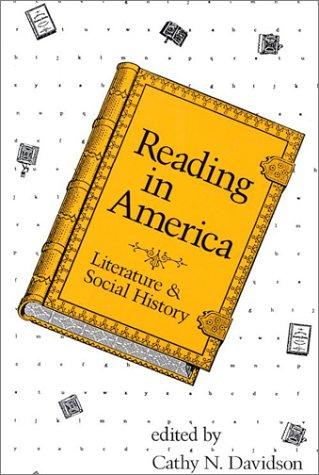
Cathy N. Davidson, "The Life and Times of Charlotte Temple" (1989). This essay, which appeared in a collection edited by Davidson called Reading in America. I could talk about Davidson's equally compelling Revolution and the Word (1984), which more broadly addressed the power of novel-reading in the new republic, but this essay was one of the first that I had encountered that analyzed, head-on, the ways in which a single novel might change the lives of ordinary readers. The novel was Susanna Rowson's Charlotte Temple, a cautionary tale of a young woman's fall from virtue, and one of early America's bestsellers. Davidson pointed out that readers developed such intensely emotional reactions to the story and the character of Charlotte that they believed that the sensational story was true. Someone even placed a tombstone for Charlotte in the churchyard of New York City's Trinity Church, signifying readers' blurring of the lines between fiction and reality, and by the 1850s, weeping readers (men and women, working and middle-class) regularly made pilgrimages to the churchyard to pay their respects. Besides suggesting the ways in which readers worked to sustain the world of a narrative outside of their encounters with that narrative (much as music or theater fans stay in "audience" mode long after performances are over), the notion of pilgrimage really resonated with me. I knew fans for Springsteen who did the same thing as Charlotte Temple readers, imbuing real places with new layers of meaning known only to them.

Wednesday, August 17, 2011

Fans Need to Dim Their Clothing

The Big League Stew reported that at a recent Oakland A's v. Baltimore Orioles game, two fans with LED jackets (one scrolling the message "Go Orioles") were asked by the umpire to turn them off. We can't have fans "disturbing" the game from up in the stands (or, more like it, disturbing the paid neon advertising), right?

I've written about this before--see Name That Audience 7, Fans on the Field, and Football's Continuous Ovation. What fans can and can't do is policed today far more than in the past. I wonder if it just might be better if they didn't attend games at all. Then athletic competition could proceed in its utmost purity: isolated and silent, except for the occasional grunt of physical exertion or the crystal call of an umpire.

Of course, if a tree falls in the forest and no one is there to hear it....

Sunday, August 14, 2011

Pleasures of Reading


I just finished Alan Jacobs's new book, The Pleasures of Reading in an Age of Distraction. It has been getting some press attention lately, with a review in the Wall Street Journal, as well as an adaptation in the Chronicle of Higher Education. 

I have to admit that I was a little worried about the title, at first glance. While Jacobs is decidely not a member of the "turn off your computer" camp (or their predecessors, the "turn off your TV" crowd), who assume a negative causal relationship between media engagement and the quality of one's reading, he does point to the ways in which the the obligations of educated refinement (promoted especially in academia), as well as the information triaging necessitated by the hyper-culture of social media, create a great deal of anxiety about sustained, deep, and enthusiastic reading. We feel we should get lost in a book, but we can't. When we do, it feels a little strange. 

First, kudos to Jacobs for trying to capture the pleasures of reading (even though he admits that it is truly impossible to convey what a "page-turner" feels like). I certainly love books in they ways that Jacobs describes and can attest to the ways in which chance encounters with individual works have changed my life. I also appreciate the ways in which he attempts to situate that joy in the context of contemporary culture, assuaging lack of confidence about "reading properly" or about "reading deeply" by encouraging "reading at whim," that is, to fully embrace the experiences of reading that feel right, no matter the dictates of taste or the competing demands on one's attention. As he writes, "The book that simply demands to be read, for no good reason, is asking us to change our lives by putting aside what we usually think of as good reasons. It's asking us to stop calculating. It's asking us to do something for the plain old delight and interest of it, not because we can justify its place on the mental spreadsheet or accounting ledger (like the one Benjamin Franklin kept) by which we tote up the value of our actions" (16).

This is, as he suggests, not so much the function of a "good book" itself, but rather of one's general approach to the ecstatic potential of any encounter with a book. That is, we read deeply when we accept, or, at least, leave ourselves open to the premise that "books are the natural and inevitable and permanent means of being absorbed in something other than the self" (116). While Jacobs tends to talk about fandom as a kind of extremism, I'd suggest that this approach to books more accurately describes fandom as it is experienced: a recognition of a performer or performance (including "texts" of all kinds--books, movies, music, art, etc.) as having the ongoing potential to move, transform, connect, and otherwise wrest one from torpor. As Tia Denora put it, we engage in culture to "aesthetize ourselves." Fan engagement can sometimes appear aberrant (when fans embrace a work that is not canonical) and it can sometimes appear obsessive (when fans allegedly spend too much time engaging one work or author), but its mode of hopeful enthusiastic engagement is unabashedly catholic and deeply pleasurable, often facilitating a kind of lasting and meaningful learning that cannot be attained through other means.

Jacobs focuses a bit too much for my taste on quietude, on shutting down cultural "distraction," though I do recognize the need for many to carve out time for sustained reading. Rather than turning things off, I always encourage my students to simply treat books differently. I tell them, first, to understand reading as not simply a mechanical movement of eyes over a page, but rather as the development of a relationship, much like one you might develop with a person. "Reading," in fact, is always a complex and unique story of encounter, flirtation, acquaintance, and knowing. It's a little weird, but I ask students to carry their books around with them, place them nearby when they are not reading (on their drawing desks, at the dinner table, etc.), and, in Whitman-esque fashion, get to know them, even unopened, as daily companions and even as old friends. I hope, this, in turn, leads to a reformation in their minds of what a book is. When some complain that a book is "dry" or "boring," or even when they assert that a book is "exciting," I tell them that, in fact, it is their relationship to the book that is "dry" or "boring" or "exciting." Books are just books; their meaning and transformative power depend on how readers bring them to life. 

These are just some of my own techniques for keeping the pleasures of reading alive; on the whole, I think Jacobs and I are far more in sync than apart. Perhaps more so than Jacobs, I sense that all this might be futile: maybe the pleasures of sustained reading are indeed being erased and are likely to be lost to us in the future. But, really, I don't know. Like Jacobs--and, I think, teachers in general--I hopefully and defiantly try to keep it alive anyway. (The cliché of teacher-motivation is true: "If I can just reach one person....").

I wish you all absorbing and transformative reading.

Sunday, July 31, 2011

Fandom Before the Internet: The Fan Club Directory


How did fans keep up with the latest news, enthuse with friends, and sustain their enthusiasms before the Web, Facebook, and Twitter? We take it for granted that a "community" can be non-geographic these days, but before the Internet that concept was not wholly accepted; a community without shared experiences and practices in a particular place felt considerably weaker, more like a loose association ("the international community," "the scientific community") than one based in a neighborhood or other locality. Nevertheless, fans' intense feelings of connection motivated them to seek one another out and attempt to build a sense of community, something that they did mostly with regular face-to-face meetings (at conventions, performances, and parties) and print communication (fanzines, newsletters, and private letters). Much of this activity, especially for fans of lesser-known stars and art forms, was DIY, and it required an amazing amount of labor and love. You really need a certain level of devotion to work at a job all day, manage a family, and then also spend your remaining time, night after night, doing the rather isolated work of collecting clippings, writing articles, compiling fan art, and mailing out photos and tapes to fellow fans.

I'll be exploring these aspects of fandom a bit more (and maybe compare them to today's practices), but for this post I just wanted to highlight an extraordinary publication, which is now defunct: The Fan Club Directory. Published between 1979 and 2002, the Directory was a two-staple, roughly 75-page booklet, produced annually by the National Association of Fan Clubs (NAFC). It listed alphabetically every fan club that elected, for free, to become a member of the NAFC, giving readers the U.S. mail address of the current president and/or contact person. The NAFC was an organization dedicated to representing "all fan clubs in all fields of entertainment," and so the listings in the Directory were unintentionally jarring: announcement of The Amazing Pudding, the fanzine for Pink Floyd, sat right across from the Annette Funicello fan club (both are listed alphabetically under "F"); "The Celestial Affiliation of Time Lords: A Time Travel Fan Organization" was next to the "Charlie Daniels Band Volunteers;" Elton John and Al Jolson were side by side. It read like a fantasy middle-school classroom before everybody went off to become famous in their various pockets of the world.


Some of the clubs were focused on stars or shows that I don't recognize anymore--Becky Hobbs, Secret Oktober, etc. But full-page breakouts were allotted for entertainment stars with more than one club, including Englebert Humperdinck, Tom Jones, Barry Manilow, and Elvis Presley. There seemed to be a mixture of both "official" fan clubs, run by an artist's management, and "unofficial," run by fans out of their homes. Of equal historical interest were the details in the Directory's ads. You could learn, for example, that The Flying Nun Fan Club "has been looking for the original hat and dress from 'The Flying Nun' for the 25th Anniversary." (One can only wonder: did they find it? What did they do with the artifacts?). Or that there was a new Keith Carradine Club in Gronau, Germany, "searching for new members who are interested in international contact with other Carradine fans all over Europe." Or that a group called "Operation Tribbles" helped to coordinate Star Trek clubs to donate stuffed "tribble" toys to people in rest homes, hospitals, and hospices around the world. In all, the Directory offered a heterogeneous slice of late 20th century popular culture in the English-speaking world. 

When I first received The Fan Club Directory in my mailbox back in 1993, I remember being amazed at how many clubs there were and how much work it must have been to bring that information together in one place. Of course, that was right at the dawn of the World Wide Web, when fans were just joining online "bulletin boards" and "discussion groups." Blanche Trinajstick, the Editor/Publisher of the Directory, retired from "fan club work" in 1992, stating that "for more than 30 years I have not known the meaning of 'spare time.'" Her successor, Linda Kaye, published the Directory for another decade before finally calling it quits in the face of the Internet explosion, which both made being a fan and communicating with other fans far easier and slowly eroded the usefulness of a printed directory. As Kaye wrote retrospectively: "While the NAFC provided a great service for a quarter of a century, the Internet made the task of keeping up with confirming the legitimacy of 'new' website clubs and responding to mountains of e-mail requests for fan information and clubs dealing with fans most of us have never heard of a burden too overwhelming to continue."

Yes, the Internet changed things. But I am wary of simply understanding technology as determining radically new kinds of human behavior. In fact, I see The Fan Club Directory as an important and necessary antecedent to today's social networking. While it is all but forgotten among the current iPod generation, I hope that at least it will be preserved (along with fanzines and other fans publications) as evidence of how enthusiasm in our culture has been continuously, as well as variously, organized.


Tuesday, July 26, 2011

A Fan's Perspective: McCartney as Dad


Musician Robert Burke Warren has a thoughtful article over at Paste on his fandom for Paul McCartney. His reflection was prompted by McCartney's recent concert at Yankee Stadium, which he describes as a powerful show for the audience gathered. As he put it, "I was a riot of sensation and notion; chill bumps, laughter, singing with strangers—all messy, uncool spillage from an open heart." Part of that spillage was realizing the extent to which his fandom has, in some way, always been about McCartney as a father figure. "I was struck" he wrote about the finish of the concert, "by the amount of families, some of whom carried sleeping children out of the still-charged stadium. This had been a family event. Of course."

In public discourse, fandom is typically reduced to stalking or silly teenage enthusiasm. (Certainly, the story of Beatlemania was always centered on screaming teenage girls). But, here, Warren shows us that such stereotypes of fandom fail to get at the consequences of individuals' long-term attachments to public performers. Devotedly following a star's career over time--for years or decades--transforms most people's initial attraction, however motivated, into a significant force for meaning in daily life. Songs get attached to personal memories and values, lyrics begin to illuminate diverse circumstances, concerts start to feel less like entertainment events and more like repeated rituals of affirmation.

McCartney as an iconic dad? Sure: for Warren. Fandom is complicated--as complicated as the diverse experiences and life stories of the millions of people who identify as fans. Especially in our complex culture, in which intense fame vies with widespread anonymity, fandom works not only as a framework for consumption but also as a technology of the self. Few have really bothered to articulate the latter, but it is obvious when someone does.

Saturday, July 16, 2011

FNL Fans, Not NFL Fans


While its not about the origins of fandom, it's worth considering as another key moment in fan history: the story of "Friday Night Lights." FNL concluded forever last night, prompting longtime supporter and TV critic Matthew Gilbert to reflect on its meanings. He talks especially about the fans, who had a particular relationship to the show that had little to do with either Texas or football, which is interesting, given that the show was based on a book and a feature film about Texas football. (Talk about "encoding and decoding"...).

Monday, July 11, 2011

Lost in Harry Potter


The final Harry Potter film opens this weekend, and a York farmer has commemorated the event with an impressively complex and artful maze. Landscape art seems to be the province of British Potter fans, who have done this sort of thing before.


Of course, displaying one's investment in Harry Potter with a maze has deeper meanings for those familiar with the books, since a maze featured prominently in Harry Potter and the Goblet of Fire.

Saturday, June 11, 2011

Fans Crossing the Line

The news in the world of "Glee" is that during a recent live performance in the TV show's national tour, an overly enthusiastic fan pulled one of the performers off the stage. It was almost a repeat of an incident a couple of weeks ago, during Rihanna's "Today Show" appearance, where a fan hugged her during the performance and wouldn't let go. These moments are clear breaches of etiquette; there are fairly strict rules today that separate music performers and audiences at concerts, from the presumed "fourth wall" of the stage to the security personnel that are sometimes hired to police it. Nevertheless, such breaches happen quite frequently.

Last month, it happened to U2 in Mexico City. It also happened to Shakira:


Recently, Lady Gaga encountered a fan gesturing along with a song on stage in Japan:


Brittany Spears had something similar happen the year before: