Showing posts with label libraries. Show all posts
Sunday, February 24, 2013
Metareading
Phantoms on the Bookshelves is a charming memoir of bibliomania, by French editor and writer Jacques Bonnet. Treading in the footsteps of classics like Walter Benjamin's "Unpacking My Library," Bonnet offers a series of reflections on his personal library and, more generally, on the quality of a life lived with books. Its 123 pages can be enjoyed in an afternoon; its charm lies in Bonnet's quiet self-awareness and wry humor. Throughout Bonnet mentions not only the books he has read (and re-read) but also the numerous authors who have, throughout human history, written about their reading and their libraries. For those interested in books about books, this tiny volume is a great map.
Bonnet is interested in something I've been pondering a lot lately: from where does a passion for books (or passion for the arts, in general) come? In the beginning of the book, he mentions how "reading...penetrated, like a shaft of sunlight, through the gloomy atmosphere of a provincial childhood of the 1960s" and about how both escape from and knowledge of the world excitingly tarried with each other for him during the tumult of France in the late-1960s. These answers are circumstantial, pointing to the power of books to re-contextualize us, to subvert the conditions in which we find ourselves. But he also wonders about the force of sheer curiosity: "The fanatical reader is not only anxious, he or she is curious. And surely human curiosity--condemned as it was by certain Fathers of the church as being of no purpose since the coming of Christ, and even prohibited, since we now have the Gospels--is one of the determining factors of all our actions? A capital element in the search for knowledge, in scientific discoveries or technological progress, the essential force behind human endeavour..." (29)
Otherwise, I was taken with his repeated assertion about libraries as alive. For readers, this is a common reality; for non-readers, it might seem hyperbolic. It is not easy to explain. Bonnet says, "A strange relationship becomes established between the bibliomaniac and his (or her) thousands of books...We may have chosen its themes, and the general pathways along which it will develop, but we can only stand and watch as it invades all the walls of the room, climbs to the ceiling, annexes the other rooms one by one, expelling anything that gets in the way." (31) Bonnet is genuinely surprised as he writes to us about his library, seeing things he had not seen before. "How did these books get into my library?" he asks at the start of chapter 5. The question is not entirely rhetorical.
One of the funniest moments was his discussion of how "human reality sometimes intrudes strangely into the principles of classification" of any library, noting how book collectors think long and hard about which books should be allowed together or forced apart. Apparently, the author of a rulebook for personal libraries in the Victorian era suggested that works of male and female authors had to be separated "unless the parties are married to one another," (41); Bonnet quotes the hero of a bibliomaniacal novel, The House of Paper, who worries about putting Borges next to Garcia Lorca, Shakespeare next to Marlowe, or other potentially unpleasant social situations.
In the end, Bonnet assert that "hundreds of thousands of people live in my library." First, he notes that each book contains a host of "imaginary" characters, with whom we have a deep experiential and psychological communion, who are always there, living their stories for eternity. Second, while asserting that authors are only fragmentary apparitions about which readers know very little, he argues that readers nevertheless are are invested in their reality and are always in search of books' creators. "We are so anxious to maintain the illusion that the author is a real person that we cannot be satisfied simply with an orphan work of literature." (83) Of course, these are the two foundations of fandom--sustained passion for a work and the quest to establish a lasting and strong relationship with others, famous or humble. Escape and knowledge.
Tuesday, October 25, 2011
E-reading
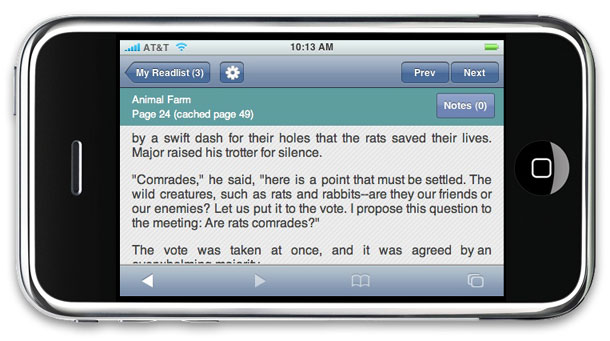
Last year, in a seminar, one of my students was using her iPhone while we were discussing Jim Deetz's In Small Things Now Forgotten. I asked her to put the phone away, since class had begun and we were engaged in discussion. But she protested, indicating that she was engaged--the text had been downloaded to her phone, and she was merely following along with the passage I had asked everyone to turn to!
We certainly live in a new world of "reading." I have no moral or philosophical objection to e-books, the digital humanities, etc. In fact, I see the incredible potential of such technologies for creating and maintaining knowledge and fostering new kinds of educational, research, and business. But I have to say that, personally, I still prefer the "hard" form of a book. Flipping pages is an economical and pleasurable means of encountering text that involves not only a particular kind of spatial understanding but also involves familiar sounds (the swish of a turning page), gestures (holding a book in different stances), and materials (glue, cardboard, pulp). I particularly like each book's design identity, implying an intellectual world. Books as singular objects--with form, color, and weight; that I can carry around, have nearby, and consult--supports my understanding of them as a unique and singular utterances of fellow human beings. I fully understand the convenience of having one's entire library in a tablet device, but at the same time, I resist the idea of making "my library" a basic unit of value, like my stock portfolio. I want my library to be chaotic, more about all the amazing ideas and debates in the world to which I often return, puzzled, curious, and seeking connection. I'd rather not have my library conveniently display my investments but rather function as an imperfectly-wrought sanctuary that I can enter for the purpose of discovery, surprise, and encounter.
At any rate, there have been many writers, readers, and critics out there who have compared old and e-books over the past several years. JBMonco had a nice comparison of experiencing Moby Dick in book and e-book back in 2009, for instance. Or author Margaret Atwood:
This is a nice chart from The Daily Beast that compares the economics of the two forms. And now researchers are starting to get in on the debate, studying reading on different devices (including this study from Johannes Gutenberg University in Mainz, Germany). The findings are not surprising. It appears that reading is not simply a cognitive action of information retrieval or even communication, but also involves wider and more complex frameworks of preference, habit, and ritual. That's why thinking about reading has become so significant. Reading is undergoing changes, but those changes are cultural as much as behaviorial.
In the end, it seems to me that to properly assess "what's the best way to read--book or ebook?", we need to move beyond just the mechanics of the behavior to the institutions and ideologies that define reading for us and make it personally and socially meaningful. How are those changing? Are schools, government agencies, or companies requiring the use of ebooks and why or why not? What does it mean to advocate for older forms of print media through newer forms of communication like blogs or YouTube? If the competition between forms continues, will simply making the choice to read a book rather than an ebook become a form of antiquarianism, curmudgeonliness, or rebellion?
Friday, May 20, 2011
My Library Story
For those of you who work in or near university libraries, the “stacks,” or the shelves holding a library’s book collection, are probably rather familiar. But for the uninitiated, they can still have a wonderful power. I remember when I was a new undergraduate at Cornell University in the 1980s. Painfully shy and overwhelmed by the whole college experience, I was hesitant to ask any questions about anything, for fear of being discovered as the admissions mistake I sincerely believed myself to be. The one thing I had going for me, an avid reader, was that the place seemed to be very book-oriented. I learned with amazement, for instance, that Cornell didn’t just have one library, but at least seven or eight, each attached to a different school across campus.
In my first week as a freshman, I managed enough gumption to enter Cornell’s main library for undergraduate students, Uris. It was quite impressive for someone who had only previously experienced the local public library. Built in 1891 in Romanesque style, the main door was appropriately intimidating, opening up into a main reference and circulation room. The “Dean Room,” as it was called, was a large sun-splashed basilica, with its center filled with tables and study carrels and its walls lined with books and paintings of Cornell’s forefathers and illustrious donors. It was much as I had imagined an Ivy League school’s library would look like; there was a reverent hush about the whole place, and people seemed to be seriously engaged in scholarship. In fact, I thought that this room was the library. It was about the same size as my entire town library back home and, while it didn’t have quite as many popular novels, it more than made up for that with its complete sets of encyclopedias and authoritative-looking reference guides to every possible subject in human history. I figured that was what college libraries were supposed to be all about.
One day, while sitting in the Dean Room, I noticed a door to the left of the circulation desk. Every once in a while a person would disappear through the door and not return. This seemed a little odd to me; at first, I figured it was some kind of shortcut for staff only. But I decided to investigate. Maybe it was an alternative exit? Or maybe it connected to a study room of some kind? This was not easy for me to do. Remember that I dreaded being found-out as an imposter; my survival depended on looking like I fit in and not getting into trouble. (“You there! Where do you think you’re going?!” a librarian might have barked as soon as I approached the door. “Everyone here knows that door is off limits!” Then, with her eyes squinted in suspicion: “Wait a minute, why don’t you know that?....” And so on).
When I took a deep breath and went through, I found that it led to a set of stairs, stairs that went down underground. Each floor had a landing and a door—B, 2B, etc.--one of which I finally decided to open, as nonchalantly as possible, of course. When I walked through the doorway, however, I suddenly found myself unable to breathe, for extending out before me were rows and rows of bookshelves. They seemed to reach infinitely beyond me into a vast dimly-lit space that seemed to have been carved deep into the earth. And all of them held books of every size and color. There were thousands of books—maybe hundreds of thousands. I was awestruck and somewhat baffled. I had never in my life seen so many volumes in one place before. Was I supposed to be here? What were these books doing, here, rather than upstairs in the library? Had I stumbled on some kind of secret warehouse under the campus?
Then another student came in. He politely walked past me, turned on one of the timer-lights at the end of a shelf a few yards away, and started to search for a book whose call number he had scribbled on a piece of scrap paper. It dawned on me that there was much to learn.
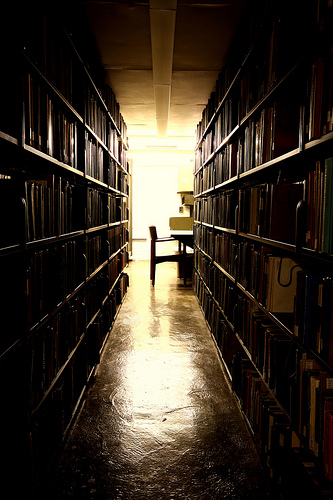
A couple of years later, I gained access to the even larger graduate library at Cornell, and, as a scholarly researcher, I’ve since been able to explore some of our nation’s finest archives, including the Library of Congress (the stacks are off-limits, there). But I will still never forget that first moment when I stumbled on the actual book collection of Uris Library and discovered that the world was much, much bigger than I had ever anticipated. Oddly, perhaps, I still have a love not only for books but for rows of books. When you see photos of college libraries, there are usually interior shots that attempt to convey the majesty of an aisle in the stacks, with two rows of books converging at a distant point. But that’s only one piece of what can usually be apprehended—typically, there can be ten, or even twenty, aisles, extending across the breadth of one’s vision. And in bigger university libraries that happens on multiple floors. Together, the stacks of any library represent a mindbogglingly large ocean of books—of human knowledge—in which an earnest student might spend a lifetime exploring. And sitting in the stacks, literally immersed in print, is a kind of heaven on earth for some of us.
In my first week as a freshman, I managed enough gumption to enter Cornell’s main library for undergraduate students, Uris. It was quite impressive for someone who had only previously experienced the local public library. Built in 1891 in Romanesque style, the main door was appropriately intimidating, opening up into a main reference and circulation room. The “Dean Room,” as it was called, was a large sun-splashed basilica, with its center filled with tables and study carrels and its walls lined with books and paintings of Cornell’s forefathers and illustrious donors. It was much as I had imagined an Ivy League school’s library would look like; there was a reverent hush about the whole place, and people seemed to be seriously engaged in scholarship. In fact, I thought that this room was the library. It was about the same size as my entire town library back home and, while it didn’t have quite as many popular novels, it more than made up for that with its complete sets of encyclopedias and authoritative-looking reference guides to every possible subject in human history. I figured that was what college libraries were supposed to be all about.
![]() |
| Dean Room, ca. 1900. Div. of Rare and Manuscript Collections, Cornell U. Library |
When I took a deep breath and went through, I found that it led to a set of stairs, stairs that went down underground. Each floor had a landing and a door—B, 2B, etc.--one of which I finally decided to open, as nonchalantly as possible, of course. When I walked through the doorway, however, I suddenly found myself unable to breathe, for extending out before me were rows and rows of bookshelves. They seemed to reach infinitely beyond me into a vast dimly-lit space that seemed to have been carved deep into the earth. And all of them held books of every size and color. There were thousands of books—maybe hundreds of thousands. I was awestruck and somewhat baffled. I had never in my life seen so many volumes in one place before. Was I supposed to be here? What were these books doing, here, rather than upstairs in the library? Had I stumbled on some kind of secret warehouse under the campus?
Then another student came in. He politely walked past me, turned on one of the timer-lights at the end of a shelf a few yards away, and started to search for a book whose call number he had scribbled on a piece of scrap paper. It dawned on me that there was much to learn.
A couple of years later, I gained access to the even larger graduate library at Cornell, and, as a scholarly researcher, I’ve since been able to explore some of our nation’s finest archives, including the Library of Congress (the stacks are off-limits, there). But I will still never forget that first moment when I stumbled on the actual book collection of Uris Library and discovered that the world was much, much bigger than I had ever anticipated. Oddly, perhaps, I still have a love not only for books but for rows of books. When you see photos of college libraries, there are usually interior shots that attempt to convey the majesty of an aisle in the stacks, with two rows of books converging at a distant point. But that’s only one piece of what can usually be apprehended—typically, there can be ten, or even twenty, aisles, extending across the breadth of one’s vision. And in bigger university libraries that happens on multiple floors. Together, the stacks of any library represent a mindbogglingly large ocean of books—of human knowledge—in which an earnest student might spend a lifetime exploring. And sitting in the stacks, literally immersed in print, is a kind of heaven on earth for some of us.
![]() |
| Uris Library Stacks, Photo by Eflon. |
Subscribe to:
Posts (Atom)