Showing posts with label fandom. Show all posts

Saturday, March 2, 2013

Fans, Artists, Love, and Exchange

Punk has always challenged traditional models of artist-audience interaction, from DIY culture to the contradictions of the record industry selling rebellion against the record industry (for more on the latter, watch The Great Rock'n'Roll Swindle, then read Mary Harron's "McRock: Pop as a Commodity" in Facing the Music: A Pantheon Guide to Popular Culture, ed. by Simon Frith). The latest wrinkle in this thread of punk history is Amanda Palmer's innovative use of online culture, including Twitter and Kickstarter, to bypass the record industry and to ask fans directly to support her artistry. She explains her approach in a recent TED Talk, "The Art of Asking," which just went up online:


TED Talks are always a little awkward (I remember someone once tweeting that they are occasions "where business people and academics pretend to like one another" - who was that?), but this talk seemed awkward in a somewhat useful way, introducing the typically staid TED audience to the glories of edgy performance art and cabaret-punk. It has not been without controversy--last year, Palmer ran into some public criticism of her essentially anarchist business model in terms of paying guest musicians, and how she addresses this controversy in the TED talk has been a matter of further discussion in the blogosphere.

I am more interested, though, in what all this says about fandom and its place in the sales and marketing of music in the digital age. Are fans rebels or ultra consumers? What are the right and wrong ways to recognize their devotion? Who, if anyone, should own crowd-sourced work? How might such questions help us to rethink (or rediscover) the participatory nature of arts? There is a lot of thinking out there about these questions, of course, from Liza Potts' investigations of Palmer's fan base to Henry Jenkins' wide-ranging work on new media distribution to Lewis Hyde's thinking about gift culture and the commons. Looks like a good new undergraduate seminar, no?


Saturday, February 16, 2013

Fandom and the Public Sphere


In 2009, I talked with literary scholar Barbara Ryan about her ongoing project on Ben-Hur fans. She has been researching the political efficacy of Ben-Hur fandom and the complexities of the "citizen-audience," a term that has gained traction in media studies through the work of scholars like Richard Butsch, Joke Hermes, Toby Miller, etc. At the time, I wasn't fully aware of the specific ways that audience studies and citizenship studies had been intersecting, but now I'm starting to encounter this approach more broadly across both academic and professional fields.

The latest was a post by Peter Gutierrez last month on his Connect the Pop blog. Citing the ways that students' participation in online fandom might offer opportunities for learning not only "netiquette" and basic online safety but also civic engagement more broadly, Gutierrez offers K-12 students a "Digital Fandom Checklist" to help students think about the social contexts and commitments the shape their fandom. Given the strong, long-term, communal nature of fandom, Gutierrez notes, "Fans must take into account not just the short-term value of making a point or having the last word, but their long-term relationships with their fellow fans, both individually and generally, the latter insofar as they’re developing a reputation or history within fandom." He goes on to suggest that the particularly social framework of fandom can help students to begin to work out what it means to engage publicly with others in a democracy, especially around issues that are fraught with strong feelings, even tension.

Obviously, there is much much more to think about in terms of how media, audiencing, education, and civics have influenced one another, especially in different historical contexts of social transformation. But I like that Gutierrez has provided teachers, librarians, and students with a means to start analyzing and applying ideas emerging from the growing scholarship on citizenship and audience.


Saturday, March 3, 2012

Jimmy Fallon, Fan


Bruce Springsteen, The Roots, Tom Morello, and Jimmy Fallon ended Springsteen Week on Fallon's show by performing "The E Street Shuffle." The look on Jimmy's face as he plays cowbell is a testament to the joys of Springsteen fandom; he's not a famous talk show host and comedian anymore but an ordinary listener, living a dream.

Friday, February 24, 2012

Jeremy Lin, Race, and Sports Fandom


Kathleen Yep, author of Outside the Paint: When Basketball Ruled at the Chinese Playground, has an insightful post at North Philly Notes about Jeremy Lin mania. I have to admit that I'm not a basketball follower, so the constant headlines about Lin at first confused me ("Jenny Lind mania is back?! Fantastic!"), but the more I've learned, the more interesting the whole phenomenon has become for me in understanding the nature and history of sports audiencing. Fan studies has done a pretty good job of exploring the complexities of gender in the history of popular culture participation, from feminist theories of spectatorship and reading to male-bonding over Elvis, but race and ethnicity in fan history remain only superficially understood (see the recent special issue of Transformative Works and Cultures, Vol. 8, for analysis on the issue). Yep, drawing on her research of a fan community that has a long history but is still little known, points out that,
...Similar to today’s frenzy over Jeremy Lin, there were multiple currents of consumption in the late 1930s from not only the mostly non-Asian American spectators but also the Chinese American communities on the basketball tour. The invisible and marginalized Chinese Americans in the 1930s marveled at the visibility of players who looked like them. In 2012, Lin’s transcendence into a popular culture hero validates the vast network of Asian American players and basketball leagues that have thrived for over one hundred years.
In her post, Yep goes on to ask some questions that might make some fans uncomfortable but are nevertheless crucial in understanding not only the fandom for Lin but also fan participation in American sports in general: "How does the sports-industrial complex simultaneously circulate colorblind and hyperracialized rhetoric about African American, Chinese American, and white players? How are these circulations similar and different for the various racial groups yet part of a similar mechanism?"

Monday, February 6, 2012

Before "Fan": The Buff

When I started this blog last year, I talked about some of the slang terms used to refer to ardent audiences before the full emergence of the term "fan." I'd to explore those terms in posts over the next several months. For me, the etymological origins of early audience names provide an important window into the history of fandom; how people chose to label themselves, or were labelled by others, can enable us to see the personal and institutional forces at work in shaping the meanings of public participation.

First up: BUFF.

The origins of using "buff" to refer to a follower of an activity is complex. According to the Oxford English Dictionary (Second edition, 1989; online version December 2011), "buff," in one of its many definitions, is a shortened form of "buffalo," and was used in particular to refer to "leather made of buffalo hide; but usually applied to a very stout kind of leather made of ox-hide, dressed with oil, and having a characteristic fuzzy surface, and a dull whitish-yellow colour." This term for a particular color of leather was used to refer to certain military uniforms, to skin (naked="in the buff"), and to a variety of Cochin fowl.

"Buffs" were apparently those who, at the start of the 20th century, enthusiastically followed firefighters and fires. According to the Oxford, the term "buff" was applied to fire enthusiasts because they were reminiscent of the volunteer firefighters of New York in the mid-19th century, who wore buff-colored uniforms.

Foremen, Phoenix Fire Company, Charleston, SC, c. 1855.
However, Robert W. Masters, in his Pictorial History of Firefighting (quoted at www.legeros.com), states that,
The name "buff" originated in the hose-and-wagon days when enthusiasts with smoke-bleared eyes stood on icy street-corners for hours, huddled together tightly under buffalo robes. Firemen humorously named them "the buffaloes," which soon became "buff" for short. In some cities, they are known as "fire-fans" and in a few as "sparkies" but whatever they're called they're easily recognized. They're the boys who attend each major blaze with almost religious determination.
Whatever the exact origin, the term is meant to indicate a quality of participation in firefighting more generally. Early 20th century buffs, gathering at the scenes of fires, especially evoked the mid-19th century, when firefighting was an amateur volunteer effort, and male camaraderie and the fellowship of street culture trumped public service or efficiency in extinguishing blazes. In fact, before being professionalized in the 1860s, firefighting in American cities involved competing clubs of urban, working-class males, who often acted quite territorially in response to alarms and used the occasion of fires to settle debts, acquire capital, and just plain rumble. Martin Scorsese captured this well in Gangs of New York:


At some point in the early decades of the 20th century, when Progressives moved to codify and clean up civil and governmental services, the culture supporting buffs started to disappear. It's something I'm only beginning to explore, but as this article (from the Elmira, N.Y, newspaper, The Summary, Vol. XXXIII, No. 43, December 23, 1905, pg. 2) suggests, buffs were increasingly forbidden to enter the firehouse or "accompanying apparatus to fires":


I haven't been able to trace the word's history further. The usual slang dictionaries are failing me, so it will take some deep mining of literature, magazines, and other primary sources. For now, it appears that the eradication of buffs from the world of firefighting freed "buff" from any specificity of meaning and allowed it to be generalized as any form of "amateur enthusiasm." The only thing I would note is that "buff," at least in my own experience, is used in particular ways. It is acceptable to refer to a history buff, sports buff, science fiction buff, television buff, film buff, etc., but "LOST buff" or "Ornette Coleman buff" seem a misuse. The term connotes intense amateur involvement in types of cultural engagement rather than any specific text or figure.

In the end, I realize that "buff" is perhaps not quite a word that circulated before "fan"--the two terms seemed to have moved out from their respective pockets of American society (firefighting and baseball) around the same time in the 1900s. But any alternate word for "fan," whether parallel or antecedent, is intriguing. It widens the scope of audience behavior and gives us a stronger basis for understanding its history.

Friday, January 27, 2012

Chuck Fans

Great post over at the Monkey See blog today by Linda Holmes on the ways that "Chuck" fans challenged the usual assumptions about producer-audience relationships in television. As she writes, "It's a common internet truism that if you're not paying for ad-supported media, you're not the customer — you, as an eyeball to be advertised to, are the product. It's most commonly said about services like Facebook, but it's just as true of ad-supported television. And Chuck fans, in their businesslike enthusiasm, sold themselves as a product." Specifically, to Subway:


Frankfurt School-inspired critiques of fandom sometimes depend on rather narrow notions of producer hegemony: the "culture industry" manipulates; consumers are directly duped or resistant. The case of "Chuck," as Holmes points out, offers a slightly different understanding of who is negotiating with whom and why. It reminds me, actually, of examples of fans embracing alleged manipulative frameworks of exchange and taking perverse pleasure in that "complicity"--from the willingly humbugged visitors to Barnum's Museum in the 1840s to the self-loathing/loving of Sex Pistols fans. (For more on this sort of complexity, see what remains, in my view, one of the best pieces of writing on the topic, Mary Harron's "McRock: Pop as Commodity," in Simon Frith, ed., Facing the Music, 1988).

At any rate, the pop pleasures of "Chuck" end tonight. But pop pleasure will endure.

Thursday, January 19, 2012

Battlestar Galactica


The television show “Battlestar Galactica” ended in 2009, but I never had cable, so I’m catching up now on Netflix. I’m watching it a lot. In fact, it’s the only thing I’ve been watching over the past month, a behavior that, in a mysterious coincidence pointed out by my friend David Ressel, was recently parodied on the brilliant comedy show “Portlandia.”


I’ve been making the argument to my family that “Battlestar Galactica” is extraordinary television, that the writing and characterization is amazing, that you have to absorb yourself in the episodes in order to understand the multiple levels of meaning, that Edward James Olmos is in it, that it’s not really cheesy science fiction like the original series in the 1970s but rather a profound commentary on the War in Iraq, etc., etc. Reality, of course, is that I used the same intensity to watch “Mary Tyler Moore” reruns in high school and, later, “The Young and Restless,” “China Beach,” and others. In fact, I’ve done this all my life. I have never really just “watched television,” simply doing the act of sitting and seeing whatever was on. I “get into” a show and watch it with focus and enthusiasm. Talk about being on the "edge of your seat"--sometimes I can't help but stand near the screen while a favorite show is on. (Actually, that started because the antenna reception on our TV used to be really bad for certain stations, and you had to get close to hear and make out the shapes in the periodic fuzziness, but still....). I suppose I have what you might call a fan-approach to viewing.

Two things that have come from my recent BG fandom:

1. Non-fans may find this odd, but the characters and plot-lines of these shows have affected me; they have become a part of my thinking and somehow woven into my accumulation of experiences. They crop up at different moments and shape how I understand things. Recently, for instance, biotechnologist Juan Enriquez visited RISD and gave a scintillating talk on the human genome and the ways in which cloning and manipulation of genetic code might aid medical science. When the discussion turned to ethics, I immediately thought, “Just look at what happened with the Cylons!” Sure, that’s the nerdiest thing you might hear today. But it was there.

2. I'm not sure what I think anymore about spoilers. During the days of the “LOST” broadcast, I wholeheartedly embraced the online world of Lostpedia and avidly moved around on discussion boards, like The Fuselage or DarkUFO, before and after every episode to try and crack the mysteries of LOST’s mythology. This time around, though, with "Battlestar Galactica," I have resisted. With "LOST," there was a sense of camaraderie and engagement in spoiling the series as it was happening. As Jonathan Gray and Jason Mittell have suggested, spoiler culture was very much a part of Lost’s “operational aesthetics.” That may have been true, too, of "Battlestar Galactica," but in my engagement with it, now--after the fact of its broadcast serialization and with the answers to its mysteries readily available online--I feel the need to protect myself from those who have already watched it or know about it. When family members teasingly said that they had gone online and knew how the series ended, I covered my ears and fled. I don’t want to know how it ends, or who betrays whom next. This is not so much about eschewing extra-textual pleasures but seems instead about the deferred timing of my viewing experience. The series is functioning differently for me now, as a lone viewer, than it might have if I had watched it with others across the world when it originally aired. Or, maybe it’s just because I’m less interested in the “puzzle” of human-cylon history than in its characters’ developing relationships. I don't know.

I’m not big on extended self-examination, especially on a blog, so I’ll just stop now and say that this has me thinking. What are the various ways in which fans are managing their viewing experiences in this new age of media access? Are there real generational differences (broadcast/post-broadcast TV) that govern how we understand a series, or is it more appropriate to locate diverse engagement as more deeply rooted in individual preference? (After all, there has always been the divide between those who, say, read the conclusion of a mystery novel first and those who prefer to read with naivete). More broadly, what kinds of historical and personal circumstances govern how a person might choose to engage a text?


Saturday, December 31, 2011

Favorite Historical Fan Studies, 2011

While I have not covered every book in fan studies that has come out in the past year, I have encountered quite a few good reads in fan history. It really is time for fan studies to expand beyond the idea that fandom is simply rooted in the “popular media” of the 20th century. As many of these books and articles show, those with enthusiastic devotion to public cultural figures and forms, whom sportswriters first called “fans” in the 1890s, have been around for centuries. There were no “fans” before 1890, but there were amateurs, beggars, boomers, buffs, bugs, connoisseurs, devotees, dilettantes, enthusiasts, fanatics, the fancy, fiends, gluttons, habitués, heads, hounds, kranks, lions, longhairs, lovers, maniacs, matinee girls, nuts, rooters, Lisztians, Wagnerians, and more.

Here are some of my favorite historical fandom books for 2011. They all engagingly offer new insights into the practices of ardent audiencing, over time and across sports, theater, literature, and music.


Lapham’s Quarterly: Celebrity
In many ways an update of Leo Braudy’s Frenzy of Renown (1988) this special issue of Lapham’s Quarterly (Winter 2011) sought to collect primary and secondary sources about celebrity in history, from Cicero’s complaints about the demands of fame to Steve Martin’s tongue-in-cheek form-letter response to fan mail. I found Lapham’s opening essay a bit too dependent on Daniel Boorstin’s negative assessment of the media’s role in modern life; I would say that the overall skepticism of the issue’s interpretive essays stem from a Frankfurt School-like focus on the productive machinations of celebrity rather than the varied activities of media reception and their meaning in the daily lives of fans. The issue nevertheless offers very good writing and a useful compendium of audiences, culture, and desire over the past several centuries.


John Thorn, Baseball in the Garden of Eden: The Secret History of the Early Game
Written by the Official Baseball Historian for Major League Baseball, this book is a detailed and fascinating account of the early days of baseball in the nineteenth century, including some nice tidbits on fandom, from audiences’ frequent interference in games and penchant for gambling (which, in part, explains rooters’ fascination with statistics) to DeWolf’s Hopper’s popularization of “Casey at Bat” to the status of a cultural mania in 1888. Most interesting is the many ways in which team owners sought to make the game appeal to fans through all kinds of changes to games rules, as well as sales gimmicks. Not directly about historical audiences, it nonetheless is a very readable history of the entire culture of baseball and fans central place in it.


Judith Pascoe, The Sarah Siddons Audio Files
One of the pleasures of writing this blog has been learning about fan research outside of my own realm of expertise. Not only did I learn about all the work out there on historical readers or early sports but also on theater audiences. Judith Pascoe’s book, which was released in May 2011, enthusiastically outlines the appeal of British actress Sarah Siddons, who was the star of London theatre in the late eighteenth century and whose aural presence fascinated Romantic poets and philosophers. Pascoe not only outlines the culture of Siddons’s celebrity, but also the trials of her own learning. Historiography has never been so fun.


Daphne Carr, Pretty Hate Machine
Okay, so the history here is fairly recent, but this is still an incisive, daring, and sometimes quite moving analysis of rock fandom in the 1990s, based on Nine Inch Nails’ 1989 album, Pretty Hate Machine. Rather than merely offering a critical appreciation of the album’s songs or a history of the album’s creative genesis, Carr locates PHM’s most profound significance in what it has meant to the fans who bought and listened to it. Her thinking about Trent Reznor’s is deepened by the transcripts of interviews with fans of various ages and backgrounds, as well as interpretive surveys of the industrial decay of north-central Ohio since the 1960s. Personally, I never really “got” NIN, but I got this.


Emily Satterwhite, Dear Appalachia
Satterwhite examines fan mail from readers of Appalachian-set fiction from 1878-2003 and identifies the ways in which such fiction serves to affirm readers’ imagined understanding of the region as a “rural, rooted place populated by simple whites with a rich cultural heritage protected from mass culture.” The ways in which this romantic construction of “authentic Appalachia” has worked for fans over the past century (from the Gilded Age to the Neo-Gilded Age of the 1980s) is not without controversy (Satterwhite acknowledges that it reinforces “simplistic versions of the region that celebrate whiteness, glorify Americanness, and figure primitive people the world over as in need of the expert guidance of well-to-do Americans”). But Satterwhite also sensitively accounts for the ways in which regional fiction engenders its own kind of fandom for the idea of a place.

Still left to read:
Claudio E. Benzecry, The Opera Fanatic: Ethnography of An Obsession
Amy Blair, Reading Up: Middle-Class Readers and the Culture of Success in the Early Twentieth-Century United States
Nancy Newman, Good Music for a Free People: The Germania Musical Society in Nineteenth-Century America

Looking forward to:
Andre Millard, Beatlemania: Technology, Business, and Teen Culture in Cold War America

Saturday, November 19, 2011

Catching Up


I must apologize for not posting very much recently. It's been a demanding couple of months at work, and finding time to blog has been a challenge. I'm hoping to revive things; as a start, I'd like to highlight some recent activity and correspondence.

Robert Burke Warren wrote to share a piece he had written on R.E.M. for The Rumpus. I had previously noted Warren's engaging reflections on his fandom for Paul McCartney; this piece is equally compelling, weaving reminiscences about R.E.M. with a moving account of personal friendship and loss. You don't have to like or dislike R.E.M. to appreciate his articulation of the profound associations and meanings that popular music can provide us in our daily lives. From now on, when people come up to me and say, with a conspiratorial wink, "So you teach popular music at the college level? What do you talk about for a whole semester?", I'm directing them here.

Scott Thompson, a former student and now guitarist/banjoist with the band Tallahassee, wrote to share a feature on booing at Freakonomics.com. It reminded me that the expression of audience displeasure is as important as audience pleasure in understanding fandom and enthusiasm. The podcast notes that booing is more appropriate in some contexts (sports) than others (Broadway), but also that the sovereignty of audience members to express themselves itself has been significantly reduced since the 19th century (Richard Butsch's work gets a nod, here). I think a deeper discussion about why such expression changed historically would have helped provide some stronger conclusions. And it also raises all kinds of questions about the sound of booing (why "boo" not "bah" or "buh"?) and the physicality of that action--versus clapping, for instance. In general, why do audiences primarily use the sonic capabilities of their bodies to send messages to performers onstage?

Ralph Rosen, at University of Pennsylvania, wrote to ask about my thoughts on Platonic conceptions of fans (or "lovers of sights and lovers of sounds"). His note made me realize the extent to which my own American studies background might be isolating me from wider global and historical conversations about fandom. In particular, I've been enjoying an essay Rosen wrote for Playing Around Aristophanes: Essays in Celebration of the Completion of the Edition of the Comedies of Aristophanes by Alan Sommerstein, ed. by Lynn Kozak and John Rich (Aris & Philips, 2006: 27-47), titled "Aristophanes, Fandom, and the Classicizing of Greek Tragedy." He explores how Greek tragic poets acquired a literary legacy in a time when performances were ephemeral and not made into texts that could establish a measurable "readership." His answer is that devoted audiences, post-performance, played a significant part in creating a poet's legacy:
I would suggest that the key players in the classicizing process are what, for lack of more technical term, I would call 'fans', although other synonyms would work just as well: devotees, cognoscenti, etc. Before a performative work is fixed and circulated as a text, it will amass a coterie of devotees for whom, for whatever reasons (and there may be many), the works have special resonance. As I noted above, however, for a work to endure, it requires some measure of iterability, even if this means simply some mechanism by which the memory of the event and its author are kept alive. Fans provide this service well in advance of any formal means of mechanical reproduction, for they will take the work seriously enough to continue discussing it among themselves and to proselytize among skeptics about the virtues of their chosen heroes. (32)
Finally, I noticed that Jennifer L. Brady has an essay about enthusiastic readers of Susan Warner's The Wide, Wide World over at Commonplace. An engaging exploration of fan letters to Warner in the early 19th century, Brady shows how "Warner's fan letters can tell us why readers like (and unlike) Alice's Admirer devoured The Wide, Wide World, why they formed deep emotional bonds with characters whom they knew to be fictional, and why they chose to bare their souls in letters to a writer whom they would never meet. They can tell us why particular readers felt so strongly about this novel and why, for some, their attachment to it endured over decades. These letters can give us fresh perspective, then, on sentimental novels, ordinary readers, and fandom in the nineteenth century—and they do so by recording the varied ways that some ordinary readers and a sentimental author were brought together by loving The Wide, Wide World." Scholarship that draws on historical fan letters is growing in a number of fields; I would add Brady's work, here, with that of Barbara Ryan (see Reading Acts, as well as her new project on Ben-Hur), Courtney Bates (see her article on Willa Cather fans in Transformative Works), Emily Satterwhite (Dear Appalachia: Readers, Identity, and Popular Fiction Since 1878, which is coming out any day now), as well as Marsha Orgeron's work on fans of movie stars like Clara Bow (Hollywood Ambitions).

That's it for me this weekend. Back soon.

Saturday, September 24, 2011

The New Economy of Attention


I started out a recent speech by noting the ways in which fandom has changed since the advent of social media, saying:
These are interesting times for reception theorists, especially those that study fandom. Fandom represents an extra-ordinary form of audiencing, including everything from emotional attachment to performers to obsessive collecting. However, the nature of fandom’s extra-ordinariness has changed a great deal in the past several decades thanks to the advent of the Internet and digital production. It seems today that previously “abnormal” fan practices have not only become more and more accepted but also explicitly supported and nurtured by new technologies and re-framed by niche marketing. Simply: we live in an age in which “following” a stranger because you “like” them is not creepy, but rather represents a harmless form of networking. As Twitter encourages us, "Follow your interests."
I didn't say much more than that about fandom's current trajectory, veering instead into a consideration of this change for those of us interested in writing fandom's history. However, a recent article by Esther Dyson, "Attention Must Be Paid," has made me think again about just how social media has changed the value system behind what we call "fandom."

I thought Dyson's essay, subtitled, "How the Internet is Changing How People Listen," was going to be an analysis of listening in the 21st century, one of my favorite topics, but it turned out to be an outline of how companies might commodify attention in the digital age. The paragraph that made me sit up a little straighter was:
The Internet is changing the economics of attention by fostering peer-to-peer interactions. People used to pay attention to those around them and to "stars." Now, they spend lots of time online paying attention to people they haven't met. And, increasingly, individuals go online to get attention, not to give it. Accordingly, companies need to learn how to give customers the attention that they crave, rather than demanding customers' attention and then charging them extra for the attention that their brand commands.
I relied on rather old categories of "normal/abnormal" in thinking about the re-framing of fandom on Facebook and Twitter. Dyson, however, suggests something even more subversive than the mere acceptance of fannish attention: she's saying that the economy of attention has changed so that what is commodified is not the cultural performance, event, or product to which one might attend but rather the very act of attending. In other words, in the world of social media, fans and fandom have become products; fans consume each other, with stars and cultural producers playing a supporting role.

Yow. This reminds me of late 18th and early 19th century opera and musical theater in the U.S., when people went to performances to see and be seen, and what happened "on stage" was secondary. Maybe cultural behavior in our society has come full circle. Except this time, of course, there are companies ready to "monetize" it all. We'll see.

Monday, September 12, 2011

Reception Study Society Conference 2011

I just finished a four-day stint at the biennial conference of the Reception Study Society, where I gave a keynote talk on the need for a more precisely comparative account of enthusiastic audiences in history. I argued that new research on pre-1900 fan-like subcultures (from kranks to matinee girls), as well as on the wider discourses of monomania, enthusiasm, and agency in the mid- to late-19th century, will help scholars to better understand how exactly fandom became a explanatory discourse for certain kinds of audiencing in modern society.

I saw lots of great presentations, from Emily Satterwhite’s discussion of fan mail about Christy (based on research from her new book) and Gillian Silverman’s analysis of 19th century reading as a “technology of intimacy” to Melissa Click’s study of adult and teen Twilight fans and Pedro Curi’s outline of the various ways in which Brazilian fans ‘Brazilianize’ American TV shows they see on the internet. Jonathan Gray also gave an amusing and provocative overview of this theory of “paratexts,” arguing that packaging, marketing, merchandising, and spinoffs of books and television shows must always be part of the “texts” that we study, since, for some people, paratexts are the texts with which they engage most. In all, a very satisfying weekend, sharing ideas with people who think similarly about culture and its meaning.

Next up: the fall semester.

Tuesday, August 30, 2011

Some Fan Studies Before "Fan Studies"

In the past, I've written about some of the classics of fan studies. In this post, I want to briefly highlight a few books that do not explicitly address fandom but nevertheless deserve mention as works of scholarship that have addressed the subject of devoted or enthusiastic audiences. For me, these works all had to do with reading; in the late 1980s, I was a newly-graduated English major, growing tired of great authors and works (I think I had read Moby Dick five times at that point), and becoming more and more interested in marginal aspects of literary studies: the physical nature of books, the business of publishing, and, especially, the history of readers. To my astonishment, I found a number of fairly recent works on those subject. I wasn't studying fandom when I first encountered these books, but once I did start to think about fans a bit later, in the context of popular music, the book's arguments and stories came back to me, providing a rush of intriguing parallels, echoes, and connections. Rousseau readers and Springsteen fans, for example, separated by centuries, seemed to be thinking in similar ways--how could that be? It's something I'm still thinking about twenty years later.

Robert Darnton, "Readers Respond to Rousseau: The Fabrication of Romantic Sensitivity" (1984). This essay appeared in Darnton's collection on French cultural history, The Great Cat Massacre. Drawing on a collection of letters between Jean Ranson, a French merchant book collector, and a Swiss publisher, Darnton unearthed Ranson's fascination with the work of Jean-Jacques Rousseau, whom Ranson called "L'ami Jean-Jacques" (my friend, Jean-Jacques) even though, as Darnton noted, he "had never met" Rousseau and could only know him through the printed word. This relationship was the set-up for an amazing analysis of what Darnton calls "Rousseauistic reading," a new way of understanding the world of a novel as an intimate representation of an author's emotional being. In some of the funniest passages, Darnton talked about Rousseau's alarm about the new type of readers he created; apparently Rousseau had to install a trap door in his home to escape the many admirers who sought him out for heart-to-heart chats and expressions of gratitude after reading books like La Nouvelle Heloise. In the described shift toward a Romantic "sharing of selfhood," I started to see patterns that pre-modelled modern fans' relationships to media celebrities.

Susan Stewart, On Longing: Narratives of the Miniature, the Gigantic, the Souvenir, the Collection (1984). Susan Stewart's On Longing was an extraordinary work of cultural theory, rooted in literary studies but also ranging outward to include giant myths, doll houses, and book collectors. For me, it was one of the first theoretical works I had encountered about the sometimes intense relationships that people develop with objects and performances. No one I knew was writing about that particular kind of desire in 1984, and her arguments about the ways in which we make sense of the world around us by sorting our experiences and manipulating time and space through narrative gave me a stronger sense of the existential gravity behind reading: it was about much more than mere entertainment or cultural refinement. Stewart's final essay on collecting directly addressed what I later recognized as a primary fan practice. She showed how collectors variously layer objects with complex narratives of authenticity, nostalgia, and the self. The book's post-structuralist language and Lacanian references were, at first, a bit impenetrable for me, but Stewart, a poet, still had a knack for thought-provoking declarations: "The printed text is cinematic before the invention of cinema." "Although reading may give form to time, it does not count in time; it leaves no trace; its product is invisible." "The souvenir must be removed from its context in order to serve as a trace of it, but it must also be restored through narrative and/or reverie." I still go back to it.

Janice Radway, Reading the Romance: Women, Patriarchy, and Popular Literature (1984). In one of my first jobs (1985-86 or so), I worked at Barnes & Noble, where I was in charge of, among other things, shelving the new series arrivals in the romance section and shipping older, unsold editions back to the publishers. I distinctly remember the customers who came into the store regularly to buy romance books and who seemed to have a deep knowledge of the nuances between Harlequin lines and other competing series. I wanted to talk to these customers more about their obvious passion for books and reading, but it was too awkward for me. Radway did. Published in 1984, Radway's pioneering research featured interviews with a group of women romance readers. Like Stewart's work, Radway was, at one level, rescuing a denigrated form of popular culture by showing the ways in which it facilitated meaning-making in everyday life; as a feminist, her goal was to find out how such books helped women to negotiate patriarchal society. There were problems with the research, at least in terms of ethnographic practice (Radway was ultimately unwilling to take the women's articulation of their own lives at face value, asserting their patriarchal oppression and then wrestling with how to interpret romance reading in light of that), but her work nevertheless showed me how fieldwork--typical for anthropology abroad rather than at home--might serve as a legitimate method in the investigation of popular culture fandom. I taught this book for many years in a seminar on audience studies, and it remains influential.

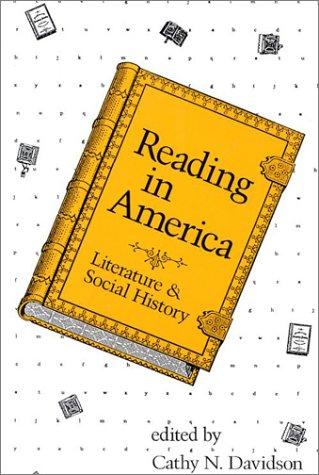
Cathy N. Davidson, "The Life and Times of Charlotte Temple" (1989). This essay, which appeared in a collection edited by Davidson called Reading in America. I could talk about Davidson's equally compelling Revolution and the Word (1984), which more broadly addressed the power of novel-reading in the new republic, but this essay was one of the first that I had encountered that analyzed, head-on, the ways in which a single novel might change the lives of ordinary readers. The novel was Susanna Rowson's Charlotte Temple, a cautionary tale of a young woman's fall from virtue, and one of early America's bestsellers. Davidson pointed out that readers developed such intensely emotional reactions to the story and the character of Charlotte that they believed that the sensational story was true. Someone even placed a tombstone for Charlotte in the churchyard of New York City's Trinity Church, signifying readers' blurring of the lines between fiction and reality, and by the 1850s, weeping readers (men and women, working and middle-class) regularly made pilgrimages to the churchyard to pay their respects. Besides suggesting the ways in which readers worked to sustain the world of a narrative outside of their encounters with that narrative (much as music or theater fans stay in "audience" mode long after performances are over), the notion of pilgrimage really resonated with me. I knew fans for Springsteen who did the same thing as Charlotte Temple readers, imbuing real places with new layers of meaning known only to them.

Sunday, August 14, 2011

Pleasures of Reading


I just finished Alan Jacobs's new book, The Pleasures of Reading in an Age of Distraction. It has been getting some press attention lately, with a review in the Wall Street Journal, as well as an adaptation in the Chronicle of Higher Education. 

I have to admit that I was a little worried about the title, at first glance. While Jacobs is decidely not a member of the "turn off your computer" camp (or their predecessors, the "turn off your TV" crowd), who assume a negative causal relationship between media engagement and the quality of one's reading, he does point to the ways in which the the obligations of educated refinement (promoted especially in academia), as well as the information triaging necessitated by the hyper-culture of social media, create a great deal of anxiety about sustained, deep, and enthusiastic reading. We feel we should get lost in a book, but we can't. When we do, it feels a little strange. 

First, kudos to Jacobs for trying to capture the pleasures of reading (even though he admits that it is truly impossible to convey what a "page-turner" feels like). I certainly love books in they ways that Jacobs describes and can attest to the ways in which chance encounters with individual works have changed my life. I also appreciate the ways in which he attempts to situate that joy in the context of contemporary culture, assuaging lack of confidence about "reading properly" or about "reading deeply" by encouraging "reading at whim," that is, to fully embrace the experiences of reading that feel right, no matter the dictates of taste or the competing demands on one's attention. As he writes, "The book that simply demands to be read, for no good reason, is asking us to change our lives by putting aside what we usually think of as good reasons. It's asking us to stop calculating. It's asking us to do something for the plain old delight and interest of it, not because we can justify its place on the mental spreadsheet or accounting ledger (like the one Benjamin Franklin kept) by which we tote up the value of our actions" (16).

This is, as he suggests, not so much the function of a "good book" itself, but rather of one's general approach to the ecstatic potential of any encounter with a book. That is, we read deeply when we accept, or, at least, leave ourselves open to the premise that "books are the natural and inevitable and permanent means of being absorbed in something other than the self" (116). While Jacobs tends to talk about fandom as a kind of extremism, I'd suggest that this approach to books more accurately describes fandom as it is experienced: a recognition of a performer or performance (including "texts" of all kinds--books, movies, music, art, etc.) as having the ongoing potential to move, transform, connect, and otherwise wrest one from torpor. As Tia Denora put it, we engage in culture to "aesthetize ourselves." Fan engagement can sometimes appear aberrant (when fans embrace a work that is not canonical) and it can sometimes appear obsessive (when fans allegedly spend too much time engaging one work or author), but its mode of hopeful enthusiastic engagement is unabashedly catholic and deeply pleasurable, often facilitating a kind of lasting and meaningful learning that cannot be attained through other means.

Jacobs focuses a bit too much for my taste on quietude, on shutting down cultural "distraction," though I do recognize the need for many to carve out time for sustained reading. Rather than turning things off, I always encourage my students to simply treat books differently. I tell them, first, to understand reading as not simply a mechanical movement of eyes over a page, but rather as the development of a relationship, much like one you might develop with a person. "Reading," in fact, is always a complex and unique story of encounter, flirtation, acquaintance, and knowing. It's a little weird, but I ask students to carry their books around with them, place them nearby when they are not reading (on their drawing desks, at the dinner table, etc.), and, in Whitman-esque fashion, get to know them, even unopened, as daily companions and even as old friends. I hope, this, in turn, leads to a reformation in their minds of what a book is. When some complain that a book is "dry" or "boring," or even when they assert that a book is "exciting," I tell them that, in fact, it is their relationship to the book that is "dry" or "boring" or "exciting." Books are just books; their meaning and transformative power depend on how readers bring them to life. 

These are just some of my own techniques for keeping the pleasures of reading alive; on the whole, I think Jacobs and I are far more in sync than apart. Perhaps more so than Jacobs, I sense that all this might be futile: maybe the pleasures of sustained reading are indeed being erased and are likely to be lost to us in the future. But, really, I don't know. Like Jacobs--and, I think, teachers in general--I hopefully and defiantly try to keep it alive anyway. (The cliché of teacher-motivation is true: "If I can just reach one person....").

I wish you all absorbing and transformative reading.

Sunday, July 31, 2011

Fandom Before the Internet: The Fan Club Directory


How did fans keep up with the latest news, enthuse with friends, and sustain their enthusiasms before the Web, Facebook, and Twitter? We take it for granted that a "community" can be non-geographic these days, but before the Internet that concept was not wholly accepted; a community without shared experiences and practices in a particular place felt considerably weaker, more like a loose association ("the international community," "the scientific community") than one based in a neighborhood or other locality. Nevertheless, fans' intense feelings of connection motivated them to seek one another out and attempt to build a sense of community, something that they did mostly with regular face-to-face meetings (at conventions, performances, and parties) and print communication (fanzines, newsletters, and private letters). Much of this activity, especially for fans of lesser-known stars and art forms, was DIY, and it required an amazing amount of labor and love. You really need a certain level of devotion to work at a job all day, manage a family, and then also spend your remaining time, night after night, doing the rather isolated work of collecting clippings, writing articles, compiling fan art, and mailing out photos and tapes to fellow fans.

I'll be exploring these aspects of fandom a bit more (and maybe compare them to today's practices), but for this post I just wanted to highlight an extraordinary publication, which is now defunct: The Fan Club Directory. Published between 1979 and 2002, the Directory was a two-staple, roughly 75-page booklet, produced annually by the National Association of Fan Clubs (NAFC). It listed alphabetically every fan club that elected, for free, to become a member of the NAFC, giving readers the U.S. mail address of the current president and/or contact person. The NAFC was an organization dedicated to representing "all fan clubs in all fields of entertainment," and so the listings in the Directory were unintentionally jarring: announcement of The Amazing Pudding, the fanzine for Pink Floyd, sat right across from the Annette Funicello fan club (both are listed alphabetically under "F"); "The Celestial Affiliation of Time Lords: A Time Travel Fan Organization" was next to the "Charlie Daniels Band Volunteers;" Elton John and Al Jolson were side by side. It read like a fantasy middle-school classroom before everybody went off to become famous in their various pockets of the world.


Some of the clubs were focused on stars or shows that I don't recognize anymore--Becky Hobbs, Secret Oktober, etc. But full-page breakouts were allotted for entertainment stars with more than one club, including Englebert Humperdinck, Tom Jones, Barry Manilow, and Elvis Presley. There seemed to be a mixture of both "official" fan clubs, run by an artist's management, and "unofficial," run by fans out of their homes. Of equal historical interest were the details in the Directory's ads. You could learn, for example, that The Flying Nun Fan Club "has been looking for the original hat and dress from 'The Flying Nun' for the 25th Anniversary." (One can only wonder: did they find it? What did they do with the artifacts?). Or that there was a new Keith Carradine Club in Gronau, Germany, "searching for new members who are interested in international contact with other Carradine fans all over Europe." Or that a group called "Operation Tribbles" helped to coordinate Star Trek clubs to donate stuffed "tribble" toys to people in rest homes, hospitals, and hospices around the world. In all, the Directory offered a heterogeneous slice of late 20th century popular culture in the English-speaking world. 

When I first received The Fan Club Directory in my mailbox back in 1993, I remember being amazed at how many clubs there were and how much work it must have been to bring that information together in one place. Of course, that was right at the dawn of the World Wide Web, when fans were just joining online "bulletin boards" and "discussion groups." Blanche Trinajstick, the Editor/Publisher of the Directory, retired from "fan club work" in 1992, stating that "for more than 30 years I have not known the meaning of 'spare time.'" Her successor, Linda Kaye, published the Directory for another decade before finally calling it quits in the face of the Internet explosion, which both made being a fan and communicating with other fans far easier and slowly eroded the usefulness of a printed directory. As Kaye wrote retrospectively: "While the NAFC provided a great service for a quarter of a century, the Internet made the task of keeping up with confirming the legitimacy of 'new' website clubs and responding to mountains of e-mail requests for fan information and clubs dealing with fans most of us have never heard of a burden too overwhelming to continue."

Yes, the Internet changed things. But I am wary of simply understanding technology as determining radically new kinds of human behavior. In fact, I see The Fan Club Directory as an important and necessary antecedent to today's social networking. While it is all but forgotten among the current iPod generation, I hope that at least it will be preserved (along with fanzines and other fans publications) as evidence of how enthusiasm in our culture has been continuously, as well as variously, organized.


Tuesday, July 26, 2011

A Fan's Perspective: McCartney as Dad


Musician Robert Burke Warren has a thoughtful article over at Paste on his fandom for Paul McCartney. His reflection was prompted by McCartney's recent concert at Yankee Stadium, which he describes as a powerful show for the audience gathered. As he put it, "I was a riot of sensation and notion; chill bumps, laughter, singing with strangers—all messy, uncool spillage from an open heart." Part of that spillage was realizing the extent to which his fandom has, in some way, always been about McCartney as a father figure. "I was struck" he wrote about the finish of the concert, "by the amount of families, some of whom carried sleeping children out of the still-charged stadium. This had been a family event. Of course."

In public discourse, fandom is typically reduced to stalking or silly teenage enthusiasm. (Certainly, the story of Beatlemania was always centered on screaming teenage girls). But, here, Warren shows us that such stereotypes of fandom fail to get at the consequences of individuals' long-term attachments to public performers. Devotedly following a star's career over time--for years or decades--transforms most people's initial attraction, however motivated, into a significant force for meaning in daily life. Songs get attached to personal memories and values, lyrics begin to illuminate diverse circumstances, concerts start to feel less like entertainment events and more like repeated rituals of affirmation.

McCartney as an iconic dad? Sure: for Warren. Fandom is complicated--as complicated as the diverse experiences and life stories of the millions of people who identify as fans. Especially in our complex culture, in which intense fame vies with widespread anonymity, fandom works not only as a framework for consumption but also as a technology of the self. Few have really bothered to articulate the latter, but it is obvious when someone does.

Thursday, July 21, 2011

Latest Work on Opera Fans

Looks like I need to catch up on a recent publication: Claudio Benzecry's The Opera Fanatic: Ethnography of an Obsession. Jessa Crispin has a review (combined, somewhat oddly, with Wayne Koestenbaum's now 18-year-old The Queen's Throat) over at the Smart Set, including a reflection on her own fandom. She focuses on the importance of love as an independent organizing force for fan behavior, a motivation that, in most post 1970s cultural studies work on fandom, is de-emphasized in favor of social and political meanings involving subculture, hegemony, resistance, etc.

I assume this focus is the case with Benzecry's book, as well; my cursory reading of the introduction indicates that he is interested in staking a claim for understanding opera fandom outside of Pierre Bourdieu's highly influential ideas in Distinction: A Social Critique of the Judgement of Taste. All good. It might be nice if, on occasion, sociologists were to consider seriously the growing work on music fandom in disciplines outside of sociology (I had the same complaint about Tia Denora's otherwise brilliant Music in Everyday Life), but I'm open to Benzecry's fieldwork insights and hope to read it thoroughly soon.

Monday, July 11, 2011

Lost in Harry Potter


The final Harry Potter film opens this weekend, and a York farmer has commemorated the event with an impressively complex and artful maze. Landscape art seems to be the province of British Potter fans, who have done this sort of thing before.


Of course, displaying one's investment in Harry Potter with a maze has deeper meanings for those familiar with the books, since a maze featured prominently in Harry Potter and the Goblet of Fire.

Saturday, July 2, 2011

Becoming a Fan of Mahler

Michael Tilson Thomas at Mahler's house in Maiernnig, Austria.
In Tramps Like Us, I wrote about the "becoming-a-fan" stories shared among Bruce Springsteen fans. They were essentially conversion narratives, articulating an intense realization of Springsteen's music. Fans reported that their discovery of Springsteen felt like a lasting dividing line in their lives, creating a transformative "before-and-after" that didn't exist previous to their conversion experiences.

I was reminded of such becoming-a-fan stories last night while watching Michael Tilson Thomas on public television hosting a documentary on composer Gustav Mahler. Mahler is an interesting figure in his own right, but what was most engaging about the program (part of the San Francisco Symphony's "Keeping Score" series) was Thomas's palpable enthusiasm for the man and his music. He just seemed so delighted to be talking about Mahler with you, the viewer, it was almost impossible not to get swept up in the whole thing. And unlike many documentaries on composers, which over-emphasize the otherworldly talent of an individual, this one actually opened with a string of becoming-a-fan stories from listeners: Thomas, Susan Graham, Frank Gehry, Patrick Stewart, and Yo-Yo Ma. (Thomas also did an interview last year in which he told his Mahler becoming-a-fan story, noting at the :50 mark that "I divide my life between before I heard that recording...and after).

Springsteen fans share their stories of becoming-a-fan to both confirm their membership in a wider community and to help others, just discovering Springsteen, to frame their experiences in understandable ways. It seemed to me that Thomas was doing something similar, except for a television audience. Thomas used his passion for Mahler as a basis for organizing the program's content; it helped to make Mahler's greatness not simply an abstraction but real, relatable, felt. By earnestly offering his life-changing discovery of Mahler, he made himself a little vulnerable--not the distant scholar or elitist expert but someone who was unexpectedly blown away by a recording when he was thirteen years old. Personally, I've never really connected with Mahler's music, but encountering Thomas's obvious love for it made me want to go back and listen again.

PBS's typical soft-spoken erudition isn't going to bring new audiences to Mahler, but Thomas's fandom just might.

Thursday, June 2, 2011

Journals Focusing on Music, Audiences, and Fandom

I'm on a slight break while I finish up the semester. In the meantime, check out what my colleagues from England are up to! Dr. Lucy Bennett is guest-editing a special issue of the journal Participations, on music and audiences, while Dr. Mark Duffett is guest-editing a special issue of Popular Music & Society, focusing on fandom. As an old fogey who remembers a time when human fans (instead of decorative fans or industrial blowers) were almost completely absent in scholarship, this is fantastic. There much to discuss--I hope that some of you out there will consider submitting a proposal. Each call for papers follows below.

Proposals are sought for a special issue of Participations: Journal of Audience and Reception Studies on music and audiences. The theme of this issue will be an examination of the music audience from a range of perspectives, with both theoretical and empirical research welcomed on all aspects of music and reception. The issue would also particularly be interested in proposals that consider music audiences in the context of debates over technology and the Internet, and in articles which focus on issues of genre, different music fan cultures, or the specifics and particularities of music audiences, due to contexts such as sexuality, generation or nationality.

Proposals are welcomed on, but not limited to, the following possible topics:

-Music fandom (s);
-Music audiences, technology and the Internet;
-Music audiences in regional, local, national and international contexts;
-Representations of, and audience responses to, gender and sexuality;
-Film, television and the music audience;
-Music taste(s) and genres;
-Responses to political engagement in music;
-Generational music audiences;
-Celebrity and stardom;
-The live music experience;
-Discussions of music engagement and meaning.

Please submit article proposals of no more than 300 words, along with a 200 word author biography to Dr Lucy Bennett (BennettL@cf.ac.uk) by 11 July 2011. Please also contact Lucy with any queries or requests for further information. Completed articles will have a submission deadline of 10 January 2012. Please note that Participations operates an open-refereeing policy. For more information see the website (http://www.participations.org).


Popular Music and Society invites article proposals for a new special issue. Fandom is both a personal expression of emotional conviction and a complex, changing, multi-faceted social phenomenon that now encompasses both online and offline activity. The study of fandom is a scholarly niche that exists at the intersection of a wide range of interests and connections. It can be contextualized by wider media research (theory by scholars such as Henry Jenkins and Matt Hills; reception analysis; celebrity studies; ethnography; subcultural theory) and by direct research into popular music culture (ethnomusicology; research on listening; live music audiences; studies of music in everyday life). We invite papers with themes that may include, but are not limited to:

• Fans as musicians / musicians as fans
• The consumer marketplace, perceptions of the music industry
• Collecting, listening, and other fan practices
• Live music, local scenes, and fandom as living culture
• Stereotyping, self-awareness, media representation, literature and fiction
• Fandom and social identities (such as gender, age, disability, race)
• Methodology, research practice, cultural theory
• Histories, critiques of fandom as a response to mass culture
• Taste, cultural capital, and the canon
• Online participatory cultures
• Case studies and ethnographies; personal narratives, memories, and investments
• Stardom and celebrity; identification, reading, and textuality
• Legacies of key representations (e.g., Fred Vermorel and Judy Vermorel's book Starlust)
• Modernity, religion, pathology, and the "cult" analogy
• Differing fandoms / specific music genres
• The fan community: insiders, outsiders, and the "ordinary" audience
• Fan culture and the paradigm of performance
• The uses of fandom: political activism, heritage, and tourism
• Fandom, the family, and / or the life cycle

Send proposals of up to 500 words in the first instance. Contributions will be peer-reviewed for potential inclusion in the main section of the journal. Polemical papers will also be considered for inclusion in the Forum section. Indicate the name under which you would wish to be published, your professional/academic affiliations, a postal address, and preferred email contact. Deadline for submission of proposals is October 31, 2011. We would hope to commission articles by December 31, 2011, and deadline for submission of the articles will be July 31, 2012. Please email proposals to guest editor Mark Duffett at m.duffett@chester.ac.uk

Saturday, May 28, 2011

Fans Celebrating After a Win

The Bruins won the playoffs last night; they haven't been in the running for the Stanley Cup since 1990. This morning, the Boston Globe released a video of fans celebrating. In many ways, it reminds me of a much older documentary, Heavy Metal Parking Lot, where fans, before a Judas Priest concert, gesture about their love of the band (and other bands) in front of the camera.


While there is definitely something about the camera that makes people act exaggeratedly, I also see the ways in which fans are continually extending the frame of performance outward in all directions: before and after the game, and beyond the seating area of the event, into the hallways leading out of the arena, into the parking lot, and even into the streets. Screaming one's excitement is one thing during a game or concert; it is quite another in the spaces of everyday life.

The historian in me longs for a motion picture of fans in 1900 doing this. Perhaps there's an early Edison short?