Monday, June 25, 2012

Singing in the Stands

A while ago on Twitter I had mentioned the need for an encyclopedia of fan rituals, across history and across cultural forms. Fellow Americanist Adam Golub suggested that a wiki-based source would be a means to start, a place where observers could note rituals they've discovered or witnessed and where a team of volunteer editors could sort the information. The social scientist in me would love the opportunities provided by simply gathering all that information in one place.

I'm thinking about this idea again in response to a piece by soccer writer Grant Wahl in the June 25th issue of Sports Illustrated. In "That's So Euro," Wahl recounts the various rites of European soccer fans, from the noble (Irish fans singing a haunting folk ballad in response to a loss; Lech Poznań fans "doing the Poznań, or groundhopping) to the ignoble (brawls, racist chants).


Wahl wonders whether the ways in which exposure to such rites among the growing numbers of English-language viewers for Euro 2012 might alter American sports spectatorship. As he notes, "NFL commissioner Roger Goodell marveled at European soccer, telling SI's Peter King that he would love to replicate the spontaneous songs and chants that are much a hallmark of the stadium experience as blaring music, Kiss Cams and T-shirt cannons are part of the NFL and other artificially enhanced U.S. sports." Wahl quotes a Polish-American Poznań fan, too, who questions whether refined middle-class NFL audiences would take to the expressive rituals of their European counterparts and whether hardcore fans might need some kind of special section in the stadium, where they might be led by a chant organizer.

It's kind of amusing that Goodell makes it sound like it was the fault of increasingly lethargic American audiences that they had to start showing candid audience shots on the jumbotron and playing AC/DC between plays. I'm not even a big sports person, yet even I have noticed how professional events have become more and more packaged for response, with choreographed fan "rituals" presented for consumption, like the brand name fast food that has taken over stadiums. The whole thing feels packaged like a commercial because, well--could it be possible that increased corporate sponsorship has anything to do with it?

Anyway, if you were to take away the packaging, and leave space for fans to organically respond to what's happening before them, I'm certain that Americans, middle-class or not, would be capable of developing and engaging in exuberant and supportive rituals. After all, they did so for much of the 19th and early 20th centuries, before professional leagues took over. And elite social status certainly does not preclude chants and singing and other forms of exuberance. Has anyone been to an Ivy League hockey game lately?


Saturday, June 23, 2012

Audiencing, Spontaneous and Chosen

Last night, while my son and his friends attended a concert by Passion Pit at the Bank of America Pavilion in Boston, I went to the Institute of Contemporary Art and, finding it closed due to an electrical outage, decided to sit outside and read a book. The ICA has a spectacular set of illuminated wood bleachers built into the rear of the building, overlooking Boston Harbor, and it was a great relief to just relax with Tom Rachman's The Imperfectionists, watch the boats pass by, and chill.


To my surprise, though, the evening quickly changed, when about fifty or so people, men and women, in various forms of performance wear (black leotards, loose-fitting tops, ballet flats, hair in buns, etc.) gathered below me on the steps. Apparently, there was a performance planned at the ICA that evening, and it was delayed due to the electrical problems. I watched as they chatted and waited; some did vocal exercises, while others practiced steps. I watched, too, when someone--apparently the director--came out, gathered them into a circle on the pier at the base of the bleachers and offered what sounded like instructions and encouragement.

The performers finally left to go inside the building, and then an audience started to arrive: young hipsters, people on dates, finely-dressed groups of friends out for a night. There's such an interesting energy among an audience before a performance: excitement, expectation, new moments of interaction between strangers and friends. Whatever the performance, there is always a negotiation in these moments--a slightly nervous sharing of purpose and a making sense of the event. This one seemed to present some difficulties for those attending--I heard snippets of conversations about the "avant garde," about the performers as "ninjas"(?), and about "the media."

Then new things started to happen. One young man emerged from the building with a music stand, a chair, and a large plastic bag filled with shoes, which he casually distributed around an area on the walkway just to the side of the bleachers. A young woman in sun dress, moving dramatically like a dancer, carefully placed tea cups at different points on the pier: on a railing, on a trash can, on a step. Then someone started playing the piano in the plaza on the other side of the bleachers. A representative from the Institute came out, apologized to the audience for the late start, and indicated that a queue had already begun on the other side of the building, so we were all to move there.

I wasn't a ticket-holder, so I didn't queue up. Instead I lingered on the bleachers as crew members continued to run back and forth, setting up some lights and more cables.  After a few minutes, the crew suspended a rope (it looked like a noose) from a balcony above the walkway with the shoes. A classical guitarist sat at the chair and music stand and started playing. A man in vaguely Japanese-style clothing started hanging from the rope and swinging himself this way and that, crying out in some sort of anguish. A group of about 20 dancers, each with a tiny spotlight held to the face, ran up through the bleachers to a side balcony, where, in a line, they danced against the railing, emerging and then receding. A large group of dancers came down to the walkway and applauded another dancer above. This went on for about 15 minutes; it was apparently some kind of preview for the people in line. I stood nearby, not sure whether I was supposed to be there or not; the dancers ran right by me several times and I wasn't removed by security, so I just watched. When the dancing and dangling ended, a man wearing a suitcase on his back (which seemed to be equipped with a speaker that fuzzily amplified dance music playing from another source) ran by. The queuing audience for the performance started to filter into the Institute, and I finally decided it was time for me to go sit in the car.

How splendid it was to spontaneously witness this bit of performance! It made me wonder about my experience, as an innocent bystander, and the experience of the paying ticket-holders. Obviously, the latter had a more immersive engagement, based on their investment of money and time, but that doesn't mean that my experience simply ought to be dismissed or forgotten. The entertainment industry has encouraged us to think of "audience" as a formal and defined role, a designation afforded by the purchase of a ticket or being located in auditorium seats. But, of course, audiences can form outside of that framework. Avant garde theater is one place where the audience role is explored and played with; many directors deliberately work against the formality of the proscenium and the imaginary fourth wall separating audiences and performers. Working against normal frameworks of audiencing is also the idea behind, say, the modern flash mob, in which a performance spectacle erupts in an everyday space, and everyone and anyone can suddenly find themselves "at the theater."

What's so interesting for me, after having done the research for Listening and Longing, is that for many people living in early 19th-century America cities, the situation was opposite. Inadvertently finding oneself audiencing music, for example, was a common occurrence. It was easy to stumble on a political rally or parade with band music, or passed by a church while its choir was making "a joyful noise unto the Lord,"or suddenly heard a neighbor in the next apartment practicing piano. Otherwise, street musicians and criers created an almost continuous sonic landscape of speech and chant. For most people, this kind of "surprise audiencing" was the primary way they heard music; more formal performances in halls were few and far between and beyond the financial reach of many. In that context, increasing opportunities to engage in formal audiencing--through the purchase of a ticket for a theater production, a minstrel show, or an opera virtuoso on tour--was marked with special meaning. It was a means to control and refine what one would hear and witness. For those among the middle- and aspiring-middle class who could afford such concerts, the excitement and anticipation about one's choice of musical experience created new kinds of enthusiasm and social power.


“Man With the Musical Ear.” Arthur’s Home Magazine (September 1853): 167.

Friday, June 22, 2012

The Ardent Audience Is Back

Well, that break was a little longer than I expected. Sorry. To get things going again, I thought I would just sort through a few odds and ends: news and pages in the world of audience that I've briefly noticed over the past couple of months while I've been busy wrapping up the academic year.


First--and I'm not sure why I didn't see this before--the Victoria and Albert Museum has put up a wonderful web page titled "A History of a Night at the Theatre." It summarizes the culture of theatre-going from 1500 to the present, including a focus on artifacts from the Museum's collections, from depictions of audiences in paintings and photographs to objects like a "box-renters fan." It's definitely something to which I will return in the future. Please check it out.


Back in February, Henrik Bo Nielsen, CEO of the Danish Film Institute, in a blog post titled "Is The Audience Always Right?," proposed a "reverse audience award" in film. He explained that "the award would go to the movie audience that has the curiosity, courage and energy to seek out challenging movie experiences." He made the proposal while lamenting the apparent boorishness of film audiences, as they follow the latest trend, demand action over substance, and generally think about movies as a quick and pleasurable escape from everyday life. While I think that problem may be due to broader socio-economic pressures more than lack of imagination, his idea of an audience award is something I'd definitely support. Recognizing great audiences (Most Engaged, Longest Applause, Deepest Post-Screening Discussion, Best Heckle, etc.) would be a good way to recognize the crucial participatory role of readers, listeners, and viewers in the arts.


At the beginning of June, the NPR jazz blog, A Blog Supreme, had a guest post, titled "'It Can't Be Done': The Difficulty of Growing a Jazz Audience, from Kurt Ellenberger. There has been considerable hand-wringing about jazz lately (which makes me wonder: is jazz dying any more now than it was after Coltrane died? Or in the 1980s?); it got a lot of attention. Personally, I thought that Ellenberger glaringly ignored the very group he was discussing--there was no engagement with actual audience members, just speculation about how to reach "them." At any rate, a summary of the comments and discussion is here


Have you been following the brouhaha around intern Emily White's post about her music collection at the All Songs Considered blog and the withering response from David Lowery? A summary of the firestorm is here. Maybe it's because I work with students everyday, but the "debate" all seems a little rehashed to me. Is it really news that people are putting together digital music collections from a variety of sources, including file-sharing and legal and illegal downloading? Didn't we have this debate twelve years ago with Napster? At least Robin Hilton wrote, "Let's be clear: The debate over compensation doesn't break down along generational lines, and didn't begin with Emily's essay. We know people have been downloading and sharing music — legally and illegally — for years. The 21st century models for recording music, getting it to fans and compensating everyone involved remain works in progress." Exactly.


Related to the subject of changing models of delivery, there was an interesting post yesterday at NPR on the literal legacy of the e-book, titled "Will Your Children Inherit Your E-Books?" Good article--and I'm not one to disparage the beauty, practicality, and endurance of the physical book--but I think one commenter on Facebook summed up the main criticism: "My child has already inherited my love of reading, which is worth far much more than the actual books." That's a point of view that I can embrace, and it's one, actually, that continues to give me hope. 

Friday, March 30, 2012

Break

I haven't posted in several weeks, so I might as well make it official: I have to take a short break for the next month or so, to take care of many pending writing deadlines and speaking commitments. I will continue to post about fans and music on my Twitter account, if anyone is interested--the 140 character limit is about all I can afford right now. Please be sure to read Listening and Longing and listen to your Springsteen while I am gone; I will talk to you again in May.


Sunday, March 11, 2012

Reading about Reading


Several books have been lurking in the background of my far-too-busy days lately, including Martyn Lyons's Books: A Living History and Nathaniel Philbrick's Why Read Moby-Dick. Lyons offers students of the history of the book a lavishly illustrated tour of the books and reading across cultures and history, from the differences between writing surfaces like papyrus, parchment, and bamboo, to book collecting and the birth of libraries, to the modern digitization of reading. While the book does not offer anything particularly new for students of book history, there are lots of great tidbits (I especially enjoyed his interpretations of the transition of scrolls to codexes and the evolution of copyright). And it is, overall, an engaging argument for the extraordinary and enduring influence of books as a technology of knowledge. While reading it, I kept remembering the times when, as a boy, visiting my grandparents, I would sit for hours while the adults talked, reading their 1970 set of the World Book Encyclopedia. Like the magazine-like glossy pages and color layout of the World Book (different than, say, the rather austere black and white text of Collier's Encyclopedia), Books: A Living History has an excitingly wide historical scope, invites you to linger over exquisite visual photography, and offers writing that is brief but fascinatingly suggestive in its potential linkages. You get the sense that Lyons could tell you much more, if he and you were to, say, meet over a pint. Most of all, it makes you yearn for an uninterrupted afternoon in the library.


Nathaniel Philbrick's Why Read Moby-Dick is a slim but delightful celebration of Melville's classic. Having read Moby-Dick too many times to count (it seemed to be on every American Studies syllabus when I was in college), I wasn't sure what Philbrick could possibly tell me, but I was pleasantly surprised. This is not so much a book about Philbrick's love for Moby-Dick, as for his love of reading the book, something he views not as a one-time affair but a regular ritual. Moby-Dick is not an easy book to move through, on the whole, something Philbrick himself admits, and educators have (much as they have done with Shakespeare) gone on a little too long about how Melville is good for you. Especially galling to Philbrick is the tendency to find symbolism in the book: "The White Whale is not a symbol. He is as real as you or I...He is a thing of blubber, blood, muscle, and bone--a creation of the natural world that transcends any fiction....So don't fall into the Ahab trap of seeing Moby Dick as a stand-in for some paltry human complaint. In the end he is just a huge, battle-scarred albino sperm whale, and that is more than enough." (This reminded me, in particular, of a professor I had at Cornell, Walter Slatoff, who, in the heyday of postmodernism, daringly argued that he would treat characters, in the novels we read, as people). At any rate, Philbrick argues that, if you spend time with the book, and you open yourself up to its meandering philosophizing, poetry, humor, and "genial stoicism in the fact of a short, ridiculous, and irrational life," it may just reach deeply into you and fundamentally change how you see the world: “Coming to a great book on your own after having accumulated essential life experience can make all the difference.” This is precisely what fans say in their becoming-a-fan stories: they don't understand or relate to an artist, and, at the behest of friends, half-heartedly try to engage but fail. Then, one day, they read or listen or look one more time, and what they encounter strikes them unexpectedly in a new and profound way. From then on, the artist and his/her work become not a piece of entertainment but a source of affirmation, meaning, and efficacy. Philbrick likewise urges us to visit Moby-Dick again and again, even when it seems daunting: "Moby-Dick is a long book, and time is short. Even a sentence, a mere phrase, will do. The important thing is to spend some time with the novel, to listen as you read, to feel the prose adapt to the various voices that flowed through Melville during the book's composition, like intermittent ghosts with something urgent and essential to say." Even if you aren't ready for such a relationship with Melville, you have to envy Philbrick's genuine and abiding enthusiasm.

Finally, as a quick and related addendum, I just want to mention Maria Popova's recent discussion, on Brainpickings, of a very cool 1933 Booklover's Map of Literary Geography. I don't have more to add, except that I want a map like this in my office.

Tuesday, March 6, 2012

The 12th Man


Great piece in the New York Times today about fan chants and their role in the outcome of soccer games: "...For their passion, a team’s most ardent fans are often called its 12th man — as important to the outcome of a match as the 11 players. They wave banners, paint their bodies and scream until the last whistle sounds. Their chants can create and sustain momentum, help build a rally for a goal, overwhelm an opponent or distract a referee."

In particular, the article features the work of Michael Dennis, one of the founders of the website Fan Chants, a repository of football chants and soccer songs from around the world. It's a pretty extraordinary fieldwork and archival project; if Alan Lomax had turned to sports rather than music, this might have been the result. In fact, Fan Chants might turn out to be a parallel Global Jukebox for future students of sports, audiences, and fandom.

Saturday, March 3, 2012

Jimmy Fallon, Fan


Bruce Springsteen, The Roots, Tom Morello, and Jimmy Fallon ended Springsteen Week on Fallon's show by performing "The E Street Shuffle." The look on Jimmy's face as he plays cowbell is a testament to the joys of Springsteen fandom; he's not a famous talk show host and comedian anymore but an ordinary listener, living a dream.

Friday, February 24, 2012

Jeremy Lin, Race, and Sports Fandom


Kathleen Yep, author of Outside the Paint: When Basketball Ruled at the Chinese Playground, has an insightful post at North Philly Notes about Jeremy Lin mania. I have to admit that I'm not a basketball follower, so the constant headlines about Lin at first confused me ("Jenny Lind mania is back?! Fantastic!"), but the more I've learned, the more interesting the whole phenomenon has become for me in understanding the nature and history of sports audiencing. Fan studies has done a pretty good job of exploring the complexities of gender in the history of popular culture participation, from feminist theories of spectatorship and reading to male-bonding over Elvis, but race and ethnicity in fan history remain only superficially understood (see the recent special issue of Transformative Works and Cultures, Vol. 8, for analysis on the issue). Yep, drawing on her research of a fan community that has a long history but is still little known, points out that,
...Similar to today’s frenzy over Jeremy Lin, there were multiple currents of consumption in the late 1930s from not only the mostly non-Asian American spectators but also the Chinese American communities on the basketball tour. The invisible and marginalized Chinese Americans in the 1930s marveled at the visibility of players who looked like them. In 2012, Lin’s transcendence into a popular culture hero validates the vast network of Asian American players and basketball leagues that have thrived for over one hundred years.
In her post, Yep goes on to ask some questions that might make some fans uncomfortable but are nevertheless crucial in understanding not only the fandom for Lin but also fan participation in American sports in general: "How does the sports-industrial complex simultaneously circulate colorblind and hyperracialized rhetoric about African American, Chinese American, and white players? How are these circulations similar and different for the various racial groups yet part of a similar mechanism?"

Friday, February 17, 2012

The Pleasure Garden, Ctd.

David Coke graciously responded to my previous post about pleasure gardens, offering a small but important correction about Vauxhall: even though gambling took place at other pleasure gardens, like Marylebone, it was outlawed at Vauxhall. He explained,
Prostitution and gambling often did go together, especially in the Georgian period, but Jonathan Tyers [Vauxhall's owner] was very adept at gauging his audience’s tolerance of certain things. Prostitutes, if they at least looked respectable, and restricted themselves to sunset and later, were part of the attraction of Vauxhall. And Tyers was happy to admit this.  On the other hand, he knew that gambling, especially card-sharps and cheats, would have put off many of his regular audience, and would have wrecked his hugely valuable word-of-mouth publicity."
These nuances of morality, class, and business are fascinating and not unlike some of the distinctions that emerged in American theatre in the 19th century. More on this, I'm sure, in the future--I'm learning before your eyes, here!

In the meantime, I encourage everyone, again, to check out the book: http://www.vauxhallgardens.com/.

From A Companion to All the Principal Places of Curiosity
 and Entertainment In and About London and Westminster
, 1801

Thursday, February 16, 2012

Record Listening in the 20th Century


Students listening to records in their dorm, 1930s. U-M Bentley Historical Library, U. of Michigan.

David Gilmour, in an interview in Rolling Stone, Sept. 28, 2011, observed that the social rituals of record listening have pretty much disappeared:
Attention spans have changed. The idea of going around to somebody else's flat or house and sitting around in a comfy room and having a really good hi-fi system and listening to a whole album all the way through, then chatting for a few minutes, then maybe putting another album on...does that happen today? (46).
Shortly thereafter, reading Keith Richards' Life, I took particular note of his account of listening to records with Mick Jagger:
It was, always, all about records. From when I was eleven or twelve years old, it was who had the records who you hung out with. They were precious things. ...Mick and I must have spent a year, while the Stones were coming together and before, record hunting. There were others like us, trawling far and wide, and meeting one another in record shops. If you didn't have money you would just hang and talk. But Mick has these blues contacts...Blues aficionados in the '60s were a sight to behold. They met in little gatherings like early Christians, but in the front rooms in southeast London. There was nothing else necessarily in common amongst them at all; they were all different ages and occupations. It was funny to walk into a room where nothing else mattered except he's playing the new Slim Harpo and that was enough to bond you all together. (80-81)
This all reminded me of William Kenney's account, in his book Recorded Music in American Life: The Phonograph and Popular Memory, 1890-1945, of jazz fans and collectors in the 1930s, including Marshall Stearns, Milt Gabler, John Hammond, Nat Hentoff, and Dan Morgenstern:
Many swing fans found meaning in the records themselves. The very act of gaining ownership of a valued jazz record became an integral part of the meaning that a fan attributed to the music. Collecting records became an enduring passion, an intellectual preoccupation, and a way of life...When at age 16 Morgenstern began collecting seriously--reading the pioneering books on jazz, comparing notes with other collectors, and finding his way to sources of records--he became adept at what he later believed to have been 78 rpm record culture. In a time before widespread record reissues, one was forced to hunt down copies on one's own. This necessity led to a a detailed knowledge of the secondhand bookstores, junk shops, flea markets, and sidewalk browser bins where the occasional jewel awaited...
This, in turn, reminded me of the phonograph society movement in the 1920s, which sought to establish clubs of listeners that would gather in private homes or public meeting halls for "phonograph recitals" and "phonograph concerts." As discussed by Tim Gracyk, phonograph societies were actively promoted by The Phonograph Monthly Review, a publication showcasing the vernacular knowledge of record collectors on, for example, how to best file a collection of 700 or more records, the pitfalls of steel needles, or the best way to listen to Beethoven (with lantern slides!).

Of course, phonograph societies were not that far from the original 1899 Edison tone tests, which themselves set up the whole practice of listening to the phonograph in one's home as one would listen to an orchestra in a concert hall:


In all, an extraordinary 20th century of people developing behaviors, values, and communities centered on listening to records.

Saturday, February 11, 2012

Beatlemania Emerges in U.S.

It was 48 years ago today...


The O Say Can You See blog, run by the Smithsonian's National Museum of American History, has an interesting post about the Beatles' first concert in America, which took place on February 11, 1964, featuring some the artifacts from the concert in the NMAH collections.

Beatlemania used to be the subject of much head-scratching, and even derision, both in the press and in academia, so I'm glad to see it recognized, here, as a significant moment in history. "Maniacal" audiences existed long before 1964, of course, but the behavior of American Beatles fans was significant as clear evidence for the vast commercial potential of teen culture (see, for example, this great collection of 1964 magazines capitalizing on the Beatles phenomenon) and also, somewhat contrarily, of the grassroots political potential of rock'n'roll, including an empowerment of young women's public expression (see Barbara Ehrenreich, Elizabeth Hess, Gloria Jacobs, "Beatlemania: Girls Just Want to Have Fun").

In the end, it remains an iconic moment of rock'n'roll audiencing.


Monday, February 6, 2012

Before "Fan": The Buff

When I started this blog last year, I talked about some of the slang terms used to refer to ardent audiences before the full emergence of the term "fan." I'd to explore those terms in posts over the next several months. For me, the etymological origins of early audience names provide an important window into the history of fandom; how people chose to label themselves, or were labelled by others, can enable us to see the personal and institutional forces at work in shaping the meanings of public participation.

First up: BUFF.

The origins of using "buff" to refer to a follower of an activity is complex. According to the Oxford English Dictionary (Second edition, 1989; online version December 2011), "buff," in one of its many definitions, is a shortened form of "buffalo," and was used in particular to refer to "leather made of buffalo hide; but usually applied to a very stout kind of leather made of ox-hide, dressed with oil, and having a characteristic fuzzy surface, and a dull whitish-yellow colour." This term for a particular color of leather was used to refer to certain military uniforms, to skin (naked="in the buff"), and to a variety of Cochin fowl.

"Buffs" were apparently those who, at the start of the 20th century, enthusiastically followed firefighters and fires. According to the Oxford, the term "buff" was applied to fire enthusiasts because they were reminiscent of the volunteer firefighters of New York in the mid-19th century, who wore buff-colored uniforms.

Foremen, Phoenix Fire Company, Charleston, SC, c. 1855.
However, Robert W. Masters, in his Pictorial History of Firefighting (quoted at www.legeros.com), states that,
The name "buff" originated in the hose-and-wagon days when enthusiasts with smoke-bleared eyes stood on icy street-corners for hours, huddled together tightly under buffalo robes. Firemen humorously named them "the buffaloes," which soon became "buff" for short. In some cities, they are known as "fire-fans" and in a few as "sparkies" but whatever they're called they're easily recognized. They're the boys who attend each major blaze with almost religious determination.
Whatever the exact origin, the term is meant to indicate a quality of participation in firefighting more generally. Early 20th century buffs, gathering at the scenes of fires, especially evoked the mid-19th century, when firefighting was an amateur volunteer effort, and male camaraderie and the fellowship of street culture trumped public service or efficiency in extinguishing blazes. In fact, before being professionalized in the 1860s, firefighting in American cities involved competing clubs of urban, working-class males, who often acted quite territorially in response to alarms and used the occasion of fires to settle debts, acquire capital, and just plain rumble. Martin Scorsese captured this well in Gangs of New York:


At some point in the early decades of the 20th century, when Progressives moved to codify and clean up civil and governmental services, the culture supporting buffs started to disappear. It's something I'm only beginning to explore, but as this article (from the Elmira, N.Y, newspaper, The Summary, Vol. XXXIII, No. 43, December 23, 1905, pg. 2) suggests, buffs were increasingly forbidden to enter the firehouse or "accompanying apparatus to fires":


I haven't been able to trace the word's history further. The usual slang dictionaries are failing me, so it will take some deep mining of literature, magazines, and other primary sources. For now, it appears that the eradication of buffs from the world of firefighting freed "buff" from any specificity of meaning and allowed it to be generalized as any form of "amateur enthusiasm." The only thing I would note is that "buff," at least in my own experience, is used in particular ways. It is acceptable to refer to a history buff, sports buff, science fiction buff, television buff, film buff, etc., but "LOST buff" or "Ornette Coleman buff" seem a misuse. The term connotes intense amateur involvement in types of cultural engagement rather than any specific text or figure.

In the end, I realize that "buff" is perhaps not quite a word that circulated before "fan"--the two terms seemed to have moved out from their respective pockets of American society (firefighting and baseball) around the same time in the 1900s. But any alternate word for "fan," whether parallel or antecedent, is intriguing. It widens the scope of audience behavior and gives us a stronger basis for understanding its history.

Sunday, February 5, 2012

Super Fans in PARADE


Writer Will Leitch wrote an intelligent PARADE Magazine cover story today on super fans. While I wish there was a bit more historical context (I am quoted briefly, but not about football's past), the piece does a good job highlighting some of the themes that seem to crop up again and again in fan studies: fandom is an extension of audiencing into everyday life, fans form a deep sense of community, fandom builds identity and friendships, etc. Leitch located and talked to actual fans, allowing them to explain their own behavior and avoiding the usual dismissive narratives of fans as dangerously pathological or superficially amusing. Good for him and for PARADE (which, let's be honest, is not known for the weight of its social analysis) in taking fandom seriously as a constructive social phenomenon.

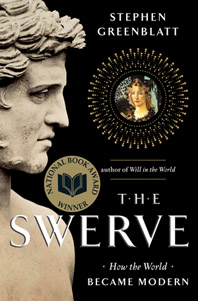
The Swerve: A History of Passionate Reading


I just finished reading Stephen Greenblatt's The Swerve: How the World Became Modern, something that I accomplished in a day. I rarely find myself so enthralled with a nonfiction book that I can't stop reading it, but this instance was even more remarkable since the The Swerve is itself about avid reading. On one level, it narrates the story of a former papal secretary, Poggio Bracciolini, whose passion for ancient texts led him to a German monastery in 1417 and to the discovery of a long-lost poem, On the Nature of Things, by the Roman philosopher Lucretius. The carefully-copied lines asserted Epicurean ideas with such eloquence and daring that--despite its challenge to fundamental precepts of Christianity--Bracciolini sought to make it known again to the world.

At another level, it is about Greenblatt's own fascination with Lucretius. Greenblatt's preface to The Swerve is an eloquent testament to the power of a text to strike, thrill, and infiltrate one's daily life. As he explained: "It was not Lucretius' exquisite language to which I was responding. Later I worked through De rerum natura in its original Latin hexameters, and I came to understand something of its rich verbal texture, its subtle rhythms, and the cunning precision and poignancy of its imagery, but my first encounter was in Martin Ferguson Smith's workmanlike English prose...No, it was something else that reached me, something that lived and moved within the sentences for more than 200 densely packed pages"(2).

Some have cited Greenblatt's engaging analysis of Epicureanism and its influence on Enlightenment thinking, but, for me, what is most significant are Greenblatt's insights into the history of ardent audiences. Most importantly, Greenblatt argues that for Bracciolini to be so passionate about books in the early 1400s was strange: "To all but a handful of people in Germany, this quest, had Poggio tried to articulate it, would have seemed weird"(18). Books were valued mostly in monasteries in the 15th century; all monks had to know how to read and were expected to engage in both "prayerful reading" and manual labor as part of their vocation. This institutionalization of reading was good for the survival of ancient texts; in order to read, the monks had to have books, and they learned to carefully reproduce texts through copying. However, it was not necessarily a joyful or exciting affair--reading and copying were, for most, compulsory chores.

Even more significant than Bracciolini's strange avidity for books was the fact that he was not alone. Greenblatt cites a small but earnest community of humanists in Italy that were devoted to uncovering and collecting lost classics. "Italians had been obsessed with book-hunting for the better part of a century, ever since the poet and scholar Petrarch brought glory on himself around 1330 by piecing together Livy's monumental History of Rome and finding forgotten masterpieces by Cicero, Propertius, and others." (23) Petrarch, Greenblatt suggests, set the model for Bracciolini, by investing "this search with a new, almost erotic urgency and pleasure, superior to all other treasure seeking" (119). Greenblatt quotes Petrarch's own assessment: "Gold, silver, jewels, purple garments, houses built of marble, groomed estates, pious paintings, caparisoned steeds, and other things of this kind offer a mutable and superficial pleasure; books give delight to the very marrow of one's bones. They speak to us, consult with us, and join with us in a living and intense intimacy."

As the story unfolds, it becomes clear that this love of books among humanists in 15th century Italy was actually an emulation of the intellectual culture of the ancient world, in which, "it became increasingly fashionable for wealthy Romans to amass large private libraries in their town houses and country villas...whether on the banks of the Rhone in Gaul or near the grove and Temple of Daphne in the province of Syria, on the island of Cos, near Rhodes, or in Dyrrhkhion in what is now Albania, the houses of cultivated men and women had rooms set aside for quiet reading." Even more remarkable, Greenblatt states that in the first century CE, the first reader-fans emerge: "At the games in the Colosseum one day, the historian Tacitus had a conversation on literature with a perfect stranger who turned out to have read his works. Culture was no longer located in close-knit circles of friends and acquaintances; Tacitus was encountering his 'public' in the form of someone who had bought his book at a stall in the Forum or read it in a library" (60-63). Based on Robert Darnton's work on Jean-Jaques Rousseau's public readership (See "Readers Respond to Rousseau" in The Great Cat Massacre), I had always associated this sort of public reader-author relationship with changing social and urban contexts of the 18th century, but this is a tantalizing revision.

There are other great tidbits in The Swerve about book hunting and collecting, about the circulation of ideas in Renaissance society, and about those whose lives were deeply shaped by the recovery and maintenance of a lost, seemingly better, past. In the end, The Swerve is really about a fan-like love of learning, from Lucretious in the first century BCE, to Bracciolini in in the early 15th century, to Greenblatt today. Their enthusiastic encounters with texts, together with one's own potentially enthusiastic reading, have the power to accumulate--or resonate together--to form an extended community of reception.

Sunday, January 29, 2012

The Pleasure Garden


The Times Literary Supplement recently published an engaging review of a new book by David Coke and Alan Borg, Vauxhall Gardens: A History. The book exhaustively re-constructs the world of Vauxhall and its enormous appeal to Londoners in the late 18th and early 19th centuries.

Essentially a pre-industrial amusement park, the pleasure garden, like Vauxhall (and, later, Niblo's in New York City), established a vogue for informal amusement outdoors--extended promenading, ice cream and other novelty refreshments, fireworks, theatrical productions, and big orchestra concerts. It had a tawdry side, too--the grand openness and informality of the park encouraged prostitution, gambling, and other illicit pleasures. One has to wonder at the kind of sensual appeal constructed in the 18th century pleasure garden--an exciting cornucopia of monumental scale, novelty, and informality. Vauxhall and later pleasure gardens were at the forefront of the emerging forms of commercial spectacle in cities that began to shape new groups of eager and devoted consumers--as well as vehement critics and earnest reformers. You could argue that "modern" popular culture starts here.

Especially useful for the study of audiences is the website accompanying an upcoming Foundling Museum exhibition on Vauxhall, curated by David Coke. As with early concerts and theater, we don't actually have much evidence about how people used and really experienced pleasure gardens, but this site collects what we do know, including a list of subscribers (and the souvenir metal "tickets" offered for a season subscription), as well as an online archive of contemporary accounts of the gardens, from the celebratory to the sarcastic.