Showing posts with label audiencing. Show all posts

Saturday, July 21, 2012

Tag-Team Audiencing


We tend to think of audiencing as a rather prescribed set of activities: purchasing a ticket, entering a theater of some kind, and watching/hearing a performance. But there are all kinds of alternative audience practices that challenge this model, either out of necessity or defiance. In Listening and Longing, for instance, I wrote about the practice of lingering outside concert halls to catch the muted strains of performed music inside, or drawing out the experience of a performance through various kinds of reproduction: writing and re-reading detailed descriptions in diaries, or purchasing sheet music or scripts of works and trying to re-create them.

I just realized the significance of another alternative practice. Harry Belafonte, in his new autobiography, My Song, writes about how he and Sidney Poitier, as young struggling actors in post-War 1940s Harlem, would go to the theater: "We started going to the theater once or twice a week, splitting the cost of a single ticket. One of us would go in for the first half, come out at intermission and pass the stub, along with a plot summary to the other. We saw some theater that way, and agreed that seeing half of each play taught us more than not seeing a play at all." (60)

Remarkably, I had just read Patti Smith's account of the same practice when she was living with Robert Mapplethorpe in New York City in the 1970s. This is a fascinating way to encounter a performance. All audiences set up a performance and then collectively interpret it afterward through conversation and criticism--but in this scenario, the performance itself is a dialogic construction, made from individually-experienced fragments, imagined together. If you believe that audiences are secondary, only receiving the primary event of performance, then this sort of tag-teaming is simply a clever way to report "what happened" among those who can't afford more than a ticket. However, if you believe that audiences in some way constitute the performances they encounter, then tag-teaming presents some very interesting questions about how texts might be understood, crafted, and made meaningful in their re-telling. 

Of course, we do this all the time. When a group of people is watching television and one person leaves for a moment to get a snack or use the bathroom and then asks, upon returning, "What did I miss?," he will piece together the narrative from experience, memory, and whatever irritated descriptions he receives. What I like about tag-team audiencing is the positive investment in the process; both Belafonte and Poitier planned to relate half the play to the other and knew that their collective understanding depended on it.

Jonathan Sterne has described the phonograph as "a machine to hear for us." In many ways, tag-team audiencing functions similarly; both Belafonte and Poitier provided playback for each other. Belafonte doesn't talk about how he, or Poitier, grew to enjoy the descriptions they gave each other as much as seeing plays, but that wouldn't be impossible to imagine. 


Saturday, June 23, 2012

Audiencing, Spontaneous and Chosen

Last night, while my son and his friends attended a concert by Passion Pit at the Bank of America Pavilion in Boston, I went to the Institute of Contemporary Art and, finding it closed due to an electrical outage, decided to sit outside and read a book. The ICA has a spectacular set of illuminated wood bleachers built into the rear of the building, overlooking Boston Harbor, and it was a great relief to just relax with Tom Rachman's The Imperfectionists, watch the boats pass by, and chill.


To my surprise, though, the evening quickly changed, when about fifty or so people, men and women, in various forms of performance wear (black leotards, loose-fitting tops, ballet flats, hair in buns, etc.) gathered below me on the steps. Apparently, there was a performance planned at the ICA that evening, and it was delayed due to the electrical problems. I watched as they chatted and waited; some did vocal exercises, while others practiced steps. I watched, too, when someone--apparently the director--came out, gathered them into a circle on the pier at the base of the bleachers and offered what sounded like instructions and encouragement.

The performers finally left to go inside the building, and then an audience started to arrive: young hipsters, people on dates, finely-dressed groups of friends out for a night. There's such an interesting energy among an audience before a performance: excitement, expectation, new moments of interaction between strangers and friends. Whatever the performance, there is always a negotiation in these moments--a slightly nervous sharing of purpose and a making sense of the event. This one seemed to present some difficulties for those attending--I heard snippets of conversations about the "avant garde," about the performers as "ninjas"(?), and about "the media."

Then new things started to happen. One young man emerged from the building with a music stand, a chair, and a large plastic bag filled with shoes, which he casually distributed around an area on the walkway just to the side of the bleachers. A young woman in sun dress, moving dramatically like a dancer, carefully placed tea cups at different points on the pier: on a railing, on a trash can, on a step. Then someone started playing the piano in the plaza on the other side of the bleachers. A representative from the Institute came out, apologized to the audience for the late start, and indicated that a queue had already begun on the other side of the building, so we were all to move there.

I wasn't a ticket-holder, so I didn't queue up. Instead I lingered on the bleachers as crew members continued to run back and forth, setting up some lights and more cables.  After a few minutes, the crew suspended a rope (it looked like a noose) from a balcony above the walkway with the shoes. A classical guitarist sat at the chair and music stand and started playing. A man in vaguely Japanese-style clothing started hanging from the rope and swinging himself this way and that, crying out in some sort of anguish. A group of about 20 dancers, each with a tiny spotlight held to the face, ran up through the bleachers to a side balcony, where, in a line, they danced against the railing, emerging and then receding. A large group of dancers came down to the walkway and applauded another dancer above. This went on for about 15 minutes; it was apparently some kind of preview for the people in line. I stood nearby, not sure whether I was supposed to be there or not; the dancers ran right by me several times and I wasn't removed by security, so I just watched. When the dancing and dangling ended, a man wearing a suitcase on his back (which seemed to be equipped with a speaker that fuzzily amplified dance music playing from another source) ran by. The queuing audience for the performance started to filter into the Institute, and I finally decided it was time for me to go sit in the car.

How splendid it was to spontaneously witness this bit of performance! It made me wonder about my experience, as an innocent bystander, and the experience of the paying ticket-holders. Obviously, the latter had a more immersive engagement, based on their investment of money and time, but that doesn't mean that my experience simply ought to be dismissed or forgotten. The entertainment industry has encouraged us to think of "audience" as a formal and defined role, a designation afforded by the purchase of a ticket or being located in auditorium seats. But, of course, audiences can form outside of that framework. Avant garde theater is one place where the audience role is explored and played with; many directors deliberately work against the formality of the proscenium and the imaginary fourth wall separating audiences and performers. Working against normal frameworks of audiencing is also the idea behind, say, the modern flash mob, in which a performance spectacle erupts in an everyday space, and everyone and anyone can suddenly find themselves "at the theater."

What's so interesting for me, after having done the research for Listening and Longing, is that for many people living in early 19th-century America cities, the situation was opposite. Inadvertently finding oneself audiencing music, for example, was a common occurrence. It was easy to stumble on a political rally or parade with band music, or passed by a church while its choir was making "a joyful noise unto the Lord,"or suddenly heard a neighbor in the next apartment practicing piano. Otherwise, street musicians and criers created an almost continuous sonic landscape of speech and chant. For most people, this kind of "surprise audiencing" was the primary way they heard music; more formal performances in halls were few and far between and beyond the financial reach of many. In that context, increasing opportunities to engage in formal audiencing--through the purchase of a ticket for a theater production, a minstrel show, or an opera virtuoso on tour--was marked with special meaning. It was a means to control and refine what one would hear and witness. For those among the middle- and aspiring-middle class who could afford such concerts, the excitement and anticipation about one's choice of musical experience created new kinds of enthusiasm and social power.


“Man With the Musical Ear.” Arthur’s Home Magazine (September 1853): 167.

Wednesday, August 17, 2011

Fans Need to Dim Their Clothing

The Big League Stew reported that at a recent Oakland A's v. Baltimore Orioles game, two fans with LED jackets (one scrolling the message "Go Orioles") were asked by the umpire to turn them off. We can't have fans "disturbing" the game from up in the stands (or, more like it, disturbing the paid neon advertising), right?

I've written about this before--see Name That Audience 7, Fans on the Field, and Football's Continuous Ovation. What fans can and can't do is policed today far more than in the past. I wonder if it just might be better if they didn't attend games at all. Then athletic competition could proceed in its utmost purity: isolated and silent, except for the occasional grunt of physical exertion or the crystal call of an umpire.

Of course, if a tree falls in the forest and no one is there to hear it....

Wednesday, June 15, 2011

A New Arts Appreciation


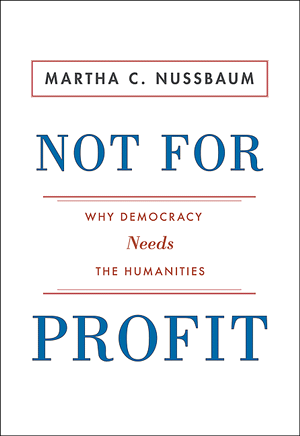
On my summer reading list is a book that came out last year, Martha Nussbaum's Not For Profit: Why Democracy Needs the Humanities. I'm reading it, among other books on the current crisis in education, not only because I am alarmed about this spring's harsh and ignorant treatment of teachers in response to state and local budget crises but also because of more recent threats to government support for the arts. We are living in an extraordinary time in which the humanities and fine arts are not only losing significant government funding support at the federal, state, and local levels but are being progressively diminished in public education in favor of more narrow degree-to-job vocational frameworks. 

Part of what's so sad is that we, as a society, lack a discourse for even valuing the arts and creativity in the first place. It seems far easier to talk about boosting science and engineering for the nation's economic health. As I heard on the news this evening, "scientists and engineers lead innovation in the economy and therefore we need to excite students about these subjects." This is the language of STEM, and somehow it seems to make sense to most Americans, whether or not they are themselves knowledgeable about the sciences. 

It's more difficult to talk about the arts in this way because of a perceived distance of the "arts" from the "economy," and an inability to understand what the arts are for, or how they relate to the accepted primacy of the bottom line. This is not a new problem in America. John Adams's elevated conception of the arts as growing out of the process of nation-building, from 1780 (“Our sons ought to study mathematics and philosophy, geography, natural history and naval architecture, navigation, commerce and agriculture in order to give their children a right to study painting, poetry, music, architecture, statuary, tapestry and porcelain”) was never really understood in his own time and was lost by the early 19th century. In the midst of the "market revolution" in the United States, engagement with the arts, whose commodification had always been problematic, became a suspicious life pursuit. Thus, for example, in 1850, Nathaniel Hawthorne worried about his ancestors' opinion of his chosen profession (“‘A writer of story-books!...Why, the degenerate fellow might as well have been a fiddler!’”). 

The STEAM initiative is a good start to creating a new discourse for the arts in already established frameworks of science and technology. What I want to suggest, in addition, is that we think carefully about what exactly we mean by that additional "A" for the "arts." Too many times, it seems to me, advocates for the arts education fall back on vocational frameworks of understanding. The assumption is that students will be making forms of music, visual art, drama and that such activity has demonstrated benefits for improving cognition and creative problem-solving. All well and good. But what is not often discussed is the social life of art, in which "audiencing" may be the primary activity. Audiencing is typically either dismissed as a mindless consumerism or left rather undefined as the end of the creative process. But recent studies in reception theory have shown the extent to which audiencing is itself creative, actively building community, shaping identity, and helping us to think about and respond to the changing world around us. I have written about this before in terms of music, but I think it is true for all the arts; understanding the arts only in terms of "authorship" prevents us from seeing its actual breadth and power.

There used to be a movement, in the early nineteenth century, that promoted arts appreciation, but it was rather classist in its mission of "uplift" and refinement. I am interested in a new movement that will more radically recognize the varieties of arts engagement. More fully valuing and including audience practices--across genres and tastes and cultures--in our discussions of the arts might better capture the arts' participatory function in daily life and make a stronger case for advocacy. As audience members, we are all engaged in art in one way or another. We listen to music on iPods, we admire the design of websites, we hang images in our homes, we laugh at each others' stories, we stand and look at buildings, we go to museums or concerts with friends, we talk together about tv shows, plays, musicals, movies, and novels. The arts cannot be so easily marginalized or dismissed if they are understood with a wider perspective that includes audiencing. That perspective would make cutting the arts not just an instance of cutting government support of esoteric studio classes or experimental drama (which some might wrongly see as not properly focused on making a living) but a more self-destructive diminishment of the participatory fabric of our daily lives, an erosion of the activities and actions that constitute the very environments in which we live and work, as well as our experiences and habits and identities.

Why is it that many are reluctant to cut, say, social security? It's because such a move would not only entail cutting a "government entitlement" but a deeply-embedded social institution. For better or worse (depending on your political persuasion), it has become a significant part of how Americans conceive and live their whole adult lives. I think there is an even stronger case for understanding the arts in this way, if we are willing to think more broadly about their definition and role and more boldly and consistently articulate that definition. Narrow ideas of artistic creativity and participation only enable those controlling wealth to rationalize cuts to arts education and to prioritize their own conceptions of what is significant in our society.

Sunday, May 8, 2011

Situation Room Photograph


While it does not depict a fan audience, last week's "situation room" photograph of President Obama and his advisors (by White House photographer Pete Sousa) is quite similar to some of the photographs of audiences that I have posted on this blog. I imagine, too, that it will become an historic and iconic image; certainly every new American history textbook is going to use it to summarize the 21st century's first decade.

Analyses of the photo have been appearing all this week; some of the better ones include Caleb Crain's discussion at Steamboats are Ruining Everything and Marco Bohr's Visual Culture Blog. While I won't add anything to their insights at this time, I hope that we can, in this moment, at least, acknowledge the significance of audiencing in our culture.

Update, May 9: Rabbi Jason Miller, via Andrew Sullivan's blog, reports that an Hasidic Jewish newspaper has removed the women in the above photograph. "Audience manipulation" is an old problem recognized by cultural studies scholars, but this is literal. Seriously, how does that change the tenor of the photo?