Saturday, September 24, 2011

The New Economy of Attention


I started out a recent speech by noting the ways in which fandom has changed since the advent of social media, saying:
These are interesting times for reception theorists, especially those that study fandom. Fandom represents an extra-ordinary form of audiencing, including everything from emotional attachment to performers to obsessive collecting. However, the nature of fandom’s extra-ordinariness has changed a great deal in the past several decades thanks to the advent of the Internet and digital production. It seems today that previously “abnormal” fan practices have not only become more and more accepted but also explicitly supported and nurtured by new technologies and re-framed by niche marketing. Simply: we live in an age in which “following” a stranger because you “like” them is not creepy, but rather represents a harmless form of networking. As Twitter encourages us, "Follow your interests."
I didn't say much more than that about fandom's current trajectory, veering instead into a consideration of this change for those of us interested in writing fandom's history. However, a recent article by Esther Dyson, "Attention Must Be Paid," has made me think again about just how social media has changed the value system behind what we call "fandom."

I thought Dyson's essay, subtitled, "How the Internet is Changing How People Listen," was going to be an analysis of listening in the 21st century, one of my favorite topics, but it turned out to be an outline of how companies might commodify attention in the digital age. The paragraph that made me sit up a little straighter was:
The Internet is changing the economics of attention by fostering peer-to-peer interactions. People used to pay attention to those around them and to "stars." Now, they spend lots of time online paying attention to people they haven't met. And, increasingly, individuals go online to get attention, not to give it. Accordingly, companies need to learn how to give customers the attention that they crave, rather than demanding customers' attention and then charging them extra for the attention that their brand commands.
I relied on rather old categories of "normal/abnormal" in thinking about the re-framing of fandom on Facebook and Twitter. Dyson, however, suggests something even more subversive than the mere acceptance of fannish attention: she's saying that the economy of attention has changed so that what is commodified is not the cultural performance, event, or product to which one might attend but rather the very act of attending. In other words, in the world of social media, fans and fandom have become products; fans consume each other, with stars and cultural producers playing a supporting role.

Yow. This reminds me of late 18th and early 19th century opera and musical theater in the U.S., when people went to performances to see and be seen, and what happened "on stage" was secondary. Maybe cultural behavior in our society has come full circle. Except this time, of course, there are companies ready to "monetize" it all. We'll see.

Friday, September 23, 2011

Fan Rituals


Check out the Boston Globe's recent photo essay of Fan Traditions and Rituals. There are many many more, of course, among sports fans and among other kinds of fans.  Not to go too anthropological on everyone, but it's worth reflecting on the ritual aspects of fan behavior, which link fandom to broader systems of human belief, symbolism, and communal affirmation.

I don't have time to do it, but I'd love to see an Encyclopedia of Fan Ritual some day. Perhaps it could be done collectively online. It would be a great way to start mapping and comparing the varieties of fan experience.

Monday, September 12, 2011

Reception Study Society Conference 2011

I just finished a four-day stint at the biennial conference of the Reception Study Society, where I gave a keynote talk on the need for a more precisely comparative account of enthusiastic audiences in history. I argued that new research on pre-1900 fan-like subcultures (from kranks to matinee girls), as well as on the wider discourses of monomania, enthusiasm, and agency in the mid- to late-19th century, will help scholars to better understand how exactly fandom became a explanatory discourse for certain kinds of audiencing in modern society.

I saw lots of great presentations, from Emily Satterwhite’s discussion of fan mail about Christy (based on research from her new book) and Gillian Silverman’s analysis of 19th century reading as a “technology of intimacy” to Melissa Click’s study of adult and teen Twilight fans and Pedro Curi’s outline of the various ways in which Brazilian fans ‘Brazilianize’ American TV shows they see on the internet. Jonathan Gray also gave an amusing and provocative overview of this theory of “paratexts,” arguing that packaging, marketing, merchandising, and spinoffs of books and television shows must always be part of the “texts” that we study, since, for some people, paratexts are the texts with which they engage most. In all, a very satisfying weekend, sharing ideas with people who think similarly about culture and its meaning.

Next up: the fall semester.

Tuesday, August 30, 2011

Some Fan Studies Before "Fan Studies"

In the past, I've written about some of the classics of fan studies. In this post, I want to briefly highlight a few books that do not explicitly address fandom but nevertheless deserve mention as works of scholarship that have addressed the subject of devoted or enthusiastic audiences. For me, these works all had to do with reading; in the late 1980s, I was a newly-graduated English major, growing tired of great authors and works (I think I had read Moby Dick five times at that point), and becoming more and more interested in marginal aspects of literary studies: the physical nature of books, the business of publishing, and, especially, the history of readers. To my astonishment, I found a number of fairly recent works on those subject. I wasn't studying fandom when I first encountered these books, but once I did start to think about fans a bit later, in the context of popular music, the book's arguments and stories came back to me, providing a rush of intriguing parallels, echoes, and connections. Rousseau readers and Springsteen fans, for example, separated by centuries, seemed to be thinking in similar ways--how could that be? It's something I'm still thinking about twenty years later.

Robert Darnton, "Readers Respond to Rousseau: The Fabrication of Romantic Sensitivity" (1984). This essay appeared in Darnton's collection on French cultural history, The Great Cat Massacre. Drawing on a collection of letters between Jean Ranson, a French merchant book collector, and a Swiss publisher, Darnton unearthed Ranson's fascination with the work of Jean-Jacques Rousseau, whom Ranson called "L'ami Jean-Jacques" (my friend, Jean-Jacques) even though, as Darnton noted, he "had never met" Rousseau and could only know him through the printed word. This relationship was the set-up for an amazing analysis of what Darnton calls "Rousseauistic reading," a new way of understanding the world of a novel as an intimate representation of an author's emotional being. In some of the funniest passages, Darnton talked about Rousseau's alarm about the new type of readers he created; apparently Rousseau had to install a trap door in his home to escape the many admirers who sought him out for heart-to-heart chats and expressions of gratitude after reading books like La Nouvelle Heloise. In the described shift toward a Romantic "sharing of selfhood," I started to see patterns that pre-modelled modern fans' relationships to media celebrities.

Susan Stewart, On Longing: Narratives of the Miniature, the Gigantic, the Souvenir, the Collection (1984). Susan Stewart's On Longing was an extraordinary work of cultural theory, rooted in literary studies but also ranging outward to include giant myths, doll houses, and book collectors. For me, it was one of the first theoretical works I had encountered about the sometimes intense relationships that people develop with objects and performances. No one I knew was writing about that particular kind of desire in 1984, and her arguments about the ways in which we make sense of the world around us by sorting our experiences and manipulating time and space through narrative gave me a stronger sense of the existential gravity behind reading: it was about much more than mere entertainment or cultural refinement. Stewart's final essay on collecting directly addressed what I later recognized as a primary fan practice. She showed how collectors variously layer objects with complex narratives of authenticity, nostalgia, and the self. The book's post-structuralist language and Lacanian references were, at first, a bit impenetrable for me, but Stewart, a poet, still had a knack for thought-provoking declarations: "The printed text is cinematic before the invention of cinema." "Although reading may give form to time, it does not count in time; it leaves no trace; its product is invisible." "The souvenir must be removed from its context in order to serve as a trace of it, but it must also be restored through narrative and/or reverie." I still go back to it.

Janice Radway, Reading the Romance: Women, Patriarchy, and Popular Literature (1984). In one of my first jobs (1985-86 or so), I worked at Barnes & Noble, where I was in charge of, among other things, shelving the new series arrivals in the romance section and shipping older, unsold editions back to the publishers. I distinctly remember the customers who came into the store regularly to buy romance books and who seemed to have a deep knowledge of the nuances between Harlequin lines and other competing series. I wanted to talk to these customers more about their obvious passion for books and reading, but it was too awkward for me. Radway did. Published in 1984, Radway's pioneering research featured interviews with a group of women romance readers. Like Stewart's work, Radway was, at one level, rescuing a denigrated form of popular culture by showing the ways in which it facilitated meaning-making in everyday life; as a feminist, her goal was to find out how such books helped women to negotiate patriarchal society. There were problems with the research, at least in terms of ethnographic practice (Radway was ultimately unwilling to take the women's articulation of their own lives at face value, asserting their patriarchal oppression and then wrestling with how to interpret romance reading in light of that), but her work nevertheless showed me how fieldwork--typical for anthropology abroad rather than at home--might serve as a legitimate method in the investigation of popular culture fandom. I taught this book for many years in a seminar on audience studies, and it remains influential.

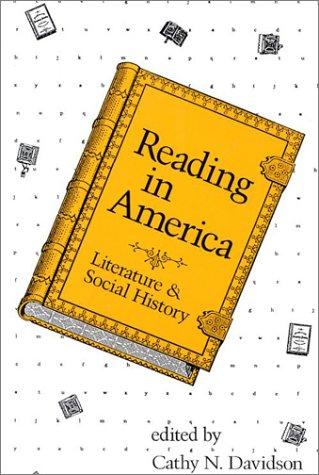
Cathy N. Davidson, "The Life and Times of Charlotte Temple" (1989). This essay, which appeared in a collection edited by Davidson called Reading in America. I could talk about Davidson's equally compelling Revolution and the Word (1984), which more broadly addressed the power of novel-reading in the new republic, but this essay was one of the first that I had encountered that analyzed, head-on, the ways in which a single novel might change the lives of ordinary readers. The novel was Susanna Rowson's Charlotte Temple, a cautionary tale of a young woman's fall from virtue, and one of early America's bestsellers. Davidson pointed out that readers developed such intensely emotional reactions to the story and the character of Charlotte that they believed that the sensational story was true. Someone even placed a tombstone for Charlotte in the churchyard of New York City's Trinity Church, signifying readers' blurring of the lines between fiction and reality, and by the 1850s, weeping readers (men and women, working and middle-class) regularly made pilgrimages to the churchyard to pay their respects. Besides suggesting the ways in which readers worked to sustain the world of a narrative outside of their encounters with that narrative (much as music or theater fans stay in "audience" mode long after performances are over), the notion of pilgrimage really resonated with me. I knew fans for Springsteen who did the same thing as Charlotte Temple readers, imbuing real places with new layers of meaning known only to them.

Monday, August 22, 2011

Do Jazz Musicians Need to Know How to Write Criticism?


The Boston Jazz Blog poses the question, "Do jazz critics need to know how to play jazz?" There are interesting answers, though I would question the question by asking, "Do jazz musicians need to know how to write criticism?" I'm not joking. I've written about this before, and it has been a subject of tension in ethnomusicology since the days of Mantle Hood argued for the primacy of "bimusicality" as a mode of understanding, but I don't agree that musicality comes automatically from playing or singing, or that it is necessarily greater among musicians than among, say, listeners or dancers--or critics. Rather than narrowly value only composers and performers (relegating all the other people that make music meaningful, from engineers and critics to retailers and fans, to secondary status), I'd rather understand music as a complex ecology of participation.

Sunday, August 21, 2011

Name That Audience 9

Can you guess what these gentlemen are watching? What's up with the odd postures? Is that man in the back sleeping? Answer after the jump.


Wednesday, August 17, 2011

Fans Need to Dim Their Clothing

The Big League Stew reported that at a recent Oakland A's v. Baltimore Orioles game, two fans with LED jackets (one scrolling the message "Go Orioles") were asked by the umpire to turn them off. We can't have fans "disturbing" the game from up in the stands (or, more like it, disturbing the paid neon advertising), right?

I've written about this before--see Name That Audience 7Fans on the Field, and Football's Continuous Ovation. What fans can and can't do is policed today far more than in the past. I wonder if it just might be better if they didn't attend games at all. Then athletic competition could proceed in its utmost purity: isolated and silent, except for the occasional grunt of physical exertion or the crystal call of an umpire.

Of course, if a tree falls in the forest and no one is there to hear it....

Sunday, August 14, 2011

Pleasures of Reading


I just finished Alan Jacobs's new book, The Pleasures of Reading in an Age of Distraction. It has been getting some press attention lately, with a review in the Wall Street Journal, as well as an adaptation in the Chronicle of Higher Education

I have to admit that I was a little worried about the title, at first glance. While Jacobs is decidely not a member of the "turn off your computer" camp (or their predecessors, the "turn off your TV" crowd), who assume a negative causal relationship between media engagement and the quality of one's reading, he does point to the ways in which the the obligations of educated refinement (promoted especially in academia), as well as the information triaging necessitated by the hyper-culture of social media, create a great deal of anxiety about sustained, deep, and enthusiastic reading. We feel we should get lost in a book, but we can't. When we do, it feels a little strange. 

First, kudos to Jacobs for trying to capture the pleasures of reading (even though he admits that it is truly impossible to convey what a "page-turner" feels like). I certainly love books in they ways that Jacobs describes and can attest to the ways in which chance encounters with individual works have changed my life. I also appreciate the ways in which he attempts to situate that joy in the context of contemporary culture, assuaging lack of confidence about "reading properly" or about "reading deeply" by encouraging "reading at whim," that is, to fully embrace the experiences of reading that feel right, no matter the dictates of taste or the competing demands on one's attention. As he writes, "The book that simply demands to be read, for no good reason, is asking us to change our lives by putting aside what we usually think of as good reasons. It's asking us to stop calculating. It's asking us to do something for the plain old delight and interest of it, not because we can justify its place on the mental spreadsheet or accounting ledger (like the one Benjamin Franklin kept) by which we tote up the value of our actions" (16).

This is, as he suggests, not so much the function of a "good book" itself, but rather of one's general approach to the ecstatic potential of any encounter with a book. That is, we read deeply when we accept, or, at least, leave ourselves open to the premise that "books are the natural and inevitable and permanent means of being absorbed in something other than the self" (116). While Jacobs tends to talk about fandom as a kind of extremism, I'd suggest that this approach to books more accurately describes fandom as it is experienced: a recognition of a performer or performance (including "texts" of all kinds--books, movies, music, art, etc.) as having the ongoing potential to move, transform, connect, and otherwise wrest one from torpor. As Tia Denora put it, we engage in culture to "aesthetize ourselves." Fan engagement can sometimes appear aberrant (when fans embrace a work that is not canonical) and it can sometimes appear obsessive (when fans allegedly spend too much time engaging one work or author), but its mode of hopeful enthusiastic engagement is unabashedly catholic and deeply pleasurable, often facilitating a kind of lasting and meaningful learning that cannot be attained through other means.

Jacobs focuses a bit too much for my taste on quietude, on shutting down cultural "distraction," though I do recognize the need for many to carve out time for sustained reading. Rather than turning things off, I always encourage my students to simply treat books differently. I tell them, first, to understand reading as not simply a mechanical movement of eyes over a page, but rather as the development of a relationship, much like one you might develop with a person. "Reading," in fact, is always a complex and unique story of encounter, flirtation, acquaintance, and knowing. It's a little weird, but I ask students to carry their books around with them, place them nearby when they are not reading (on their drawing desks, at the dinner table, etc.), and, in Whitman-esque fashion, get to know them, even unopened, as daily companions and even as old friends. I hope, this, in turn, leads to a reformation in their minds of what a book is. When some complain that a book is "dry" or "boring," or even when they assert that a book is "exciting," I tell them that, in fact, it is their relationship to the book that is "dry" or "boring" or "exciting." Books are just books; their meaning and transformative power depend on how readers bring them to life. 

These are just some of my own techniques for keeping the pleasures of reading alive; on the whole, I think Jacobs and I are far more in sync than apart. Perhaps more so than Jacobs, I sense that all this might be futile: maybe the pleasures of sustained reading are indeed being erased and are likely to be lost to us in the future. But, really, I don't know. Like Jacobs--and, I think, teachers in general--I hopefully and defiantly try to keep it alive anyway. (The cliché of teacher-motivation is true: "If I can just reach one person....").

I wish you all absorbing and transformative reading.

Tuesday, August 2, 2011

Hearing Disfluency


An article posted last week on Slate, Michael Erard makes the case for the usefulness of "ums" and "ahs" in speech, "disfluencies" that we typically discourage. Apparently, such pauses in the flow of speech engender a feeling of anticipation in listeners that can focus attention, if not overused. It reminds me, in a way, of musicologist Charles Keil's notion of "participatory discrepancies," the ways in which being slightly "out of time" and "out of tune" in performance actually can make music feel more, not less, groovy and danceable.

Unfortunately, it is far easier to understand a speech as an artifact that is to be delivered (without disfluency) rather than an utterance that is heard (with disfluency). In our culture, a public speech is commonly documented as a script that has gone through multiple drafts, can be scrolled on a teleprompter, and whose success depends on an accurate delivery. Even a transcript of a speech, after the fact, tends toward idealized representation, with the true messiness of non-sentences, false starts, and paralinguistic acts edited out and the dynamics of the speaking event largely ignored. Journalistic transcriptions of the annual State of the Union address are a good example of this sort of reduction. While the text of the speech is always offered for study, anyone who witnesses the event knows that a major part of its meaning is about the dynamics of delivery and response: how things are said and who in the room applauds, stands, sits, smiles, or scowls--and when. How is that behavior documented? Why don't we have good ways to represent it?

The institutionalization of langue over parole leads me to the problem of how we might recognize disfluency in the past. Imagine that you wanted to look back and really analyze the oratory of a public speaker and how his or her delivery was variously heard and understood by audiences. Could you do so? You can partially recover instances of speaking and hearing during the era of recording, using a combination of audio records, film, and contextual understanding of audiences from acoustics, linguistics, oral history, and social history. However, for 19th century public speakers like Henry Ward Beecher, or even early 20th century figures like Theodore Roosevelt (who apparently had a surprisingly high-pitched voice), such analysis is even more difficult. To account for how public speakers were heard before 1900 or so, you can only work with fragments: brief written descriptions (from letters and news reports) of how speakers may have sounded, or how audiences reacted; images and photographs, if you can find any, that might allow you to make something out of the body language and facial expressions of audience members. It's not promising.

It seems to me that the static nature of what we typically deem as "historical evidence" erases the dynamism of the events we would like such evidence to represent. I'm quite interested in thinking more about what, exactly, we archive as historical evidence, something that raises all sorts of questions about processes of interpretation and the limits of historical practice. I also think we can do much now to more fully document contemporary performing and audiencing (with its "ums" and "ahs") for the historians of the future.

Monday, August 1, 2011

Sunday, July 31, 2011

Fandom Before the Internet: The Fan Club Directory


How did fans keep up with the latest news, enthuse with friends, and sustain their enthusiasms before the Web, Facebook, and Twitter? We take it for granted that a "community" can be non-geographic these days, but before the Internet that concept was not wholly accepted; a community without shared experiences and practices in a particular place felt considerably weaker, more like a loose association ("the international community," "the scientific community") than one based in a neighborhood or other locality. Nevertheless, fans' intense feelings of connection motivated them to seek one another out and attempt to build a sense of community, something that they did mostly with regular face-to-face meetings (at conventions, performances, and parties) and print communication (fanzines, newsletters, and private letters). Much of this activity, especially for fans of lesser-known stars and art forms, was DIY, and it required an amazing amount of labor and love. You really need a certain level of devotion to work at a job all day, manage a family, and then also spend your remaining time, night after night, doing the rather isolated work of collecting clippings, writing articles, compiling fan art, and mailing out photos and tapes to fellow fans.

I'll be exploring these aspects of fandom a bit more (and maybe compare them to today's practices), but for this post I just wanted to highlight an extraordinary publication, which is now defunct: The Fan Club Directory. Published between 1979 and 2002, the Directory was a two-staple, roughly 75-page booklet, produced annually by the National Association of Fan Clubs (NAFC). It listed alphabetically every fan club that elected, for free, to become a member of the NAFC, giving readers the U.S. mail address of the current president and/or contact person. The NAFC was an organization dedicated to representing "all fan clubs in all fields of entertainment," and so the listings in the Directory were unintentionally jarring: announcement of The Amazing Pudding, the fanzine for Pink Floyd, sat right across from the Annette Funicello fan club (both are listed alphabetically under "F"); "The Celestial Affiliation of Time Lords: A Time Travel Fan Organization" was next to the "Charlie Daniels Band Volunteers;" Elton John and Al Jolson were side by side. It read like a fantasy middle-school classroom before everybody went off to become famous in their various pockets of the world.


Some of the clubs were focused on stars or shows that I don't recognize anymore--Becky Hobbs, Secret Oktober, etc. But full-page breakouts were allotted for entertainment stars with more than one club, including Englebert Humperdinck, Tom Jones, Barry Manilow, and Elvis Presley. There seemed to be a mixture of both "official" fan clubs, run by an artist's management, and "unofficial," run by fans out of their homes. Of equal historical interest were the details in the Directory's ads. You could learn, for example, that The Flying Nun Fan Club "has been looking for the original hat and dress from 'The Flying Nun' for the 25th Anniversary." (One can only wonder: did they find it? What did they do with the artifacts?). Or that there was a new Keith Carradine Club in Gronau, Germany, "searching for new members who are interested in international contact with other Carradine fans all over Europe." Or that a group called "Operation Tribbles" helped to coordinate Star Trek clubs to donate stuffed "tribble" toys to people in rest homes, hospitals, and hospices around the world. In all, the Directory offered a heterogeneous slice of late 20th century popular culture in the English-speaking world. 

When I first received The Fan Club Directory in my mailbox back in 1993, I remember being amazed at how many clubs there were and how much work it must have been to bring that information together in one place. Of course, that was right at the dawn of the World Wide Web, when fans were just joining online "bulletin boards" and "discussion groups." Blanche Trinajstick, the Editor/Publisher of the Directory, retired from "fan club work" in 1992, stating that "for more than 30 years I have not known the meaning of 'spare time.'" Her successor, Linda Kaye, published the Directory for another decade before finally calling it quits in the face of the Internet explosion, which both made being a fan and communicating with other fans far easier and slowly eroded the usefulness of a printed directory. As Kaye wrote retrospectively: "While the NAFC provided a great service for a quarter of a century, the Internet made the task of keeping up with confirming the legitimacy of 'new' website clubs and responding to mountains of e-mail requests for fan information and clubs dealing with fans most of us have never heard of a burden too overwhelming to continue."

Yes, the Internet changed things. But I am wary of simply understanding technology as determining radically new kinds of human behavior. In fact, I see The Fan Club Directory as an important and necessary antecedent to today's social networking. While it is all but forgotten among the current iPod generation, I hope that at least it will be preserved (along with fanzines and other fans publications) as evidence of how enthusiasm in our culture has been continuously, as well as variously, organized.


Saturday, July 30, 2011

Tuesday, July 26, 2011

A Fan's Perspective: McCartney as Dad


Musician Robert Burke Warren has a thoughtful article over at Paste on his fandom for Paul McCartney. His reflection was prompted by McCartney's recent concert at Yankee Stadium, which he describes as a powerful show for the audience gathered. As he put it, "I was a riot of sensation and notion; chill bumps, laughter, singing with strangers—all messy, uncool spillage from an open heart." Part of that spillage was realizing the extent to which his fandom has, in some way, always been about McCartney as a father figure. "I was struck" he wrote about the finish of the concert, "by the amount of families, some of whom carried sleeping children out of the still-charged stadium. This had been a family event. Of course."

In public discourse, fandom is typically reduced to stalking or silly teenage enthusiasm. (Certainly, the story of Beatlemania was always centered on screaming teenage girls). But, here, Warren shows us that such stereotypes of fandom fail to get at the consequences of individuals' long-term attachments to public performers. Devotedly following a star's career over time--for years or decades--transforms most people's initial attraction, however motivated, into a significant force for meaning in daily life. Songs get attached to personal memories and values, lyrics begin to illuminate diverse circumstances, concerts start to feel less like entertainment events and more like repeated rituals of affirmation.

McCartney as an iconic dad? Sure: for Warren. Fandom is complicated--as complicated as the diverse experiences and life stories of the millions of people who identify as fans. Especially in our complex culture, in which intense fame vies with widespread anonymity, fandom works not only as a framework for consumption but also as a technology of the self. Few have really bothered to articulate the latter, but it is obvious when someone does.

Sunday, July 24, 2011

Name That Audience 7

I've been focusing a lot on music lately, so time for something different. That's your hint for this week's Name That Audience:


Saturday, July 23, 2011

An Ecological Approach to Awe


There is a very interesting moment in the narrative of Geerat J. Vermeij's The Evolutionary World: How Adaptation Explains Everything From Seashells to Civilization, when, after laying out some of the basics of his thesis about adaptation, he describes a profound concert experience:

On a cold Thursday evening, Edith and I sit in the cavernous Hooglandse Kerk in Leiden, the Netherlands, immersed in sonic splendor, and move to deep contemplation as the sacred music of Tomás Luis de Victoria and other Spanish late Renaissance masters, performed alternately on the great Baroque organ and a capella by the choir, fills the church. Everyone and everything--the audience, the chords and melodies, the organist and his craft, the singers and their conductor, the artistry of the composers, and even the church with its echoing acoustics--have become one, a three-dimensional edifice of harmony and meaning.

I've been collecting descriptions of concert experiences for as long as I can remember, but this one is different than most. Being moved by a performance is most often described by contemporary Americans in the language of religious faith; the feelings generated by experiencing something greater than oneself most closely recall one's feelings about God. But Vermeij, as a biological scientist, offers a slightly different analogy, using the principles of ecology to account for aesthetic pleasure. In fact, after admitting that the concert is "a transcendent construction, inspired by a fervent faith in God, anchored in beliefs in miracles and creation stories and the afterlife, all doctrines I rejected long ago," he explains his being moved in terms of his own awareness of participating in a complex ecosystem, as a one component among many:

But the magic--the ecstasy created by coordinated complex machines inside a massive box of stone--endures. The components taken singly may be ordinary and undistinguished, but the whole achieves a grandeur and significance, a richness of experience, that transcends the context in which it was created....This is as compelling a demonstration as can be found of parts working together to produce an emergent whole, a unit with properties that none of its components possesses. Water, a molecule consisting of two hydrogen atoms and one oxygen atom, is utterly unlike the two component elements. It is a liquid rather than a gas at room temperature, it expands rather than contracts in the solid state, and it is an exceptionally good conductor of heat. The properties of water seem irreducible, much as our complex brain might appear to be irreducible to its many constituent parts; but in fact they arise through the interaction--the working together, or synergy--of components. Likewise in music, chords and melodies convey patterns and evoke emotions that single tones cannot. Sentences, paragraphs, and books have meanings that individual words and letters do not. Living things, too, work together to add dimensions of value, function, and meaning. Survival and propagation are themselves expressions of emergence and synergy common to all life-forms; but we humans are motivated and enriched by more than these lifewide aspirations. We perceive a greater purpose--through love, curiosity, a social conscience, helping others, and perhaps above all, through aesthetics--a deeper meaning that makes our individual lives worthwhile to others. Without that added significance, and without the intentionality that enables us to create a future according to our tastes and values, life would be empty; we would descend into apathy and callousness. Purpose and meaning, however they come into our lives, are as real and as essential as the evolved imperative to survive and reproduce.

It might be productive to place this understanding of a "transcendent construction" next to others that have come down to us over the years from more religiously-minded philosophers (enthusiasm, the sublime, etc.). In fact, I see the beginnings of a bad academic joke: "Plato, Kant, and Darwin are sitting in the audience at a concert...." Seriously, Vermeij's ecological approach to thinking about aesthetic experience recalls early American concert-goers in the 1840s and 1850s. Before reformers insisted on reverence for great works, concert-goers primarily reported being moved--sometimes overwhelmed--by the entire experience of a concert, from acoustics and seating to the sensation of mass applause. I'm not sure their experiences included Vermeij's admiration of "synergy," but they did involve heightened attention to the interaction of multiple and dynamic parts, which was, in a way, a nascent sort of ecological awareness.