Showing posts with label arts funding. Show all posts

Wednesday, July 6, 2011

Give the People What They Want, Seriously

Sixth Symphony Concert, Greek Theatre, Berkeley, California, 1906. Library of Congress.
There is an interesting article by Norman Lebrecht on the demise of urban symphony orchestras over at Standpoint. While this is a theme that has been repeated for at least the past several decades, things do seem to be more dire than usual this year.

He talks about why orchestras have mattered, in terms of civic boosterism and social cohesion, but one thing he adds, which in my view is probably the most important factor, is that people wanted them. As he notes, orchestras have survived historically because they signified valuable meanings for listeners: in the 1830s, they were part of "a rising demand for entertainment from a growing middle class;" in the 1900s, after both World Wars, they were symbols of hope and a better, civilized future. "It was both 'the done thing' in English cities to go to symphony concerts and a refuge from the otherwise inescapable gloom of postwar austerity. In America, GIs returning from war to a free college education and a small-town life demanded orchestral concerts of the kind they had heard abroad."

Lebrecht goes on to make an argument for orchestras today as a much-needed antidote to our hyperculture of communication: "...In a lifestyle of wall-to-wall wi-fi and instant tweets, the concert hall is one of the few places where we become reachable, where we can switch off our lifelines and surrender to a form that will not let us go for an hour or more. The symphony orchestra is our relief from the communicative addiction. It forces us, willy-nilly, to resist the responsive urge. It is a cold-turkey cure for our reactive insanity, our self-destroying restlessness. The more concerts I attend, the more I see how they restore balance to over-busy lives. It may well be that we, as a society, need the symphony orchestra now more than ever before."

I suppose this is true for some people but probably not the people orchestras need to reach in order to survive. In my view, this describes a perceived cultural need but not a popular want. Orchestras can be a part of people's daily lives but only if they become more vital to people's actual desires and enthusiasms. The instinct to pose the arts as a corrective to society, as a distinct alternative to a speeding world, is not the way I'd think about it, however much I might sympathize with the sentiment on occasion. While Lebrecht turns to 1940s post-war audiences' desire for contrast and redirection as his model for how to revive orchestras, I think our "over-busy" lives are more like those of the music lovers of the 1850s, who were, in their way, also people of "busi-ness," in awe of technology, living in topsy-turvy urbanized environments. Before genteel reformers got to them, they saw a symphony orchestra concert as an exciting extension of the exuberance, sophistication, and progressive promise of urban life. Concerts were part of going-out and moving up, of being with thousands of strangers, of participating in a world of sensation.

How can orchestras and their public concerts more actively and dynamically connect to this new age of technology, migration, and urbanization? What's the new role for art music in civic boosterism? How can the sonic palette of symphony orchestras truly create excitement for potential audiences, on the move and on the keyboard?

A Wilco concert--I'm there. A BSO concert--questions, hesitation, memories of discomfort. That's the problem.

Wednesday, June 15, 2011

A New Arts Appreciation


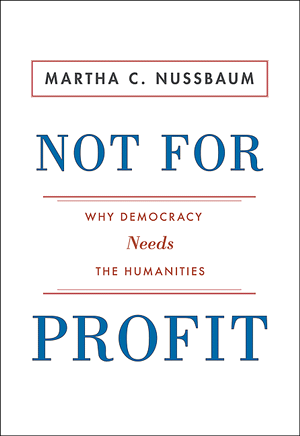
On my summer reading list is a book that came out last year, Martha Nussbaum's Not For Profit: Why Democracy Needs the Humanities. I'm reading it, among other books on the current crisis in education, not only because I am alarmed about this spring's harsh and ignorant treatment of teachers in response to state and local budget crises but also because of more recent threats to government support for the arts. We are living in an extraordinary time in which the humanities and fine arts are not only losing significant government funding support at the federal, state, and local levels but are being progressively diminished in public education in favor of more narrow degree-to-job vocational frameworks. 

Part of what's so sad is that we, as a society, lack a discourse for even valuing the arts and creativity in the first place. It seems far easier to talk about boosting science and engineering for the nation's economic health. As I heard on the news this evening, "scientists and engineers lead innovation in the economy and therefore we need to excite students about these subjects." This is the language of STEM, and somehow it seems to make sense to most Americans, whether or not they are themselves knowledgeable about the sciences. 

It's more difficult to talk about the arts in this way because of a perceived distance of the "arts" from the "economy," and an inability to understand what the arts are for, or how they relate to the accepted primacy of the bottom line. This is not a new problem in America. John Adams's elevated conception of the arts as growing out of the process of nation-building, from 1780 (“Our sons ought to study mathematics and philosophy, geography, natural history and naval architecture, navigation, commerce and agriculture in order to give their children a right to study painting, poetry, music, architecture, statuary, tapestry and porcelain”) was never really understood in his own time and was lost by the early 19th century. In the midst of the "market revolution" in the United States, engagement with the arts, whose commodification had always been problematic, became a suspicious life pursuit. Thus, for example, in 1850, Nathaniel Hawthorne worried about his ancestors' opinion of his chosen profession (“‘A writer of story-books!...Why, the degenerate fellow might as well have been a fiddler!’”). 

The STEAM initiative is a good start to creating a new discourse for the arts in already established frameworks of science and technology. What I want to suggest, in addition, is that we think carefully about what exactly we mean by that additional "A" for the "arts." Too many times, it seems to me, advocates for the arts education fall back on vocational frameworks of understanding. The assumption is that students will be making forms of music, visual art, drama and that such activity has demonstrated benefits for improving cognition and creative problem-solving. All well and good. But what is not often discussed is the social life of art, in which "audiencing" may be the primary activity. Audiencing is typically either dismissed as a mindless consumerism or left rather undefined as the end of the creative process. But recent studies in reception theory have shown the extent to which audiencing is itself creative, actively building community, shaping identity, and helping us to think about and respond to the changing world around us. I have written about this before in terms of music, but I think it is true for all the arts; understanding the arts only in terms of "authorship" prevents us from seeing its actual breadth and power.

There used to be a movement, in the early nineteenth century, that promoted arts appreciation, but it was rather classist in its mission of "uplift" and refinement. I am interested in a new movement that will more radically recognize the varieties of arts engagement. More fully valuing and including audience practices--across genres and tastes and cultures--in our discussions of the arts might better capture the arts' participatory function in daily life and make a stronger case for advocacy. As audience members, we are all engaged in art in one way or another. We listen to music on iPods, we admire the design of websites, we hang images in our homes, we laugh at each others' stories, we stand and look at buildings, we go to museums or concerts with friends, we talk together about tv shows, plays, musicals, movies, and novels. The arts cannot be so easily marginalized or dismissed if they are understood with a wider perspective that includes audiencing. That perspective would make cutting the arts not just an instance of cutting government support of esoteric studio classes or experimental drama (which some might wrongly see as not properly focused on making a living) but a more self-destructive diminishment of the participatory fabric of our daily lives, an erosion of the activities and actions that constitute the very environments in which we live and work, as well as our experiences and habits and identities.

Why is it that many are reluctant to cut, say, social security? It's because such a move would not only entail cutting a "government entitlement" but a deeply-embedded social institution. For better or worse (depending on your political persuasion), it has become a significant part of how Americans conceive and live their whole adult lives. I think there is an even stronger case for understanding the arts in this way, if we are willing to think more broadly about their definition and role and more boldly and consistently articulate that definition. Narrow ideas of artistic creativity and participation only enable those controlling wealth to rationalize cuts to arts education and to prioritize their own conceptions of what is significant in our society.