Canons of great authors, artists, and composers have fallen out of favor in some humanities disciplines lately; judging some work as better than others, once the core work of criticism, has become a bit old-fashioned in the wake of post-structuralism. At least, how scholars understand the power of "good" art has changed. After the first wave of reception-theory in the 1970s, which pointed out the complexity, diversity, unpredictability, and even perversity of audiences as they received and "decoded" creative expression, the Arnoldian idea that a person would simply need to expose himself to works of genius in order to become educated or "cultured," or the modernist notion that structural complexity is a primary marker of artistic significance, needs to be understood with a degree of skepticism. "Canon formation," or how we evaluate the best works in a society, has turned out to involve more than just merit.
I don't really believe that we should abandon the idea of a canon in humanities scholarship, even as we expose its politics. Judgments about worth, after all, are vital for defining shared values and for democratic decision-making. And working through the process of judging is a key component of learning, and doing that through the evaluation of artistic works is useful. However, I do think that canonicity is often too narrowly-focused on authorship. Great works are almost always attributed to the great minds that conceived them. That's why musicologists or literary scholars still tend to develop expertise in particular authors deemed worthy of in-depth study (especially if they want a faculty appointment and/or tenure), or why textbook cultural histories continue to organize their narratives around moments of creative production, conveniently offering decontextualized lineages of creative influence, as if all great artists in history are really just part of one, big, family of geniuses.

It seems to me that if we are going to go through the effort of canonization, we ought to open up the process to all aspects of artistic culture. We can have a canon of great authors, as long as we also have canons of great bookbinders, concert promoters, instrument manufacturers, and audience members. Certainly, judgments could be made in those areas, too. In fact, I've been thinking a lot lately of whether it might be possible to create a canon of great fans, audience members who we might deem as having been the best and the brightest readers, listeners, and spectators of their times.
Some names immediately come to mind from the American nineteenth century (which where I've been spending most of my time for the past eight years). Walt Whitman, for instance, is good initial candidate.
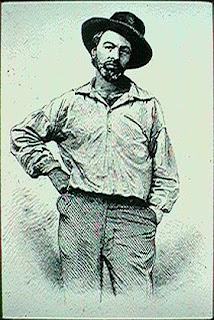
As a young journalist and man-about-town, Whitman was an especially active participant in New York City’s rapidly growing number of theaters, lectures, exhibitions, and concerts in the 1840s. He was a regular at the Bowery Theater and loved the intense emotionalism of actors like Junius Brutus Booth and Edwin Forrest. He was an enthusiastic follower of oratory, attending political rallies and abolitionist meetings at Broadway Tabernacle to study the fiery rhetoric of reformers; he especially was eager for lectures by Brooklyn preacher Henry Ward Beecher or temperance speaker John Gough. Perhaps most of all, Whitman was huge opera fan, following what he called his "musical passion." His status as a journalist put him on the “free-list” for concerts in the city, he heard most of the major virtuosos that passed through in the late 1840s and early 1850s. In Specimen Days, he recounts, for instance:
Of course, there are other great fans in history for whom we have evidence, some famous and some unknown, and I hope to highlight some of them in the coming months on this blog. (James Boswell ought to be here!) The larger point, here, is that thinking about a canon of fans, however reactionary, can re-orient our understanding of what's significant when we think about how art works in society and how we might account for its history. And that re-orientation is worth pursuing further.
 |
Our Great Authors, 1865 |
I don't really believe that we should abandon the idea of a canon in humanities scholarship, even as we expose its politics. Judgments about worth, after all, are vital for defining shared values and for democratic decision-making. And working through the process of judging is a key component of learning, and doing that through the evaluation of artistic works is useful. However, I do think that canonicity is often too narrowly-focused on authorship. Great works are almost always attributed to the great minds that conceived them. That's why musicologists or literary scholars still tend to develop expertise in particular authors deemed worthy of in-depth study (especially if they want a faculty appointment and/or tenure), or why textbook cultural histories continue to organize their narratives around moments of creative production, conveniently offering decontextualized lineages of creative influence, as if all great artists in history are really just part of one, big, family of geniuses.

It seems to me that if we are going to go through the effort of canonization, we ought to open up the process to all aspects of artistic culture. We can have a canon of great authors, as long as we also have canons of great bookbinders, concert promoters, instrument manufacturers, and audience members. Certainly, judgments could be made in those areas, too. In fact, I've been thinking a lot lately of whether it might be possible to create a canon of great fans, audience members who we might deem as having been the best and the brightest readers, listeners, and spectators of their times.
Some names immediately come to mind from the American nineteenth century (which where I've been spending most of my time for the past eight years). Walt Whitman, for instance, is good initial candidate.

As a young journalist and man-about-town, Whitman was an especially active participant in New York City’s rapidly growing number of theaters, lectures, exhibitions, and concerts in the 1840s. He was a regular at the Bowery Theater and loved the intense emotionalism of actors like Junius Brutus Booth and Edwin Forrest. He was an enthusiastic follower of oratory, attending political rallies and abolitionist meetings at Broadway Tabernacle to study the fiery rhetoric of reformers; he especially was eager for lectures by Brooklyn preacher Henry Ward Beecher or temperance speaker John Gough. Perhaps most of all, Whitman was huge opera fan, following what he called his "musical passion." His status as a journalist put him on the “free-list” for concerts in the city, he heard most of the major virtuosos that passed through in the late 1840s and early 1850s. In Specimen Days, he recounts, for instance:
I heard, these years, well render'd, all the Italian and other operas in vogue, "Somnambula," "The Puritans," "Der Freischutz," "Huguenots," "Fille d'Regiment," "Faus," "Etoile du Nord," "Poliuto," and others. Verdi's "Ernani," "Rigoletto," and "Trovatore," with Donizetti's "Lucia" or "Favorita" or "Lucrezia," and Auber's "Massaniello," or Rossini's "William Tell" and "Gazza Ladra," were among my special enjoyments. I heard Alboni every time she sang in New York and vicinity--also Grisi, the tenor Mario, and the baritone Badiali, the finest in the world.In addition to his obsessive attendance at the cultural events of the city, he had a consistent, almost unbridled excitement about those experiences--his ardent listening, participation, and spectatorship shaped many of the descriptive passages of urban life in Leaves of Grass and shone through his criticism, essays, and reminiscences. Such experiences were important enough for him to note at the end of his life, in "Good-Bye My Fancy" (Complete Prose Works, 511):
Seems to me I ought to acknowledge my debt to actors, singers, public speakers, conventions, and the stage in New York, my youthful days, from 1835--say to '60 or '61--and to plays and operas generally....Seems to me now when I look back, the Italian contralto Alboni (she is living yet, in Paris, 1891, in good condition, good voice yet, considering) with the then prominent histrions Booth, Edwin Forrest, and Fanny Kemble and the Italian singer Bettini, have had the deepest and most lasting effect upon me. I should like well if Madame Alboni and the old composer Verdi (and Bettini the tenor, if he is living), could know how much noble pleasure and happiness they gave me then, and how deeply I always remember them and thank them to this day.


