Showing posts with label audience participation. Show all posts

Saturday, June 23, 2012

Audiencing, Spontaneous and Chosen

Last night, while my son and his friends attended a concert by Passion Pit at the Bank of America Pavilion in Boston, I went to the Institute of Contemporary Art and, finding it closed due to an electrical outage, decided to sit outside and read a book. The ICA has a spectacular set of illuminated wood bleachers built into the rear of the building, overlooking Boston Harbor, and it was a great relief to just relax with Tom Rachman's The Imperfectionists, watch the boats pass by, and chill.


To my surprise, though, the evening quickly changed, when about fifty or so people, men and women, in various forms of performance wear (black leotards, loose-fitting tops, ballet flats, hair in buns, etc.) gathered below me on the steps. Apparently, there was a performance planned at the ICA that evening, and it was delayed due to the electrical problems. I watched as they chatted and waited; some did vocal exercises, while others practiced steps. I watched, too, when someone--apparently the director--came out, gathered them into a circle on the pier at the base of the bleachers and offered what sounded like instructions and encouragement.

The performers finally left to go inside the building, and then an audience started to arrive: young hipsters, people on dates, finely-dressed groups of friends out for a night. There's such an interesting energy among an audience before a performance: excitement, expectation, new moments of interaction between strangers and friends. Whatever the performance, there is always a negotiation in these moments--a slightly nervous sharing of purpose and a making sense of the event. This one seemed to present some difficulties for those attending--I heard snippets of conversations about the "avant garde," about the performers as "ninjas"(?), and about "the media."

Then new things started to happen. One young man emerged from the building with a music stand, a chair, and a large plastic bag filled with shoes, which he casually distributed around an area on the walkway just to the side of the bleachers. A young woman in sun dress, moving dramatically like a dancer, carefully placed tea cups at different points on the pier: on a railing, on a trash can, on a step. Then someone started playing the piano in the plaza on the other side of the bleachers. A representative from the Institute came out, apologized to the audience for the late start, and indicated that a queue had already begun on the other side of the building, so we were all to move there.

I wasn't a ticket-holder, so I didn't queue up. Instead I lingered on the bleachers as crew members continued to run back and forth, setting up some lights and more cables.  After a few minutes, the crew suspended a rope (it looked like a noose) from a balcony above the walkway with the shoes. A classical guitarist sat at the chair and music stand and started playing. A man in vaguely Japanese-style clothing started hanging from the rope and swinging himself this way and that, crying out in some sort of anguish. A group of about 20 dancers, each with a tiny spotlight held to the face, ran up through the bleachers to a side balcony, where, in a line, they danced against the railing, emerging and then receding. A large group of dancers came down to the walkway and applauded another dancer above. This went on for about 15 minutes; it was apparently some kind of preview for the people in line. I stood nearby, not sure whether I was supposed to be there or not; the dancers ran right by me several times and I wasn't removed by security, so I just watched. When the dancing and dangling ended, a man wearing a suitcase on his back (which seemed to be equipped with a speaker that fuzzily amplified dance music playing from another source) ran by. The queuing audience for the performance started to filter into the Institute, and I finally decided it was time for me to go sit in the car.

How splendid it was to spontaneously witness this bit of performance! It made me wonder about my experience, as an innocent bystander, and the experience of the paying ticket-holders. Obviously, the latter had a more immersive engagement, based on their investment of money and time, but that doesn't mean that my experience simply ought to be dismissed or forgotten. The entertainment industry has encouraged us to think of "audience" as a formal and defined role, a designation afforded by the purchase of a ticket or being located in auditorium seats. But, of course, audiences can form outside of that framework. Avant garde theater is one place where the audience role is explored and played with; many directors deliberately work against the formality of the proscenium and the imaginary fourth wall separating audiences and performers. Working against normal frameworks of audiencing is also the idea behind, say, the modern flash mob, in which a performance spectacle erupts in an everyday space, and everyone and anyone can suddenly find themselves "at the theater."

What's so interesting for me, after having done the research for Listening and Longing, is that for many people living in early 19th-century America cities, the situation was opposite. Inadvertently finding oneself audiencing music, for example, was a common occurrence. It was easy to stumble on a political rally or parade with band music, or passed by a church while its choir was making "a joyful noise unto the Lord,"or suddenly heard a neighbor in the next apartment practicing piano. Otherwise, street musicians and criers created an almost continuous sonic landscape of speech and chant. For most people, this kind of "surprise audiencing" was the primary way they heard music; more formal performances in halls were few and far between and beyond the financial reach of many. In that context, increasing opportunities to engage in formal audiencing--through the purchase of a ticket for a theater production, a minstrel show, or an opera virtuoso on tour--was marked with special meaning. It was a means to control and refine what one would hear and witness. For those among the middle- and aspiring-middle class who could afford such concerts, the excitement and anticipation about one's choice of musical experience created new kinds of enthusiasm and social power.


“Man With the Musical Ear.” Arthur’s Home Magazine (September 1853): 167.

Tuesday, March 6, 2012

The 12th Man


Great piece in the New York Times today about fan chants and their role in the outcome of soccer games: "...For their passion, a team’s most ardent fans are often called its 12th man — as important to the outcome of a match as the 11 players. They wave banners, paint their bodies and scream until the last whistle sounds. Their chants can create and sustain momentum, help build a rally for a goal, overwhelm an opponent or distract a referee."

In particular, the article features the work of Michael Dennis, one of the founders of the website Fan Chants, a repository of football chants and soccer songs from around the world. It's a pretty extraordinary fieldwork and archival project; if Alan Lomax had turned to sports rather than music, this might have been the result. In fact, Fan Chants might turn out to be a parallel Global Jukebox for future students of sports, audiences, and fandom.

Monday, August 22, 2011

Do Jazz Musicians Need to Know How to Write Criticism?


The Boston Jazz Blog poses the question, "Do jazz critics need to know how to play jazz?" There are interesting answers, though I would question the question by asking, "Do jazz musicians need to know how to write criticism?" I'm not joking. I've written about this before, and it has been a subject of tension in ethnomusicology since the days of Mantle Hood argued for the primacy of "bimusicality" as a mode of understanding, but I don't agree that musicality comes automatically from playing or singing, or that it is necessarily greater among musicians than among, say, listeners or dancers--or critics. Rather than narrowly value only composers and performers (relegating all the other people that make music meaningful, from engineers and critics to retailers and fans, to secondary status), I'd rather understand music as a complex ecology of participation.

Wednesday, July 6, 2011

Give the People What They Want, Seriously

Sixth Symphony Concert, Greek Theatre, Berkeley, California, 1906. Library of Congress.
There is an interesting article by Norman Lebrecht on the demise of urban symphony orchestras over at Standpoint. While this is a theme that has been repeated for at least the past several decades, things do seem to be more dire than usual this year.

He talks about why orchestras have mattered, in terms of civic boosterism and social cohesion, but one thing he adds, which in my view is probably the most important factor, is that people wanted them. As he notes, orchestras have survived historically because they signified valuable meanings for listeners: in the 1830s, they were part of "a rising demand for entertainment from a growing middle class;" in the 1900s, after both World Wars, they were symbols of hope and a better, civilized future. "It was both 'the done thing' in English cities to go to symphony concerts and a refuge from the otherwise inescapable gloom of postwar austerity. In America, GIs returning from war to a free college education and a small-town life demanded orchestral concerts of the kind they had heard abroad."

Lebrecht goes on to make an argument for orchestras today as a much-needed antidote to our hyperculture of communication: "...In a lifestyle of wall-to-wall wi-fi and instant tweets, the concert hall is one of the few places where we become reachable, where we can switch off our lifelines and surrender to a form that will not let us go for an hour or more. The symphony orchestra is our relief from the communicative addiction. It forces us, willy-nilly, to resist the responsive urge. It is a cold-turkey cure for our reactive insanity, our self-destroying restlessness. The more concerts I attend, the more I see how they restore balance to over-busy lives. It may well be that we, as a society, need the symphony orchestra now more than ever before."

I suppose this is true for some people but probably not the people orchestras need to reach in order to survive. In my view, this describes a perceived cultural need but not a popular want. Orchestras can be a part of people's daily lives but only if they become more vital to people's actual desires and enthusiasms. The instinct to pose the arts as a corrective to society, as a distinct alternative to a speeding world, is not the way I'd think about it, however much I might sympathize with the sentiment on occasion. While Lebrecht turns to 1940s post-war audiences' desire for contrast and redirection as his model for how to revive orchestras, I think our "over-busy" lives are more like those of the music lovers of the 1850s, who were, in their way, also people of "busi-ness," in awe of technology, living in topsy-turvy urbanized environments. Before genteel reformers got to them, they saw a symphony orchestra concert as an exciting extension of the exuberance, sophistication, and progressive promise of urban life. Concerts were part of going-out and moving up, of being with thousands of strangers, of participating in a world of sensation.

How can orchestras and their public concerts more actively and dynamically connect to this new age of technology, migration, and urbanization? What's the new role for art music in civic boosterism? How can the sonic palette of symphony orchestras truly create excitement for potential audiences, on the move and on the keyboard?

A Wilco concert--I'm there. A BSO concert--questions, hesitation, memories of discomfort. That's the problem.

Wednesday, June 15, 2011

A New Arts Appreciation


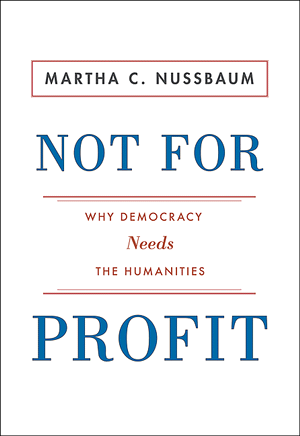
On my summer reading list is a book that came out last year, Martha Nussbaum's Not For Profit: Why Democracy Needs the Humanities. I'm reading it, among other books on the current crisis in education, not only because I am alarmed about this spring's harsh and ignorant treatment of teachers in response to state and local budget crises but also because of more recent threats to government support for the arts. We are living in an extraordinary time in which the humanities and fine arts are not only losing significant government funding support at the federal, state, and local levels but are being progressively diminished in public education in favor of more narrow degree-to-job vocational frameworks. 

Part of what's so sad is that we, as a society, lack a discourse for even valuing the arts and creativity in the first place. It seems far easier to talk about boosting science and engineering for the nation's economic health. As I heard on the news this evening, "scientists and engineers lead innovation in the economy and therefore we need to excite students about these subjects." This is the language of STEM, and somehow it seems to make sense to most Americans, whether or not they are themselves knowledgeable about the sciences. 

It's more difficult to talk about the arts in this way because of a perceived distance of the "arts" from the "economy," and an inability to understand what the arts are for, or how they relate to the accepted primacy of the bottom line. This is not a new problem in America. John Adams's elevated conception of the arts as growing out of the process of nation-building, from 1780 (“Our sons ought to study mathematics and philosophy, geography, natural history and naval architecture, navigation, commerce and agriculture in order to give their children a right to study painting, poetry, music, architecture, statuary, tapestry and porcelain”) was never really understood in his own time and was lost by the early 19th century. In the midst of the "market revolution" in the United States, engagement with the arts, whose commodification had always been problematic, became a suspicious life pursuit. Thus, for example, in 1850, Nathaniel Hawthorne worried about his ancestors' opinion of his chosen profession (‘A writer of story-books!...Why, the degenerate fellow might as well have been a fiddler!’”). 

The STEAM initiative is a good start to creating a new discourse for the arts in already established frameworks of science and technology. What I want to suggest, in addition, is that we think carefully about what exactly we mean by that additional "A" for the "arts." Too many times, it seems to me, advocates for the arts education fall back on vocational frameworks of understanding. The assumption is that students will be making forms of music, visual art, drama and that such activity has demonstrated benefits for improving cognition and creative problem-solving. All well and good. But what is not often discussed is the social life of art, in which "audiencing" may be the primary activity. Audiencing is typically either dismissed as a mindless consumerism or left rather undefined as the end of the creative process. But recent studies in reception theory have shown the extent to which audiencing is itself creative, actively building community, shaping identity, and helping us to think about and respond to the changing world around us. I have written about this before in terms of music, but I think it is true for all the arts; understanding the arts only in terms of "authorship" prevents us from seeing its actual breadth and power.

There used to be a movement, in the early nineteenth century, that promoted arts appreciation, but it was rather classist in its mission of "uplift" and refinement. I am interested in a new movement that will more radically recognize the varieties of arts engagement. More fully valuing and including audience practices--across genres and tastes and cultures--in our discussions of the arts might better capture the arts' participatory function in daily life and make a stronger case for advocacy. As audience members, we are all engaged in art in one way or another. We listen to music on iPods, we admire the design of websites, we hang images in our homes, we laugh at each others' stories, we stand and look at buildings, we go to museums or concerts with friends, we talk together about tv shows, plays, musicals, movies, and novels. The arts cannot be so easily marginalized or dismissed if they are understood with a wider perspective that includes audiencing. That perspective would make cutting the arts not just an instance of cutting government support of esoteric studio classes or experimental drama (which some might wrongly see as not properly focused on making a living) but a more self-destructive diminishment of the participatory fabric of our daily lives, an erosion of the activities and actions that constitute the very environments in which we live and work, as well as our experiences and habits and identities.

Why is it that many are reluctant to cut, say, social security? It's because such a move would not only entail cutting a "government entitlement" but a deeply-embedded social institution. For better or worse (depending on your political persuasion), it has become a significant part of how Americans conceive and live their whole adult lives. I think there is an even stronger case for understanding the arts in this way, if we are willing to think more broadly about their definition and role and more boldly and consistently articulate that definition. Narrow ideas of artistic creativity and participation only enable those controlling wealth to rationalize cuts to arts education and to prioritize their own conceptions of what is significant in our society.

Tuesday, June 7, 2011

USA v. Spain, In the Stands


The U.S. Men's National Team faced 2010 World Cup Champion Spain this past weekend at Gillette Stadium in Foxborough, Massachusetts. The game was a disappointment for the United States, with Spain adroitly running circles around the U.S. team and winning 4-0. With 60, 000 in attendance, however, it was still a festive event. People like me have as much fun studying the crowd as the game.


The wearing of national flags is typical at international events, especially soccer and tennis. And I mean, literally, the wearing of a flag:


It's a powerful statement of national loyalty throughout the game, and, of course, comes in handy at moments of fervent cheering:


Sunday, March 20, 2011

Fans on the Field

World Series, 1903
Huntington Ave Park, Boston, 1904

Ohio Football League Championship, 1906
Brookside Park, Cleveland, 1914
Stagg Field, Chicago, 1915. Chicago History Museum.
One of the things that impresses me most when I look at images of early sporting events is just how close the audience was to the field of play. While this is still generally true for amateur and college games, in professional sports, the grounds of play have become sacred; audiences cannot enter the space during game time without risking censure, arrest, or a heavy fine. In fact, when fans are allowed to cross the boundaries of the field, that act is always ritualized and marked as special; it's okay when a home team wins a championship, for example, or when one has paid a fee for a specially-guided tour.

But it wasn't always so. Look at these images. Before stadiums and bleachers organized the flow of sports crowds into designated areas, audiences tended to congregate as close as possible to the players. Especially in baseball, the audience helped to shape the field's broader outlines; in some games, fans were actually on what we could today consider the frame of the field. In all, fans' bodies, voices, and dynamic responses must have been a far more integral part of the game.


Yale Football Game, 1879
In football, around the turn of the century, it was decided that something had to be done about the crowds. As Walter Camp explained in his 1894 book, American Football, audiences were starting to create problems for the news kinds of highly-ruled play that had developed. In other words, they needed to be separated from the game:
To-day the teams which meet to decide the championship are brought up to the execution of at least twenty-five different plays, each of which is called for by a certain distinct signal of its own. The first signals given were “word signals;” that is, a word or a sentence called out so that the entire team might hear it and understand whether a kick or a run was to be made. Then, when signals became more general, “sign signals” (that is, some motion of the hand or arm to indicate the play) were brought in and became for a time more popular than the word signals, particularly upon fields where the audience pressed close upon the lines, and their enthusiastic cheering at times interfered with hearing word signals. Of late years numerical combinations have become most popular, and as the crowd is kept at such a distance from the side lines as to make it possible for teams to hear those signals, they have proven highly satisfactory… (120-121)
Compare these two images of the first Rose Bowl in 1902 and then the first game in the new Rose Bowl stadium in 1923:


The audience is bigger, obviously, but what's notable, I think, is the extent to which they have been moved, away from the field, up on grandstands, and behind barriers. I wonder what the relationship of this removal is to the late 19th century "disciplining of spectatorship" in theater and music, where audiences were asked to silently behold--or, at least, not interfere with--the unfolding of a work onstage? Or is this all simply progress--audiencing made more convenient, the field made visible to all, the game allowed to be played as a pure contest between teams?  

Friday, March 18, 2011

The Canon of Great Fans

Canons of great authors, artists, and composers have fallen out of favor in some humanities disciplines lately; judging some work as better than others, once the core work of criticism, has become a bit old-fashioned in the wake of post-structuralism. At least, how scholars understand the power of "good" art has changed. After the first wave of reception-theory in the 1970s, which pointed out the complexity, diversity, unpredictability, and even perversity of audiences as they received and "decoded" creative expression, the Arnoldian idea that a person would simply need to expose himself to works of genius in order to become educated or "cultured," or the modernist notion that structural complexity is a primary marker of artistic significance, needs to be understood with a degree of skepticism. "Canon formation," or how we evaluate the best works in a society, has turned out to involve more than just merit.

Our Great Authors, 1865

I don't really believe that we should abandon the idea of a canon in humanities scholarship, even as we expose its politics. Judgments about worth, after all, are vital for defining shared values and for democratic decision-making. And working through the process of judging is a key component of learning, and doing that through the evaluation of artistic works is useful. However, I do think that canonicity is often too narrowly-focused on authorship. Great works are almost always attributed to the great minds that conceived them. That's why musicologists or literary scholars still tend to develop expertise in particular authors deemed worthy of in-depth study (especially if they want a faculty appointment and/or tenure), or why textbook cultural histories continue to organize their narratives around moments of creative production, conveniently offering decontextualized lineages of creative influence, as if all great artists in history are really just part of one, big, family of geniuses.


It seems to me that if we are going to go through the effort of canonization, we ought to open up the process to all aspects of artistic culture. We can have a canon of great authors, as long as we also have canons of great bookbinders, concert promoters, instrument manufacturers, and audience members. Certainly, judgments could be made in those areas, too. In fact, I've been thinking a lot lately of whether it might be possible to create a canon of great fans, audience members who we might deem as having been the best and the brightest readers, listeners, and spectators of their times.

Some names immediately come to mind from the American nineteenth century (which where I've been spending most of my time for the past eight years). Walt Whitman, for instance, is good initial candidate.


As a young journalist and man-about-town, Whitman was an especially active participant in New York City’s rapidly growing number of theaters, lectures, exhibitions, and concerts in the 1840s. He was a regular at the Bowery Theater and loved the intense emotionalism of actors like Junius Brutus Booth and Edwin Forrest. He was an enthusiastic follower of oratory, attending political rallies and abolitionist meetings at Broadway Tabernacle to study the fiery rhetoric of reformers; he especially was eager for lectures by Brooklyn preacher Henry Ward Beecher or temperance speaker John Gough. Perhaps most of all, Whitman was huge opera fan, following what he called his "musical passion." His status as a journalist put him on the “free-list” for concerts in the city, he heard most of the major virtuosos that passed through in the late 1840s and early 1850s. In Specimen Days, he recounts, for instance:
I heard, these years, well render'd, all the Italian and other operas in vogue, "Somnambula," "The Puritans," "Der Freischutz," "Huguenots," "Fille d'Regiment," "Faus," "Etoile du Nord," "Poliuto," and others. Verdi's "Ernani," "Rigoletto," and "Trovatore," with Donizetti's "Lucia" or "Favorita" or "Lucrezia," and Auber's "Massaniello," or Rossini's "William Tell" and "Gazza Ladra," were among my special enjoyments. I heard Alboni every time she sang in New York and vicinity--also Grisi, the tenor Mario, and the baritone Badiali, the finest in the world.
In addition to his obsessive attendance at the cultural events of the city, he had a consistent, almost unbridled excitement about those experiences--his ardent listening, participation, and spectatorship shaped many of the descriptive passages of urban life in Leaves of Grass and shone through his criticism, essays, and reminiscences. Such experiences were important enough for him to note at the end of his life, in "Good-Bye My Fancy" (Complete Prose Works, 511): 
Seems to me I ought to acknowledge my debt to actors, singers, public speakers, conventions, and the stage in New York, my youthful days, from 1835--say to '60 or '61--and to plays and operas generally....Seems to me now when I look back, the Italian contralto Alboni (she is living yet, in Paris, 1891, in good condition, good voice yet, considering) with the then prominent histrions Booth, Edwin Forrest, and Fanny Kemble and the Italian singer Bettini, have had the deepest and most lasting effect upon me. I should like well if Madame Alboni and the old composer Verdi (and Bettini the tenor, if he is living), could know how much noble pleasure and happiness they gave me then, and how deeply I always remember them and thank them to this day.
Of course, there are other great fans in history for whom we have evidence, some famous and some unknown, and I hope to highlight some of them in the coming months on this blog. (James Boswell ought to be here!) The larger point, here, is that thinking about a canon of fans, however reactionary, can re-orient our understanding of what's significant when we think about how art works in society and how we might account for its history. And that re-orientation is worth pursuing further.

Saturday, March 5, 2011

Canned Enthusiasm


We tend to think of enthusiastic audiences as spontaneously reacting with fervor and admiration to performers, but of course enthusiasm can also be manufactured by clever entrepreneurs for the purposes of manipulation and profit. In the music world of the 19th century, for example, tricks of the ticket trade include “deadheading,” which created demand for a concert ticket by giving away most seats for an opening night to associates to create an irresistible “full house.” Other managers paid carriage drivers to line the curb outside their theaters, suggesting that people must be fascinated with something going on inside. Most deceptive were claqueurs, professional applauders, in the audience for 18th century Parisian opera. As a travel writer in Harper’s Monthly (February 1854: 310) explained,
After one has been led by the contagious force of example to join in a round of uproarious applause, with which some favorite actor or piquant speech has been greeted, and perhaps been simple enough to add a bouquet to the pile cast at the feet of a pretty actress, whose emotions of gratitude, too powerful for speech, can only be expressed by a well-studied pantomime, it is as killing to sentiment as frost to flowers, to hear a cynical Frenchman beside you, with a latent smile at your greenness just discernible on his otherwise polite features, coolly remark, “that cost fifty francs.” You turn to him and ask an explanation. Monsieur is always happy to enlighten strangers, even when the information conveys no compliment to his own institutions. In the first place, he tells you never to take a seat in the centre of the parquette, just under the chandelier. You wonder at this, as it is really the best place in the house to see the stage and audience, but after the explanation you avoid it as you would one of the plagues of Egypt. It is the locality of the “claqueurs.” Remark that group immediately under the chandelier, some fifty persons, they are called “Les Chevaliers du lustre.” See how periodically they applaud; how well they are drilled; a hundred hands clapping in perfect unison. They are like soldiers, and have their corporals and captains, who motions they follow with all the regularity that a flock of geese follows its leader.
In this context, true admiration was always relative to the false kind:
It is reasonable to suppose when a French audience has a mercenary band to execute gratis for them all the clapping, stamping, and shouting, they do not trouble themselves much with such fatiguing ceremonies. If they are so far carried out of their dignified contempt for the claqueurs as to join in applause, it must be by something decidedly good in their estimation.


Friday, February 4, 2011

Football's Continuous Ovation


Before the establishment of professional football (the American Professional Football Association was founded in 1920), there was college football. Many of the core practices of American football (or "new football") were worked out in this time period, from team cheers to rules of play to techniques for keeping crowds off the field. Interestingly, even a cursory reading of reports from before 1920 shows the extent to which the audience was very much a part of the experience. While today fans might cheer, in the 1890s cheering itself was seriously considered a “play,” contributing to the outcome of any game. For example, regarding the Yale-Princeton Game of 1892, one writer complained that the crowd was not involved enough; Yale won despite the spectators’ lackluster involvement. (“Yale and Princeton, -92.” The Illustrated American, Vol. 12, December 10, 1892, 579):
“The new football,” says a writer in the Nineteenth Century, “is a far more effectual arouser of the unregenerate passions of mankind than either a political gathering or a race meeting…At a modern football match…it is a distinct point that the players are human beings, with sensibilities much on a par with the sensibilities of the spectators. These latter are well aware of the fact. And it is by playing loudly upon their sensibilities that the spectators endeavor to incite their darlings to strain every nerve to win.” 
Not very loudly did the forty odd thousand persons present at the football match, played between the Yale and Princeton teams at the Manhattan Athletic Field, New York-city on Thanksgiving Day, play upon the susceptibilities of the young collegians, but sufficiently loudly to incite Yale to win by 12 to 0. 
It was not nearly as interesting a game as that played between Yale and Harvard at Springsfield, Mass., the Saturday before, for it was a metropolitan game. It was the right thing to see, and probably half the people present knew nothing about and cared less for the game. At the Springfield game, on the other hand, nearly every one who saw it knew something about football and everyone was enthusiastic. In New York it is not "good form" to express too loudly your ‘unregenerate passions….
There are many more descriptions and issues around audience for pre-professional football, some of which I will deal with in separate posts. For now, let me share a description of the emotions of the crowd during a college game, by Freeman Furbush. (“Football As We Find It.” National Magazine, Vol. 7, No. 2, November 1897: 161+). For him, football is all about the spectators. Humorous pieces like this, offered at a time when football was growing as popular entertainment, helped to educate naïve readers—including the literary-minded, middle-class subscribers to National Magazine--about how to think about their own potential participation in the game.