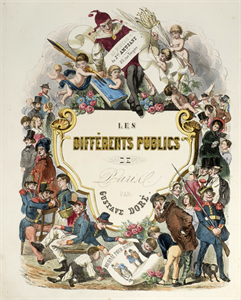
Stephen J. Gertz, at Booktryst, had an interesting post today about Gustave Doré's Les Différents Publics de Paris (1854), a remarkable set of lithographs depicting the people of Paris in the audience at various public amusements, from a magic show to the library. Through the language of caricature, Doré offers insightful social commentary about audience behavior, from the fawning men in the opera's loge de lions to the casually-refined postures of seated spectators at a wrestling match.
In some ways, the prints remind me of the rich culture of amusements described in Paul Metzner's The Crescendo of the Virtuoso. Metzner points to a significant rise of publicization in France in the late 18th and early 19th centuries, that is, the process by which activities and skills that were previously private (everything from making music to athletics) were commodified and made available to new and ever-larger audiences for the purposes of entertainment. Clearly Doré found the changing city of the 1850s interesting, as well; his repeated emphasis, here, is on different publics (an interesting concept in itself), audiencing the talents of others.
Overall, this kind of imagery, especially from period books, magazines, and other ephemera, represents one of the few historical traces that we have for audience behavior in the 19th century. One of the things I've been trying to do on this blog (and in my own research on fandom) is to start a repository of such images. Is there more work like Duré's out there?

