Showing posts with label readers. Show all posts
Sunday, February 24, 2013
Metareading
Phantoms on the Bookshelves is a charming memoir of bibliomania, by French editor and writer Jacques Bonnet. Treading in the footsteps of classics like Walter Benjamin's "Unpacking My Library," Bonnet offers a series of reflections on his personal library and, more generally, on the quality of a life lived with books. Its 123 pages can be enjoyed in an afternoon; its charm lies in Bonnet's quiet self-awareness and wry humor. Throughout Bonnet mentions not only the books he has read (and re-read) but also the numerous authors who have, throughout human history, written about their reading and their libraries. For those interested in books about books, this tiny volume is a great map.
Bonnet is interested in something I've been pondering a lot lately: from where does a passion for books (or passion for the arts, in general) come? In the beginning of the book, he mentions how "reading...penetrated, like a shaft of sunlight, through the gloomy atmosphere of a provincial childhood of the 1960s" and about how both escape from and knowledge of the world excitingly tarried with each other for him during the tumult of France in the late-1960s. These answers are circumstantial, pointing to the power of books to re-contextualize us, to subvert the conditions in which we find ourselves. But he also wonders about the force of sheer curiosity: "The fanatical reader is not only anxious, he or she is curious. And surely human curiosity--condemned as it was by certain Fathers of the church as being of no purpose since the coming of Christ, and even prohibited, since we now have the Gospels--is one of the determining factors of all our actions? A capital element in the search for knowledge, in scientific discoveries or technological progress, the essential force behind human endeavour..." (29)
Otherwise, I was taken with his repeated assertion about libraries as alive. For readers, this is a common reality; for non-readers, it might seem hyperbolic. It is not easy to explain. Bonnet says, "A strange relationship becomes established between the bibliomaniac and his (or her) thousands of books...We may have chosen its themes, and the general pathways along which it will develop, but we can only stand and watch as it invades all the walls of the room, climbs to the ceiling, annexes the other rooms one by one, expelling anything that gets in the way." (31) Bonnet is genuinely surprised as he writes to us about his library, seeing things he had not seen before. "How did these books get into my library?" he asks at the start of chapter 5. The question is not entirely rhetorical.
One of the funniest moments was his discussion of how "human reality sometimes intrudes strangely into the principles of classification" of any library, noting how book collectors think long and hard about which books should be allowed together or forced apart. Apparently, the author of a rulebook for personal libraries in the Victorian era suggested that works of male and female authors had to be separated "unless the parties are married to one another," (41); Bonnet quotes the hero of a bibliomaniacal novel, The House of Paper, who worries about putting Borges next to Garcia Lorca, Shakespeare next to Marlowe, or other potentially unpleasant social situations.
In the end, Bonnet assert that "hundreds of thousands of people live in my library." First, he notes that each book contains a host of "imaginary" characters, with whom we have a deep experiential and psychological communion, who are always there, living their stories for eternity. Second, while asserting that authors are only fragmentary apparitions about which readers know very little, he argues that readers nevertheless are are invested in their reality and are always in search of books' creators. "We are so anxious to maintain the illusion that the author is a real person that we cannot be satisfied simply with an orphan work of literature." (83) Of course, these are the two foundations of fandom--sustained passion for a work and the quest to establish a lasting and strong relationship with others, famous or humble. Escape and knowledge.
Thursday, January 3, 2013
Reading in Public
If you've come across this blog before, you probably know that I enjoy talking about reading as much as--well, reading. That's why I enjoyed this post by Scott Aiken and Robert Talisse, about "Reading Weird Books in Public," over at 3 Quarks Daily. Apparently, people have strong reactions to what others read. Think of it as a kind of social marginalia.
As an academic whose professional life revolves around reading, I bring books everywhere. There is always reading to be done, and, as a parent who must drop-off and pick-up children on a daily basis, I am often waiting, with time to kill. Why not catch up on the latest journal? Take notes on a book for research? Prep for the next class reading? It doesn't really matter whether it's at the mall or gymnastics class or on the soccer field--if there's light, I can read.
Apparently this is not always cool. Usually, I don't ever get more than a second glance, or someone wise-cracking "a little light reading, eh?," when I am spotted outside of the classroom with an academic monograph. Of course, there was that one time when a woman on a plane was curious about my copy of David Mitchell's The Cloud Atlas and asked if I were "studying to be a meteorologist." And I do still get grief from my family about the time I sat amidst roaring fans in the stands at a high school football game, engrossed in Brian Ward's Just My Soul Responding. (In my defense, I had class the next morning).
Inappropriate reading has a long history, reaching at least into the 18th century, including workers sharing pamphlets, housewives engaging in novels instead doing housework, etc. (see http://pastispresent.org/2010/curatorscorner/the-novel-reader/). I never really thought about the extent to which we still maintain all kinds of prescriptions and rules about what, when, and where to read. It may not be threatening anymore, but it can still provoke.
For more on the contemporary phenomenon of reading in public, be sure to check out:
Underground New York Public Library
Or
http://6thfloor.blogs.nytimes.com/2012/07/11/is-it-creepy-to-see-someone-reading-fifty-shades-of-grey-on-the-subway/
Sunday, February 5, 2012
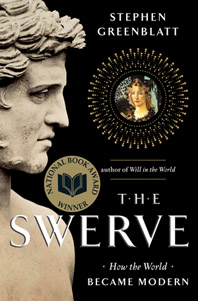
The Swerve: A History of Passionate Reading
I just finished reading Stephen Greenblatt's The Swerve: How the World Became Modern, something that I accomplished in a day. I rarely find myself so enthralled with a nonfiction book that I can't stop reading it, but this instance was even more remarkable since the The Swerve is itself about avid reading. On one level, it narrates the story of a former papal secretary, Poggio Bracciolini, whose passion for ancient texts led him to a German monastery in 1417 and to the discovery of a long-lost poem, On the Nature of Things, by the Roman philosopher Lucretius. The carefully-copied lines asserted Epicurean ideas with such eloquence and daring that--despite its challenge to fundamental precepts of Christianity--Bracciolini sought to make it known again to the world.
At another level, it is about Greenblatt's own fascination with Lucretius. Greenblatt's preface to The Swerve is an eloquent testament to the power of a text to strike, thrill, and infiltrate one's daily life. As he explained: "It was not Lucretius' exquisite language to which I was responding. Later I worked through De rerum natura in its original Latin hexameters, and I came to understand something of its rich verbal texture, its subtle rhythms, and the cunning precision and poignancy of its imagery, but my first encounter was in Martin Ferguson Smith's workmanlike English prose...No, it was something else that reached me, something that lived and moved within the sentences for more than 200 densely packed pages"(2).
Some have cited Greenblatt's engaging analysis of Epicureanism and its influence on Enlightenment thinking, but, for me, what is most significant are Greenblatt's insights into the history of ardent audiences. Most importantly, Greenblatt argues that for Bracciolini to be so passionate about books in the early 1400s was strange: "To all but a handful of people in Germany, this quest, had Poggio tried to articulate it, would have seemed weird"(18). Books were valued mostly in monasteries in the 15th century; all monks had to know how to read and were expected to engage in both "prayerful reading" and manual labor as part of their vocation. This institutionalization of reading was good for the survival of ancient texts; in order to read, the monks had to have books, and they learned to carefully reproduce texts through copying. However, it was not necessarily a joyful or exciting affair--reading and copying were, for most, compulsory chores.
Even more significant than Bracciolini's strange avidity for books was the fact that he was not alone. Greenblatt cites a small but earnest community of humanists in Italy that were devoted to uncovering and collecting lost classics. "Italians had been obsessed with book-hunting for the better part of a century, ever since the poet and scholar Petrarch brought glory on himself around 1330 by piecing together Livy's monumental History of Rome and finding forgotten masterpieces by Cicero, Propertius, and others." (23) Petrarch, Greenblatt suggests, set the model for Bracciolini, by investing "this search with a new, almost erotic urgency and pleasure, superior to all other treasure seeking" (119). Greenblatt quotes Petrarch's own assessment: "Gold, silver, jewels, purple garments, houses built of marble, groomed estates, pious paintings, caparisoned steeds, and other things of this kind offer a mutable and superficial pleasure; books give delight to the very marrow of one's bones. They speak to us, consult with us, and join with us in a living and intense intimacy."
As the story unfolds, it becomes clear that this love of books among humanists in 15th century Italy was actually an emulation of the intellectual culture of the ancient world, in which, "it became increasingly fashionable for wealthy Romans to amass large private libraries in their town houses and country villas...whether on the banks of the Rhone in Gaul or near the grove and Temple of Daphne in the province of Syria, on the island of Cos, near Rhodes, or in Dyrrhkhion in what is now Albania, the houses of cultivated men and women had rooms set aside for quiet reading." Even more remarkable, Greenblatt states that in the first century CE, the first reader-fans emerge: "At the games in the Colosseum one day, the historian Tacitus had a conversation on literature with a perfect stranger who turned out to have read his works. Culture was no longer located in close-knit circles of friends and acquaintances; Tacitus was encountering his 'public' in the form of someone who had bought his book at a stall in the Forum or read it in a library" (60-63). Based on Robert Darnton's work on Jean-Jaques Rousseau's public readership (See "Readers Respond to Rousseau" in The Great Cat Massacre), I had always associated this sort of public reader-author relationship with changing social and urban contexts of the 18th century, but this is a tantalizing revision.
There are other great tidbits in The Swerve about book hunting and collecting, about the circulation of ideas in Renaissance society, and about those whose lives were deeply shaped by the recovery and maintenance of a lost, seemingly better, past. In the end, The Swerve is really about a fan-like love of learning, from Lucretious in the first century BCE, to Bracciolini in in the early 15th century, to Greenblatt today. Their enthusiastic encounters with texts, together with one's own potentially enthusiastic reading, have the power to accumulate--or resonate together--to form an extended community of reception.
Tuesday, January 17, 2012
Searching for the Poe Toaster
The latest news among Edgar Allan Poe's followers is that they will wait one last time for the appearance of an anonymous dedicated fan, known as the Poe Toaster, who, until recently, paid tribute to Poe every year on January 19th. Visiting authors' (and performers') grave sites is an old fan tradition. (For more on literary tourism, see my recent post.) What's most fascinating in this example is the extent to which a Poe fan has created his own fans and admirers. As I first argued in Tramps Like Us, the idea that a fan is totally obsessed with the object of his/her fandom is a very naive view; most fans also spend a lot of time enthusing about fandom itself as a means to build and sustain the fan community.
Saturday, December 31, 2011
Romantic Fandom
Before the holiday, I heard from Professor Eric Eisner of George Mason University, who shared that he had edited a volume of the Romantic Circles Praxis Series, on "Romantic Fandom," in April 2011. I am not very well-acquainted with literary studies these days (and especially not British Lit.), so I was delighted to check it out. Clearly there are exciting things happening in the study of Romanticism--between this and Judith Pascoe's book on Sarah Siddons, I now see the Romantic Era as a key moment in the history of audiences. Much as the "market revolution" in the United States during the 1830s and 1840s changed the very nature of cultural consumption and participation, Eisner writes that, in England, the Romantic period of the late 18th century
...saw the popularization of recognizable "fan practices," spurred by the growth of consumer culture and the development of a mass audience for culture generally. Admirers collected autographs, souvenirs, portraits and relics of celebrity writers, artists, performers, military heroes, and athletes; snapped up mementos associated with beloved plays or books or music; visited the homes and haunts of celebrities; pored over gossip-filled periodicals and newspaper notices; imitated celebrities’ fashion statements; fantasized about becoming friends or lovers with celebrities; wrote fan mail and formed communities of like-minded aficionados.And while I’ve emphasized the connections between modern and historical fans in this blog, these essays advocate caution. As Eisner explains in his introduction, “If these essays contest literary criticism’s abjection of the fan as ‘naïve, obsessive, desirous, and dangerously predatory’ (Watson), they also resist simply celebrating the fan or identifying Romantic-era readerly desire with our own…Fandom is always historically situated, always tied to specific and shifting cultural as well as individual situations.”
The essays are consistently excellent, examining everything from the literary tourism of Lady Frances Shelley to the surprising mania in the 1820s for Pierce Egan’s Life in London; or, the Day and Night Scenes of Jerry Hawthorn, Esq., and his Elegant Friend Corinthian Tom, Accompanied by Bob Logic, the Oxonian, in their Rambles and Sprees through the Metropolis, with other contributions by Nicola J. Watson, Clara Tuite, Mark Schoenfield, and David A. Brewer. I have taken note!
Subscribe to:
Posts (Atom)